FIght On #1 – The Tomb-Complex of Ymmu M'Kursa


Explore the ruins of an ancient monastery. Delve in to the depths of the burial vaults of a decadent city-state. Journey to a corrupt nature node to make it pure once again.
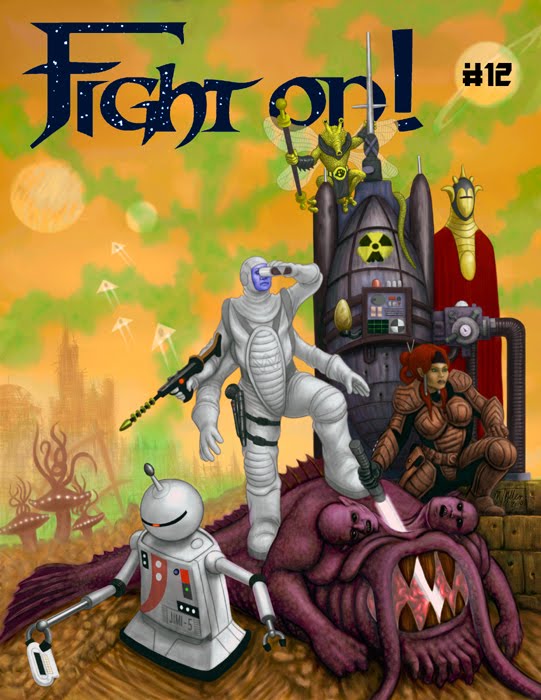
I’m got a stack of Fight On! magazines on my desk, each with a couple of adventures in it. Rather than review the magazine, or review the adventurers in the magazine, I’m going to review all of the adventures in each issue, naming my favorite in the subject line. I don’t know how this is going to work, so comments are welcome. The magazine proper is full of great articles that remind me of the very early Dragon magazine and Strategic Review articles. Defiantly worth picking up if you want some fresh content.
 
The Ruined Monastery
by James Maliszewski
1st Level
This is a small 14 room dungeon that describes the first level of a complex under a ruined monastery that could be expanded upon by the DM. The map design is relatively simple and would be familiar to players of 3/3.5. The map is small and the wandering monsters rather straight forward for first level: goblins, wolf, skeletons, spiders, slime, and rats. Not much interesting there, other than all of the classic bases are covered. The 14 encounters are spread out over 5 pages, including the map. Thus the writing and descriptions are rather verbose in a round-about way that I don’t prefer. Essentially each rooms original purpose is described. This writing style, not uncommon, sets me on edge. I don’t need a description of what a vestry is, or what could be found in a vestry. I want to know what’s unusual about the vestry. Eventually the room descriptions get around to that point however even then it’s in a round-about manner. The actual encounters are not too imaginative: a scriptorium with yellow mold, a larder with spiders, etc. The weird and wooly world of the idiosyncratic is not present in this adventure. It’s clearly a tribute to Gygax; it’s a shame it’s not a very good one. Overall it’s a serviceable little adventure that’s primary sin is the Vanilla nature.
 
The Tomb-Complex of Ymmu M’Kursa
by Gabor Lux
4th level? 5th? “Old school mixed” is probably a better level designator
This is a pretty sweet little dungeon adventure. These are the burial vaults of the decadent city-state mentioned in the teaser and they do a good job delivering. There are only 15 keyed entires on the map, although several have (a) and (b) parts to the rooms. The adventure is spread out over four pages so it has that compactness and terseness that I appreciate. The wandering monster table is full of of the usual suspects of undead, from skeletons to shadows and mummies and include an entry or two for generating mixed groups or one of the tombs ‘named’ undead leading a group of 1d2+1 groups against the party if they sloppy/noisy! Ouch! I believe that’s the first time I’ve seen that on a wandering monster table and I like it! The map of the tomb is sufficiently complex to lead to some fun escapades as the party uses corridors to get behind behind or get ambushed by monster doing the same. I counted five loops in the map some of which intersect with each other. The encounters are all wonderfully bizarre and idiosyncratic.  For example, at one point the party encounter a group of statues who’s heads have been decapitated. If the party repairs one then the statue speaks: “We are the men of Konoth, and such is out thanks.” Save vs wands or be decapitated by an invisible sword. A W E S O M E ! That’s the kind of mysterious and strange D&D that I want to play! There are also animated mummy wrappings, cool little unique magic items like “The burial shroud of Ymmu M’Kursa” or “Ymmu’s paw”. Or maybe the potion that turns bodies of bodies of water in to glass from the waist down? How can you not love stuff like that? It boggles the mind how published high fantasy modules can survive when stuff like this is floating around. Plus, there’s an amazon woman in carbonite with a laser pistol and laser sword. It’s a deadly little tomb but it is going to give the party the feel of exploring a tomb more so than almost any other adventure published. Highly recommended!
 
Nature’s Nasty Node
by Makofan
Levels 4-7
This is a short 12 room adventure through a set of caves near a collapsed tower. A magical nature node has been corrupted and the party needs to purify it again. The map has a little variety near the beginning however it quickly turns in to a linear map after the first 5 or 6 rooms. The nature of the adventure, a magical nature node, immediately gives it a bit more flavor than the standard dungeon dressing of The Ruined Monastery, however in the end it’s really just about the same in content, although it manages to do it in only three pages. Like the first adventure this one is quite serviceable but doesn’t really distinguish itself much. It does feature pixies and a basilisk, both solid Mystic Wood type creatures. This and a few other touch contribute a lot to it’s more mystical feel. There’s also a short little set of tables in the back, a tribute to Bob Bledsaw, which you can use to generate your own Nature Node adventure. Roll a boss, a fantastic monster, a normal monster, a setting, normal treasure, fantastic treasure, guarded treasure, what’s being wielded, and the hook agent and you’ve got yourself a customized adventure! If you assume the point of the dungeon is to show how the table can be used then you’ve got much better  possibilities, but then it wouldn’t be an adventure and I wouldn’t be reviewing it.
 

Posted in Reviews | 9 Comments

TM1 – The Lost Caravan

Fifty years ago a treasure-laden caravan accompanied the Princess Allisandra to her destiny – A pre-arranged marriage with a prince from a neighboring kingdom. Then the caravan and princess disappeared without a trace. Now a clue has surfaced that may uncover the fate of The Lost Caravan.

This is a two-part tournament module originally created for MDG’s Wintercon in 1982. Tournament modules have a reputation for being rather linear, a requirement for scoring different parties, however this one is more open than a lot of non-tournament modules I’ve seen. There is a heavy tactical element to the scoring.

The setup here is better than most: An aged and dying King summons the party to him. Fifty years ago his daughter disappeared while on her way to her pre-arranged wedding. A clue recently emerged, the first to ever do so, and he’d like the party to look in to it before he dies … which will be quite soon. Not earth shattering stuff but a decent enough hook. There are supposed to be two paths for the party to then take: attempting to track the caravan or following up on the clue which turns out to be a bit of a family tree exploration: Track down Bobs sister, ask about their father, go visit with his friends, etc. Because the clue is directly related to this second option its pretty certain the party will do that first and then go track down the caravan from there. Both parts have to be completed however the linkage from the family tree clue to the caravan is not the strongest. I’d perhaps drop a clue or two more in there. Both paths have an NPC encounter in which points can be earned, and both have some pretty big set piece battles. The caravan path has an old abandoned monastery to explore, a group of giants to potentially battle, and a cave to explore that comes with another giant battle. The family-tree path has a potentially much more deadly encounter: the party is ambushed while at an inn.  The ambush is pretty good, believable, and not forced at all. And very very deadly. It’s a very large battle in a burning inn at night with a lot of 1HD opponents. The cultists that are attacking are never really explained very well however by stepping back a bit the DM can easily come up with a good reason. There are a lot of humanoids in this adventure, both in the set encounters and on the wandering tables. I usually object to that however not this time, for reasons I’ll explain at the end. Both plot lines seem very combat heavy however the NPC and exploration elements are very well done, especially in the cave plot line. It’s got a lot to love: the abandoned monastery has some nice little exploration pieces, there’s a crotchety old NPC for the party to interact with, and lots of things to get the party in to trouble. The family-tree plot is more straightforward in its NPC interactions … so much so that I didn’t get a lot of flavor from them. The inn attack however is a VERY good set piece. Played correctly its hard to imagine the PCs escaping without some major damage. This leads once again to the problem of the caravan vs/ family tree plot. The caravan plot taking place first make the inn an excellent place to end the first part of the adventure. A little more work to strengthen ‘tracking the caravan’ in the introduction would be a good way to get the party there first while still preserving their ability to choose.

The second part has the party journeying to where they believe the princess is and brining her back to see the dying king. There are five of six encounters that all will take place in a pretty much linear format. This part is essentially a test of the parties ability to stay on task. As they traverse a LARGE mountain lake system they are confronted with an island each night that they can & should camp on. Each of the four islands has some kind of encounter on it. Each encounter has NOTHING to do with finding the princess and bringing her back. It’s just one BIG RED SHINY SHINY BUTTON every night. The islands involve a bunch of giant monsters straight out of those bad 70’s ‘giant vermin’ movies, a hermit who wants to be left alone, a group of dwarves after some buried treasure, and a strange obelisk. They all have a nicely distinct flavor to them and they will ALL lead to the party screwing themselves over. Stay on Target. Stay on Target! The adventure ends with the party finding the princess in her fortress and a set piece attack from a group of giants on her outpost. This is another LARGE battle with lots of troops involved. This second section is … strange. A smart party will avoid the islands … but a meta-think party will know they can pick up some points on the islands. Avoiding the island encounters basically means that there is just one large battle on this part of the adventure; not too exciting. This is a little akin to finding a pouch of 100gp in the first room on your first adventure and then going back home to live in peasant splendor the rest of your life: realistic but boring. A non-tourney party won’t be point-whoring and should have an excellent time roleplaying with the hermit and helping the dwarves find their treasure.

The designer suggests, and I agree, that this would be a pretty good lead in to the G1/G2/G3 series of modules. It features giants and humanoids and raiding by both the monsters and the humans. It’s a little weak on the weird magic and fungus men front, however it is an excellent tourney module.

This is available on DriveThru.

https://www.drivethrurpg.com/product/263915/TM1-The-Lost-Caravan?affiliate_id=1892600

Posted in Reviews | 1 Comment

Stonehell Supplement 2 – Buried Secrets

Explore “Modnar’s Cellar,” the undercroft of a ruined tower owned by a magic-user with a strange agenda. Visit “The Nest of Otrogg,” a cave system once occupied by a loathsome cult. Discover the secrets of  “The Sanctuary of Chthonia,” a secret sub-level located inside Stonehell Dungeon and overseen by an undead witch.

This is a nice little Stonehell supplement that collects three separate expansion areas. They can be used without Stonehell although together they serve to really fill out the Sandbox.

The three small areas presented in this product do a good job of providing some sublevel environments to a dungeon. The first two are areas outside of Stonhell dungeon while the third is meant to be a true sublevel to the dungeon. Modnar’s Cellar is the basement on an old wizards tower that blew up. The map feels rather small with 31 or so encounters on it. The design is roughly that of two or three looping corridors around the central entrance with some branches off of it. There’s lots of secret doors, and doors for that matter, however I just can’t shake the feeling that the map is smaller and/or simpler than the ones in Stonehell. The wandering monster table has about 10 entries of mostly vermin and oozes, but including bugbears and kobolds. The humanoids seem thrown-in on this one. I would probably replace them with bandits. This keeps the shock impact of humanoids in Stonehell high and also provides for a bit of a transition from the mundane world to the that of the fantastic. The actual room encounters in the cellar are great. Each one is about two or three sentences and they all provide some kind of interesting place for the party to explore. There are lots of rooms with nothing too fantastic in them that are otherwise interesting. A bucket on a pole, mounds of humanoid bones, and so on. SOme will contain treasure if the party is creative; like looting a partially constructed summoning circle. Quite a few rooms have something MUCH more interesting. A statue that will recharge a wand, or a well that can let you reroll a stat, once. The entire cellar is full of these sorts of idiosyncratic things. This is exactly what I’m looking for in a module: non-standard things for the party to hang themselves with. And unlike Stonehell the monster names are bolded in each entry allowing the DM to pick out the creature easily. The humanoids in the dungeon (bugbears and kobolds) feel out of place to me however that’s hard to argue considering the number of humanoids in Stonehell proper. If I had never seen Stonehell then I’d be pleased with the encounters but slightly disappointed in the map, although it is quite a bit better than most.

The Nest of Otrogg expands on an area near the entrance of the dungeon. This is supposed to be the forgotten temple of a vermin god. The caverns have about 17 keyed encounters and the map is simple yet contain several loops. The wandering monsters are pretty perfect: vermin & ooze! The temple caverns are described as a Nest … but I’m not sure I got that feeling in reading. Certainly many of the rooms have some flavor text with the words ‘moss’, ‘damp’ or ‘fungus’ in them, and the introduction recommends that there be an abnormal amount of harmless bugs present, that get in to everything, but I just didn’t feel the vibe. It could be that it plays a lot better. Hmmm, maybe the hallways/tunnels/corridors are what’s killing the atmosphere for me? Anyway, there’s a lot of interesting things to explore in the caves and get freaked out by.  It’s less “wizard weird” and more “fungus weird.”

The final area is a true sublevel to Stonhell and is presented in the same fashion as the dungeon encounters are in the core dungeon book. This means a two page introduction and then a map, notes, wandering monsters, and key description appearing on two more pages. This is a great format and works well. The map is not too complex, really just 16 encounter areas in a simple layout. The entire place has an empty feel to it; much like exploring an old decrepit house would. The interactions with the environment is mostly going to be through mundane things, like looking in teapots and so forth. The central concept of the NPC’s on this level is very good and this level could perhaps serve as a hidey hole for parties exploring the dungeon.

This provides some interesting areas to expand on the environs around and in Stonhell and the first two mini-dungeons are excellent example of incorporating idiosyncratic and weird in to a dungeon. There’s a real old school feel to those encounters and rooms. This is better than 90% of the product produced, so you shouldn’t have any problems justifying adding it to your collection given the price.

Posted in Reviews | Leave a comment

Lost Man’s Trail


The trail east from Modron to the Coast, known as Lost Man’s Trail, has been a source of mystery for some time. Adventurers have a habit of disappearing from the trail. Are they lured away by some enticement, or waylayed by the legendary Skandik Raiders? The only safe place to stay, The Fat Deer Inn, offers good ale, soft bedding, and an assortment of characters; each having their own reason for being there.

Four more hexes for the Wilderlands. Encounters are limited to four or five major ones rather than the hex crawl sentences. A fine example of a regional sandbox building block.

I generally don’t review regional settings. Or rather, I review everything I purchase and I don’t generally purchase regional settings, so this one is going to be short. I stumbled upon Lost Man’s Trail because it was Bob “Judge’s Guild” Bledsaw’s last work prior to his passing. There are maps for four more Wilderlands hexes; this time between Modron and Tegal. The hexes feature a trail from Modron to the Fat Deer Inn. All of the encounters provided take place in this last hex. Essentially, the inn is a base for the characters while they explore some of the juicy rumors they hear there. The inn takes up about 1/4 of the pages in the book and is described enough to provide some good play. What I mean by this is that each room is described, however the primary descriptions of the various rooms tend to be the occupants and what they are doing at the inn and how they react to the players and so on. What this gets you is a rich set of people interacting with the party, an absolute necessity for any type of social portion of the game. They have relationships to each other and their own motivations outside of the party. That’s what is going to bring the inn alive and make it a memorable place.

There are about four different sets of bandits roaming the hex with the inn, along with a potentially friendly encounter with a hermit and a small/simple four-level cave system. The bandits are all very different, even though one set is humanoids (ug!) One of the sets of bandits could be called the focus of the adventure, and their defeat probably leads the mini-dungeon and it’s 20 or so rooms/encounters. It’s full of what one expect from a Judge’s Guild product: great atmosphere. Cages made from human/animal hair, great item/jewelry/magic item descriptions, non-standard magic items, and freaky non-standard creatures. This is exactly the sort of detail I’m looking for. I don’t want orcs, I want weird fungus pumpkins that waddle along the floor, or giants slugs that secret strange gasses. That’s the sort of personalized, idiosyncratic whimsy that I’m looking for in a module.

This is available on DriveThru.

https://www.drivethrurpg.com/product/85053/Lost-Mans-Trail-2010?affiliate_id=1892600

Posted in Reviews | Leave a comment

Lost Man’s Trail

The trail east from Modron to the Coast, known as Lost Man’s Trail, has been a source of mystery for some time. Adventurers have a habit of disappearing from the trail. Are they lured away by some enticement, or waylayed by the legendary Skandik Raiders? The only safe place to stay, The Fat Deer Inn, offers good ale, soft bedding, and an assortment of characters; each having their own reason for being there.

Four more hexes for the Wilderlands. Encounters are limited to four or five major ones rather than the hex crawl sentences. A fine example of a regional sandbox building block.

I generally don’t review regional settings. Or rather, I review everything I purchase and I don’t generally purchase regional settings, so this one is going to be short. I stumbled upon Lost Man’s Trail because it was Bob “Judge’s Guild” Bledsaw’s last work prior to his passing. There are maps for four more Wilderlands hexes; this time between Modron and Tegal. The hexes feature a trail from Modron to the Fat Deer Inn. All of the encounters provided take place in this last hex. Essentially, the inn is a base for the characters while they explore some of the juicy rumors they hear there. The inn takes up about 1/4 of the pages in the book and is described enough to provide some good play. What I mean by this is that each room is described, however the primary descriptions of the various rooms tend to be the occupants and what they are doing at the inn and how they react to the players and so on. What this gets you is a rich set of people interacting with the party, an absolute necessity for any type of social portion of the game. They have relationships to each other and their own motivations outside of the party. That’s what is going to bring the inn alive and make it a memorable place.

There are about four different sets of bandits roaming the hex with the inn, along with a potentially friendly encounter with a hermit and a small/simple four-level cave system. The bandits are all very different, even though one set is humanoids (ug!) One of the sets of bandits could be called the focus of the adventure, and their defeat probably leads the mini-dungeon and it’s 20 or so rooms/encounters. It’s full of what one expect from a Judge’s Guild product: great atmosphere. Cages made from human/animal hair, great item/jewelry/magic item descriptions, non-standard magic items, and freaky non-standard creatures. This is exactly the sort of detail I’m looking for. I don’t want orcs, I want weird fungus pumpkins that waddle along the floor, or giants slugs that secret strange gasses. That’s the sort of personalized, idiosyncratic whimsy that I’m looking for in a module.

This is available on DriveThru.

https://www.drivethrurpg.com/product/85053/Lost-Mans-Trail-2010?affiliate_id=1892600

Posted in Reviews | Leave a comment

Stonehell Dungeon

Beware All Who Enter
These Benighted Halls of Stone.
Within Lies No Solace
Nor Any Comforts of Home.
Toiling For Our Crimes
We Must Dig Where We Dwell,
With No Freedom or Mercy
In Our Vast Stony Hell.

-Inscription over the entrance of Stonehell Dungeon

A megadungeon. A wonderful wonderful megadungeon. A good megadungeon makes you forgot all your troubles and all of the nonsense you’ve seen before. W wonderful wonderful megadungeon.

This is certainly one of the best works to come out of the OSR. It’s a megadungeon and it’s close to perfect. The dungeon was once a prison and now, hundreds of years later, has evolved in to something else. The place _feels_ like it has history. There’s about an eight page section in the beginning that describes the history of the dungeon, an overview of what’s going on today, and how to integrate it in to a campaign. I wasn’t that excited when I first saw the length however I must admit that it works. The concept of a megadungeon has always been a bit implausible and now 40 years later we have to examine everything through the lens of what has come before. This one works. The history makes sense. Not just enough to get by but enough to make Stonehell feel like a real place and completely plausible. This extends as well to the creatures found within the dungeon. Not only the vermin and oozes but also all of the other creatures. Why are there cannibal berserkers? Because they are the descendants of the former inmates. Why are there kobolds? Because they were the former slaves and ingratiate themselves as servants to whoever is in charge. Why are there undead? The tombs of the former dead inmates. Why are there hobgoblins? They are setting up an advance base in order to take over the dungeon and invade the human lands. Why are there ogres? They are bachelors who’ve come up from a tribe lower down, having a great time drinking, gambling, working out, and living a life free of their pesky ‘betters.’ My clumsy descriptions don’t begin to do justice to the realism and plausibility of the humanoids situations. The key point here is that everything works together.

I should talk a little about the general layout. There are six levels presented if the surface ruins are included. Each level has two pages of introduction most of which is made up of a large map. There’s also a small introduction and a list of monster stats for the creatures that appear on that level. The map is divided up in to four sections and each section is then detailed separately. Each of these section also has a two page introduction which details what’s going on in that section. Then there are two pages which contain a large map of that section, a wandering monster table, and the encounter descriptions for that section of the dungeon. This is a near perfect format. It allows the encounter descriptions to be short and to the point. The entire thing is very similar to the one-page dungeon format. Just to be clear, each level is composed of four full maps, each maps having 40 or so keyed encounters on it, for a total of about 150 encounters per level. This takes place on each of the six levels. And that’s just the first half of the megadungeon! There’s supposed to be another booklet that details the next six! The maps themselves are wonderfully complex. Lots of cool design features, lots of stairs up and down, slides and pits that deposit you on different levels, and so forth. There’s lots and lots of room for the party to ambush and be ambushed. I LOVE these sorts of maps. They all have a different feel than the others as well, which is a pretty major accomplishment given the quantity.

The encounters are excellent. There are lots of things to play with in the dungeon, potions and labs and temples and other things to get in to trouble with. The creatures are all  generally doing something when encountered. Getting ready to go raiding, beefing up the “larder”, and so on. Oh, there are guard posts and the like as well, however the encounters are all done in such a way as to bring them, and the dungeon, to life. You really get the feeling that this is not just some static place but is a real living and breathing environment. Something like “Southern Guard post: Signs of regular traffic. Smells of cooking. There’s a 50% chance that the guards in room #25 are watching this area.” or “Dank Room: Mildew on walls; musty stench in the air; broken furniture sprouting sickly mushrooms. Empty.” These encounter descriptions are short (remember, you have to fit 40 or so, along with  nice large map and wandering monster table on two pages!) but do a great job of providing the DM with just enough detail to set the scene. This is EXACTLY what I am looking for. Just enough detail to get me going so I can run a good room, I can fill in the rest.

There are factions GALORE in this place. The party will routinely run in to the kobolds, who can be a great source of information. There’s an evil guy in the crypts who really just wants to be left alone. There’s also some evil acolytes in the crypts who are looking for the evil guy because they think he’s their leader. He’s hiding form them and leading them in to traps. There’s goblins on the surface who are hiding out and sulking because their tribe was massacred by orcs. There are HUGE numbers of creatures to talk to, hire, and get in to trouble with, and most of them are looking to get one over on almost everyone else. This is great because it provides so much more depth to a dungeon, the parties not limited by just kicking in the door and hacking the occupants. There’s also a wealth of new creatures, magic items, and spells. These are detailed in the two page intro for each map, so it puts the data right where you need it.

If I were to nitpick this I’d say things could be improved in four areas. First, I would have liked it had the monsters been bolded or highlighted in some way in the encounter descriptions. This would help me pick things out much more easily. As it is I would probably need to take a highlighter to the encounters in the book. Secondly, although there is a great deal of new magic items there are also a great quantity of “book” items. A little personalization in this areas as well as the gem/jewelry area would be nice. There are space constraints, so perhaps I should be content to use my own tables to work up some personalized descriptions. [I do this ahead of time for gems & jewelry. I print off a page of gem descriptions and another of jewelry descriptions and then just mark a description off the list when the party find a “50gp gem”.] Thirdly, more map notes would be great. If the guys 50′ down the corridor in the next room are noisy then a note on the map, something like “#18/Fighting” would be helpful to clue clue the party in on environmental/sound/light issues in nearby areas. Finally the entire place could use just a bit more whimsy. This may be because I’m just coming off of Demonspore, but a few more things that are truly freaky and whimsical would add a nice air to the place also. Maybe we’ll see a machine level or the faerie dragon level on the second book?

This is a monumental book and sure to be a classic. Pick it up. You won’t be sorry.

Posted in Level 1, Reviews, The Best | 12 Comments

Demonspore – The Secret of the Shrooms

Established in the subterranean cyst left by their dead god, a zealot band of Shrooms, a race known for bizarre projects and subtle objectives, have now been working for decades on the strangest task in their strange history.      … They are growing themselves a new god.

Yeeeehaw! This is enough alien and bizarre stuff in these modules to drive a bucket of eels through! This is an OSR module done right. I love it!

This is one awesome ride in to the idiosyncratic depths of the OSR. The encounters and environments in this module are unlike those that many of us have to come expect, even i nan OSR product. They are, however, the very core of what I consider to be the OSR. The modules contains two adventures: Throne of the Toad-King and Stone Cyst of the Shroom Priests. Throne can be used as a lead-in to the Stone Cyst or they can be easily used as stand-alone pieces. Both modules have some pretty tenuous hooks; we’re talking G1/G2 territory here. There’s the briefest of ideas of how the party could stumble upon the halls of the Toad-King and then a brief note in the adventure that can link it up to the Stone Cyst, much in the same way G1 had a small note in it that linked it to G2. There’s a slight reliance on rather generic magic items that’s a toad disappointing. (Get it! Get it! Toad! Hahahahahaha!) There are more than a few freaky items to play with, but there’s also a pretty large quantity of mundane magic. Maybe those items make the freaky stuff all the more freaky, in contrast? Maybe, but I don’t think so. Other than those two points the modules are as close to my platonic ideal of OSR as I’ve seen.

The halls of the Toad-King have about 43 encounters in them. They are situated in a kind of natural stopping point in the underground world and so the toads are somewhat used to getting visitors. In fact, the party can pay the sentries and stay for up to a week in the visitors quarters! Unfortunately the once-proud race of the toad people has fallen in to Chaos. Our toad friends are being corrupted. The party could approach this as a hack-fest or try to loot the place while they are visiting. They can also get approached by a (friend?) in the halls who wants them to look in to something for him. This is a great set up; the party is not forced in to a linear combat of room after room, they can instead venture around “peacefully” and get themselves in over their head! Perfect! I don’t usually like humanoids but I’m making an exception with the toads. They are given enough style and depth that they actually feel like distinct people. They go about their lives with their buckets of eels or fish guts and are pretty close to having a real culture presented; without the Harn-like exposition that is generally provided by authors trying to do this. The detail of the toads is mainly presented in the encounter text, which is exactly where I want it. There are a couple of pages in the beginning that describe the general lay of the land in the halls, but no real lengthy exposition to suffer through. There’s also an excellent wandering monster table. A great many could be described as events instead of monsters, and combat is seldom forced. They are very interesting though in a way that lets the DM expand on the nuggets provided to bring the encounter to life. That’s exactly what I’m looking for in a wandering table.

The halls have multiple opportunities for the party to find some allies. This can add heaps of fun to a dunegoncrawl: rescuing prisoners, intrigue with people you may not be able to trust, and mini-quests to gain allies. This is yet another example of “Stuff to do in a dungeon besides kill things.” The more of that “stuff” then the more likely it is that the adventure is a good one. There always has to be the threat of the Wrath of the Dungeon coming down on the parties heads, and thus the tension of the party trying not to screw things up enough to make that happen while grabbing as much as they can. Along those lines there are also a pretty decent amount of things for the group to do while in the dungeon. Lot’s of things to talk to and, notably, an alchemy lab for the players to push their luck in. “I drink from the fountain. What happens?” should be a staple of every OSR adventure. The map is better than average with a couple of different options to choose from at any given point. In addition it has a lot of variety: a lake, river, tunnels, and so on. It’s quite a bit more interesting than almost every other map and almost qualifies as a good megadungeon map. There are several new monsters besides the toad-people, including a pretty cool toad hydra. I don’t usually comment on art, however Jason Shultis did the interior art on tis and it is PERFECT. I can’t image the creatures any other way.

The second adventure, Stone Cyst of the Shroom Priests, takes all of the good qualities from Toad-King and amps them up. The map is made much better by adding a third dimension to it. It’s also larger, containing about a hundred rooms/encounter areas. There are more new monsters, more weird things to play with, and the weirdness/whimsy dial is turned up to 11. Just a description of the main shaft, a weird greenish lava lamp like environment, is more of an evocative environment than most people will have seen in a published product. Once you add in the Green Brains, the Shrooms proper, and all of their various fungi and other creations … wow, the party is going to have a majorly good time in this.

This is one of the finest products yet released for the OSR. Go buy it now.

Posted in Level 4, Reviews, The Best | 15 Comments

The Spider-God’s Bride


Enter the City of Stone and slay the high priest of Jul-Juggah! Plunder the ancient gold of Namthu! Seek the fabled jewel of Khadim Bey, but beware the nameless horrors of the Al-Khazi desert! Fight the dread adepts of the ape-god, or succumb to the pleasures of the Moon-Juice of Yaatana! Or perhaps you will perish by the curses of Ur-Kharra, the long-dead sorcerer-king of Elder Kuth?

A 200-page booklet full of Swords & Sorcery with a mesopotamian flair. It’s hard to get through at times, but delivers as a solid genre book … if you’re definition is the same as the designers.

I don’t review supplements, yet anyway. I don’t find what they present to be interesting, generally. This product is essentially a supplement dealing with a particular style of swords & sorcery play. I bought it because it because I thought it contained ten adventures. It does … however they are … different. The book is large, 200 pages, and that makes it difficult for me to work with. These days I’m all about simplicity and “small” and “lay flat” are highly valuable to me. Yeah, content is still king but marginal content gets rapidly downgraded when it’s a pain for me to use. This is almost certainly unfair to the designer. It’s akin to a movie reviewer telling you they didn’t like a movie because there were no furry futa’s with balloons in it. In the world of movie reviews you can just go read a reviewer. In this genre though … well, I hope you like furry futa’s with balloons.

The first forty or so pages of this product describe how to run a d20 game with a swords & sorcery feel to it. Human-centric, low magic but vile magic, monstrous monsters and the like. It also presents an overview of a campaign setting that has a decidedly mesopotamian/sultanate air to it. That certainly IS a part of the swords & sorcery trope but not my go to imagery. This carries through to the ten adventurers and is more than little off-putting for my tastes. I think vile priests in dense swamps with giant snakes & lizards and some gorean art mixed in. It doesn’t help that the writing style is more than a little dry. Combined with the art I get the sense I’m reading an academic journal. That’s not the evocative style I’m looking for. It also doesn’t help that there are no maps in the book, you have to go download them. I’m supportive of supplemental material on the web however once day the xoth.net website is going to go down forever and there will be no more maps. It’s also confusing as hell until you figure out the maps are online. Yeah, You’re gonna photocopy them anyway so having them online makes sense, but it’s confusing as hell. The

If you work at it you can get past many of these issues and find some nuggets. What’s presented in the ten adventures are some site-based encounters, but not in the way that term is generally used today. Generally the adventure presents a vaguely arabic location like a home, temple, or the like, and then suggests some reasons for the party to go rob them. There are generally a few more things thrown in as well: a wandering monster table for the journey, or a couple of events that can take place. It’s probably most similar to some of the older MERP products. Those presented a location such as a tower or fortress, and then described a few adventures that could take place there in the various ages of Middle Earth. For some reason this product seems to lack the charm of those older MERP products, It could be nostalgia talking but I just didn’t get the same imagery  from these locations. There are not railroad adventures in the typical sense, in fact many of them are quite the opposite: VERY free form. It’s almost like the designer is giving you some outlines or notes for an adventure that you can then work to make your own. The wandering monster tables are very nice and provide some decent details to the monsters, creatures, and environmental issues you may meet. In addition the adventures of full of advice on what to do if the party does Y instead of X and/or how to reintroduce certain aspects of an adventure. What if the party doesn’t take the hook? Then Y or Z could happen. This sort of advice is invaluable in these third age edition products, given their … goals? of getting the party to the adventure in a plausible manner.

It’s a low-magic swords & sorcery world with a mashup of mesopotamian and sultanate cultures combined with some vile cults and the like. You need to do some work to get through the text and you’ll need to flesh things out quite a bit, however these are some excellent seeds if you’re in to that type of game.

This is available on DriveThru.

https://www.drivethrurpg.com/product/110168/Legend-The-Spider-Gods-Bride?affiliate_id=1892600

Posted in Reviews | Leave a comment

G4-5-6-7-8-9 Super Giant Adventure

The giants await, as your meek and humble group assembles to venture forth and defeat them. But to do so, you must travel to distant lands, survive extreme conditions and challenges as you search out their hiding places. But afterward, when you think your job is done, and you have gathered all the treasure you can carry, can you find your way back through the Verbeeg Valley?

This is a compilation product containing the six Giant adventures by R.C. Pinnell along with a supplemental adventure just for this product. The modules are a decent homage to the TSR G1-2-3 Against the Giants series. For the most part they succeed well. I consider G1 one of the best modules ever produced and thus this designers work draws comparisons.

The products contains:
G4 – Sanctum of the Stone Giant Lord
G5 – Curse of the Cloud Giant Queen
G6 – Forge of the Formian Smith Lord
G7 – Giants in the Deep
G8 – Manor of the Mountain Giant King
G9 – Secret of the Swamp Giant Steward
The Verbeeg Valley

That’s a lot of adventuring in this compilation, most of it at very high levels!

G4 – Sanctum of the Stone Giant Lord
This adventure features a little romp through a 34 room temple complex of the stone giants. Like G1, the setup and hook are very brief. The map here is a good one, with lots of alternate paths from one location to the next. This allows the party to sneak about a bit, avoid encounters, and ambush as well as be ambushed. There are some options on the map that should allow the DM to extend the complex to a second level if they wish. The primary opponents are stone giants, with a great number being shamans, fighting above their HD and having cleric spells. This is going to make the encounters a real challenge. The designer emulates the quirky design style of G1 well, with a Hammer of Thunderbolts behind some junk in one of the rooms, and a flying carpet hanging up on the wall in one location. Slaying the high priest in the greater temple is not without peril: he attempts to commune and if he succeeds then the temples demigod shows up to battle the party! That’s the kind of old school logic I like! There’s a boat load of very powerful magic items laying about, but then again this is a module for levels 10-14. I missed not having a wandering table or a second level to explore, as well as the factions in G1. There is an attempt made to make this a living & breathing complex, with the occupants going about their own business before being interrupted. This falls a little flat though, mostly because of the lack of multiple creature types. The lesser creatures in G1, rushing about and in the middle of things, really brought that element to life. This adventure feels a little flat.

G5 – Curse of the Cloud Giant Queen
This adventure is one of the more interesting ones in the compilation. Could giants, allies of some local nobility, have called for help and the party is tasked with fulfilling the obligations of treaty by freeing the queen from the basement of her castle, where she’s hiding. This time the dungeon complex has two levels, although the second level is quite small and contains the cloud giants in hiding. The first level map is another excellent one of the type I like; lots of hallways and linking passages. Four separate wandering monster tables are available, one for each section of the upper level. This time out the encounters feel a lot more lively. The party catches the invading fog giants and cyclopskin in a variety of situations. That plus the addition of the cyclopskin as well as the cloud giants allies in the basement really liven things up. There was a minor plot element in G4 that dealt with the motivations of the stone giants however it wasn’t really fleshed out much at all. This module though has quite a bit more to discover in it, with several of the individuals having a lot to reveal and lots of clues for the party to pick up on. There are dead cloud giants everywhere as well as rampaging fog giants. I really enjoyed those extra details and thought they added a lot. This time out the main villain is not a Drow and is refreshing in and of himself. There’s also a slight nod to G3: the cloud giant king has run off with a vile temptress and his treasury to visit the fire giant king.

G6 – Forge of the Formian Smith Lord
Another of the standouts, containing only 28 encounters. The party descends in to a cave system, following a map from G4. The caves have three distinct parts. First there’s some natural caverns. These have mostly animal-like encounters in them. The second part is a massive cavern system that leads DOWN, while the third os a worked stone complex that is home to the Formian Smith Lord, another demigod. The map for the upper chambers has lots of twists and turns and has a couple of notable encounters: one with an injured adventurer and one with the cast-off experiments of a demigod. The central section is essentially one big puzzle room, or rather a large natural obstacle that the party must figure out how to overcome. There’s a bit of a gimp here since flying and teleportation don’t work, although levitation/feather falling do. I have a long standing distaste for those types of reindeer games. Besides, given the set up of this encounter I suspect that flying and/or teleportation would make the room MORE interesting, in terms of separating the party for what’s to come. The lower chambers could have been better. The middle section seems to imply something interesting is coming up however that promise is unfulfilled. These chambers are the home to the Formians demigod of smithing, along with his assistants and applicants for tutoring. I would have preferred to see something more fantastic than what’s presented. A Beholder is worked in well, however the opportunity was lost to get really creative with the environment, treasure, and creatures.

G7 – Giants in the Deep
G8 – Manor of the Mountain Giant King
G7 and G8 are closely linked, being two levels of the same complex. They are also two of the most interesting in this compilation. G7 starts off with a little Descent in to the Depths of Earth map action with the parties final destination being the gold mine of some dwarves who haven’t been heard from in awhile. Once again the magic of G1 shines through: with only six pages of text the designer provides an underground journey, a couple of warm-up encounters in the caverns, and then a full on adventure in an interesting place with lots to see and do! The two set encounters are quite interesting, both in terrain and function, as is the main entrance to the dwarves mine. I really got a good feel for the environments and the brief text got my imagination going. The story element behind the mine, brief and mostly included in the text as it should be, is quite nice as well.

G8 continues where G7 left off. It seems the dwarves tunneled up in someones basement … in the middle of the main temple. Oops! G8’s maps are the smallest of the pack but still manage to fit in some alternate paths. The shaman giants show up again, and quite a few of the other giants are advanced in HD. Despite the large number of servants in the lower halls almost none show up in this module, which was most notable on the wandering table. A few more servants wandering around would have been a great addition and allowed for some more local color.

G9 Is essentially a hex crawl through a swamp. There’s an annoying effect that dampens magic items and use that consumer far too much of the text, although the designed does note several times that the DM is free to ignore it if it annoys them. The hex crawl contains a fine assortment of swamp creatures including more basilisk. I find this humorous because most of the other modules have basilisk as well. We all have our favorite children, after all … Anyway, this adventure has a nice twist to it and will reward intelligent play much more than many of the others. Uh … intelligent non-tactical play. This is the least *hack*able of the adventure modules and a nice change of pace from the typical G1/G2/G3 *hack* style.

In all of the modules there are couple of things I did not prefer. The text for the entires can run on for longer than I would prefer. That is combined with integrating the monsters and treasure in to the text, sometimes bolded and sometimes not, makes the entries hard to read and run during play. It’s going to take some time with a highlighter to turn the entires in to the ‘at a glance’ type that I refer. The magic items are generally standard book items, which keeps with the flavor of the G1-2-3 series however, not everything G1-2-3 did was good. This, along with just listing monster HP and not their stats, means more work for a GM in prepping the adventure. No more than in the original G1 series though. More notes on how the giants respond to incursions, including an order of battle, would have been appreciated.

All in all, these are very good modules. They suffer a bit because of the inevitable comparisons to G1, however they are very goo din their own right.

Posted in Reviews | 1 Comment

C1 – The Circle of Fire

Surrounded by swarming giant fire ants, the end appears near and only a smoldering pyre will mark your death. Escape is at hand. Is it salvation or are you only jumping into yet another Circle of Fire?

This module has a slow burn. The party is faced with several life or death situations in an environment with little to no time pressure. It incorporates some classic play elements, such as an ancient tower with many empty, and some strange, rooms to explore.

While strolling through the park one day in the very merry month of May, the parties taken by surprise by a GNAWING AND GNASHING MANDIBLES! *CLACK* *CLACK* *CLACK*! THEM! THEM! Hmmm, fair warning. By ‘park’ I actually mean ‘barren and desolate wasteland’ and by ‘month of May’ I actually mean ‘Fire Ant Season.’ It seems that every ten years or so the fire ants erupt from the ground en masse and go through some strange ritual of creating a giant circle that gets more and more restrictive. And the party is trapped in it. How embarrassing … It seems that there are thousands upon thousands of giant fire ants encircling the party and slowly closing the ring. This being Dungeons & Dragons, the ‘fire’ is literal; the heat is so intense that everything is being burnt to a crisp hundreds of feet prior to the actual ant ring reaching the party. The ring appears centered on a nearby oasis, with an abandoned inn next to it, and the ants should reach it in about eight hours. More than enough time for the party to contemplate their DOOM. The inn has several encounters, all of which are perhaps the weakest portion of the module. The first are sand golems that block the way if the party doesn’t sign the ledger at the guard shack. There are two ways to take this: either as a goofy lark or as a bit of high fantasy. It doesn’t feel like the silly goofiness that sometimes appears in modules, but rather a bit of high fantasy magical economy. That’s a major turn off for me. The second are a couple of encounters with desert dwellers who know the secrets of avoiding the ants. These are some “let’s get drunk and loot the place” halfling and a band of wasteland orcs with much the same goal, if more hostile intent. Neither group will share the information with the party, and thus it seems to be just an excuse to have some hostile orcs and bizarre halfling show up. It could have perhaps been more interesting with some vermin encounters and making the orcs unwilling but potential “allies” of the party, for certain definitions of that word. Eventually the party will hopefully find two things of interest: a pond with some small gold gems in it and an ancient stone archway standing in a barn at the site that has a yellow keystone. Digging at it’s base shows some yellow powder. The party is supposed to crush a yellow gemstone which will activate the portal and allow the parties escape. The party is transported elsewhere …

This second portion of the module becomes much more interesting. The party find themselves on a great floating roadway under a mighty dome with a great tower at the center. All around the floating roadway are piles of rubble and debris; the ruins of an ancient city. And, of course, it’s occupants: The Wretched. These are essential ghoul-like degenerate humans with a kind of berserker frenzy in them. The party encounters a small group soon after arriving and from their elevated position can see more and more coming out of holes in the rubble piles and moving towards the roadway. Thus starts a frantic rush by the party to get to the great tower. Huge numbers of enemies are massing behind them and pursuing while the party will have to negotiate several sections of broken and rubble-choked roadway. Arriving at the tower they will find the massive doors blown off of it, but no Wretched will enter: they are terrified of the tower. The party now gets to enjoy a non-pressured exploration of the great tower and it’s five levels. The vast majority of the towers 57 rooms contain to encounters are are just mundane rooms.  The more notable rooms have some nice freaky stuff for the party to play with, a memorable Curse, and the dangers of the abysmal chasm under the lower floor. Plunging in to a seemingly bottomless chasm will be a constant reminder and threat as the party explores as several areas are open to the chasm and several floor areas are weakened. What’s interesting about most of the tower is that it’s just a routine exploration of room after room of nothing much of note that is then punctuated by brief moments of tension and excitement. Things pick up quite a bit on level 4 of the tower with several of the rooms serving as bait for the party and some sort of elemental creature or hazard at play. On Level 5 the party briefly encounters the enigmatic Phantom Mage who warns them that the tower is about to disappear … which means The Wretched once again come in to play. Or … they could exit through that crack in the ceiling … One blue dragon later they have some blue gems and can make their exit back through a portal with a blue keystone.

The adventure has more than few interesting things going for it. The knowledge of their impending doom by the ants at the beginning of the module sets a nice tone for the adventureIt seems like you have time however there is no escape from the ants relentless efforts. The transition from this pacing to the frantic run to the tower while being chased by an amassing horde of the Wretched is quite effective. It’s seen again near the end when the party has a much more concrete deadline and needs to escape the tower before they fall prey to the Wretched. In between is the exploration of the strange tower which once again repeats the theme: a slow burn of exploration punctuated by brief encounters of terror. The tower represents itself well as an ancient and mysterious edifice that’s partially abandoned and yet remains full of mysteries. There are several new magic items and several objects for the party to explore and figure out. Many, if not all, of the combat encounters in the tower can be avoided. The module is an excellent example of risk/reward and an old school style of exploration. Hope you’ve got rope; you’re going to need it on this one!

This is available on DriveThru.

https://www.drivethrurpg.com/product/263893/C1-The-Circle-of-Fire?affiliate_id=1892600

Posted in Level 4, No Regerts, Reviews | Leave a comment