Dungeon Magazine Summary: Issues 1 through 25

I’m trying to write up my notes and finish up my Dungeon reviews, so you can expect a few more of these as I work on 25 issues a week. Then I’ll write up a grand summary and be done with the thing.

Dungeon 1
Into the Fire, the cover adventure, is surprisingly good, with LARGE wilderness encounters with huge numbers of humanoids. 12 trolls, 100 bandits, 20 soldiers, and so on. Falls in to the “gimp the players” trap in order to make an 88hp dragon challenging. That’s too bad.

Dungeon 2
Caermor has a great low magic/peasants vibe going on, with mobs and morons. Needs fleshed out more.

Keep at Koralgesh reminds me a lot of Silver Princess/Amber/Lost CIty … a little generic complimented by some very specific window dressing.Creatures & magic are both a little generic though.

Dungeon 3
Falcon’s Peak feels like a tactical assault on a real location. Good map, and the entire place presented as a sandbox locale.

Blood on the Snow is nice, but its going to take several months of game time to pull off this scandinavian themed adventure of long treks through the snow

Dungeon 5
Kappa at Pachee Bridge is another linear OA folklore adventure … that I LUV. OA gets fairies and monsters right.

Lady of the Lake has an almost dream-like air to it. The wonder of D&D is communicated fairly well, in spite of the adventures many problems.

Dungeon 6
Forbidden Mountain has a non-euclidian dungeon and it’s good to see something a little different and more wondrous. Most of it is worthless, but the non-euclidian part is neato.

House of the Brothers is much loved in Internet circles, but I don’t think it works. It’s too adversarial for my tastes.

Dungeon 7
Nightshade is pretty worthless except for a reprobate wizards home you could steal form.

Matchmakers is a good adventure hampered by its organization. Notes & a good amount of prep can turn this in to a zany adventure complications in a great town environment.

Dungeon 8
Wounded Worm has a nice evil villain and minions that you could integrate in to a region as a kind of evil bad guy … if you can dig through the mountains of tex.

Dungeon 9
Golden Bowl is an OA adventure. I like the way these tend to integrate folklore much more in to the adventure … similar to leaving out milk on the stopp for the little people. Roleplaying and combat get a good mix, with a strong folklore theme.

Dungeon 10
Secrets of the Towers is more like a group of adventure seeds than an adventure. It stands out as something worth stealing for your own ends.

Dungeon 11
Dark Conventicle is an evil temple with a good map and a massive final fight. Lame encounters will require work to turn this in to something decent.

Ward of the Witching Ways is a tournament adventure, but isn’t linear as most are. Too much text stands out, but it’s open in a way that few things are.

Dungeon 12
Spottle Parlor
A social and event based adventure with strong NPC’s and a great whimsy and absurd factor to it. Strong themes and classical archetypes for the NPC’s make this a delight.

Huddle farm highlights the mundane drama of idyllic halfling life. That’s the background to the hook … the rest is ok but very badly organized for the type of events adventure it is.

Dungeon 13
Ruins of Nol-Daer is good adventure in a ruined keep in the countryside. Good hooks, countryside, descriptions, magic items. This thing is a cut above.

Nests & Nations is going to be more of an outline that you have to build from. Good concepts but you need to throw a lot away and do a six million dollar rebuild. Lots of events, lots of chaos, and a good monster enemy.

Dungeon 14
Masqueraider was a small wilderness area and cave system that really got close to the line of being acceptable. Most of the encounters had a nugget of something good with some decent descriptions.

Stranded on the Baron’s Island was a social adventure, full of NPC’s to interact with. Unfortunately it was formatted like an exploratory dungeon instead of a social adventure, and needs to be completely reorganized to be useful.

Dungeon 15
Dragon’s Gift is a linear adventure, but it’s got that Oriental Adventures charm. I think a lot of the early OA adventures in Dungeon had a strong folklore vibe, and I’m a sucker for that kind of thing. Talking animals, classic situations … and paperwork from the celestial bureaucracy. These have a social element to most of the encounters which boosts the adventure up above its weight class.

Roarwater Caves
A great little dungeon crawl with lots of chaos, a good map, decent encounters, and a short timeline to mix things up further.

The Elephants Graveyard
I mention this one because the Internet and I disagree. I think it’s got a couple of decent ideas but falls down in the tedium of managing an expedition. The Internet has fond memories of it.

Dungeon 16
Necropolis was a short adventure in a village with a fraudster and a real undead guy that could be a future resource for the party. It could provide some nice background trivia for a starting locale.

Vesicant was a ok-ly done pirate town with some decent factions and a nearby dragon lair. With some subplots added, you could respin this through a lot of work in to a decent town campaign locale.

Dungeon 17
The Waiting Room of Yen-Wang-Yeh is Yet Another OA Adventure, meaning of course that I want to suck it off. The beginning is better than the end, feeling more like an OA/Brave Little Trailer adventure. The second half devolves in to boring old hacking.

Dungeon 18
Irongard is a Ed Greenwood adventure. He does a great job coming up with interesting encounters and decent imagery, along with great magic items. I think it’s close to unusable because of the bullshit word padding, but it is decent.

I have mixed feelings about Tallow’s Deep. It’s very tactical focused, and I’ve become very wary of that sort of adventure. There IS a place in my D&D for stabbing bad guy goblins, and this would probably meet that threshold had I not just slogged through a zillion crappy tactics-porn 3e adventures from later issues.

Crocodile Tears is another OA adventure with a strong folklore vibe, and thus I ignore, again, the linear nature.

Chadrather’s Bane has a small region with factions and an ok social element with lots of potential. It brings the factasic to D&D by presenting the characters as shrunk down and the region is the inside of a house.

Dungeon 19
This issue was plagued by good ideas used as doorstops. In almost every one, there is some good ideas, or content to be stolen, but its then WRECKED by the rest of the adventure, or goes nowhere. Nothing reaches salvageable-with-work levels for me, but there are a lot of individual elements to be stolen for other projects.

Dungeon 20
Ancient Blood is a nice winter wilderness and dungeon adventure that has a great quiet horror vibe going on in it, a kind of gothic atmosphere … if you skip the Papers & Paychecks logistics shit.

I’m disappointed in Pride of the Sky. It has man-scorpions in a cool temple, but fucks it up terribly by being boring as fuck (and that’s ignoring the shitty airship hook.) You could take inspiration from this one and do something great, if you were willing to start from scratch.

Dungeon 21
Jammin’ marks the appearance of Spelljammer and Ward does a decent job of bringing a magical and wondrous environment to life.

Incident at Strathern Point is sticky. Read it once, maybe twice, and it sticks with you enough to run it on the fly. Real, grim, gritty … it FEELS like a demon-haunted adventure.

Dungeon 22
Dark Forest had a couple of decent ideas with mass combats and weird myconids, but has a pretty weak middle section.

Dungeon 23
Vinyard Vales has a decent Viking-like theming, and a good “beast man” thing going on with some lizard men, supplemented by great wandering monster tables.

Old Sea-Dog is a great little city/harbor adventure tightly done. Good town environment and well designed.

Dungeon 25
Of Kings Unknown contains an almost platonic entry on how to write a bad room description: “4. Trophy Room. This room once contained trophies of war. Swords, spears, and armor of all kinds were dedicated here to the everlasting glory of the fallen orc leaders. Centuries ago, the walls were draped with elven banners, dwarves sigils, gnome heraldry, and the flags and standards of men, goblins, and various orc tribes. The moon orc leaders have stripped the room of anything useful in order to outfit the tribe. The weapons and armor were quickly divided among the warriors, while the flags and banners were torn down and used for blankets or ripped apart and resewn into bags, sacks, and clothing. The room now contains only refuse and rusty, unusable equipment.”

Hrothgar’s Resting Place has a good map of a “realistic” cave environment and encounters that feed off it. Nice treasure and fun stuff like a spider lowering itself on silk.

Rose for Talaka is another I disagree with the Internet on. They like it and I think its loads of emo crap with no real adventure to it.
Posted in Dungeon Magazine, Reviews | 3 Comments

(5e) Yearning for Adventure


By Frank Schmidt
Self Published
5e
Level 1

A religious festival in the nearby town of Saratoga is the spot your introductory level PCs have opted to begin their careers. With so many people coming to the festival the group anticipates finding information on adventures they can start their budding careers with. Action begins sooner than expected as the celebration is interrupted by a group of Stirges bothering some of the revelers and it quickly gets worse…

This 32 page starter adventure takes characters to level four from adventures in and around a small village being attacked by undead. Single column, bad read-aloud, bad DM text, “challenge” orientation … There are certain things in adventure design that make you say “ought oh!” and anticipate the worst. I’m not saying it’s right, but it happens. A high page count to low encounter count is one such thing. It doesn’t always mean trouble, but can. Another is PROMINENTLY DISPLAYING YOUR TRADEMARK NUMBER ON THE COVER. Priorities may have been misplaced. This is the usual combat dreck.

This adventure has a point of view and it embeds it in the text, deeply. The player background is a good example of this. “The time has come for you to be the hero you want to be” and “your master has explained …” and “you’ve finished your training and said your goodbyes …” Typical of most railroad adventures, you’re told what you feel and how to be. The player is robbed; their story is no longer theirs but the DM’s … or designer. This isn’t a village being attacked by undead that the characters encounter; that kind of open ended thing that you can slot your game in to. You’re told who you are and why you are there. This is embedded throughout the adventure.

Moving on to the DM text we’re told “The path of an adventurer is not an easy one and great care should be taken in selecting associates of a similar train of thought.” and “Although it is a small village, the area of Saratoga is about to present the young adventurers will a very large opportunity for their careers.” This kind of nonsense drives me nuts. It’s filler. It serves no purpose. Unfocused writing, not understanding the purpose of an adventure.

The read-aloud is consistently weak. “A quick look around shows several people near the edge of the festival attempting to fend of large flying creatures. As you look on you realize that this is a problem.” Really? They realize that this is a problem? Large flying creatures? Well that certainly makes the mind race and the pulse quicken. And the DM text for this? It starts “The first test for the new PCs will be a group of four Stirges …” Weak read-aloud, unfocused DM text …

The adventure is essentially linear, with programmed events occurring. Skeletons come down the path to the village, after the stirge attack. If you’re not there then a small child comes to get you. No skipping! Then you go to the cemetery and enjoy text like “You wanted a little adventure in your life, seems it has found you already.” Then on to the next encounter/challenge. No real village to interact with, generic descriptions …

You know, there’s something to be said for Just Do It. It’s admirable. Dude wrote and published an adventure. That’s a hurdle a lot of people don’t get over. He’s also charging for it and didn’t disclose that the fucking thing was 5e! Uncool. This thing is just a series of combats broken up by read-aloud.

This is $3 on DriveThru. They have it in the OSR category. Nothing could be further from the truth. The preview is two pages and it shows you EXACTLY the kind of content you are getting. Ponderous read-aloud. Ponderous DM text. Embedded plot. Enjoy.https://www.drivethrurpg.com/product/219845/SQ1–Yearning-for-Adventure?term=yearning+for+adventure?affiliate_id=1892600

Posted in Reviews | 5 Comments

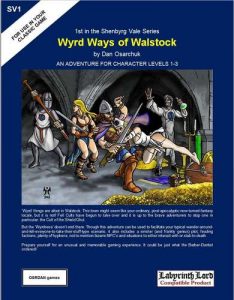
Wyrd Ways of Walstock


By Dan Osarchuk
OSRDAN Games
Labyrinth Lord
Levels 1-3

‘Wyrd’ things are afoot. This town might seem like your ordinary, post-apocalyptic-now-turned-fantasy locale, but it is not! Fell Cults have begun to take over and it is up to the brave adventurers to stop one in particular: the Cult of the Shield Ghul.

This 32 page adventure presents a timeline of a cults attempted takeover of a town. The cult has a timeline of activities and the party will, hopefully, get in the way of a few of them. At the end of the third day there’s a percentage roll to determine if the cult thinks its been effective in its lead up activities, and if they proceed/succeed. It presents a great D&D town, full of the oddities and character that I like so much, ala Pembrooktonshire and Marlinko, with the more out there elements of those filed off. It could use a reference sheet for the NPCs, and some names, in addition to numbers, on the town map. It uses, though, a pretty focused writing style that concentrates on gameable detail, with few exceptions. It’s a good town, and a decent series of events in that town.

What this adventure does, that so many fail at, is to provide the correct amount of detail, the correct amount of GAMEABLE detail, for the locations. There’s enough here, and its generally written well enough, to spark the DM’s imagination and allow them to fill in the rest. It relies on strong situations, iconic and stereotypical stretched just a little more. In one vile inn the stairs up are listed as: “These lead to a series of rickety, filth-ridden rooms, rife with vomiting and diseased dregs and harlots.” Nice! No need to stat out each of the individual rooms upstairs; from this we can get a strong idea of what the upstairs is like and run it on the fly. I could quibble, about a couple of events upstairs, but the rest of the locations, most of the more common rooms especially, have a nicee series of events/tables already for adding little things. The back door to the place is “barely functional.” There’s a pig fighting ring. The drinks are served not in glasses but in a trough that runs down the bar. Odors of manure and ale emanate on the outside. Another Bohemian, sho is bedecked with flowers, crystals, and potent incense. I think we all understand what this kind of place has, with dreamcatchers and lace and the like. These are descriptions and locales that you can hang your hat on. Further, most of the locations are contained to a single page, or part of one, meaning little to no page flipping to make scanning the entries harder.

As a social adventure it has factions, something like eight of them. The cultists, a group of healers, an ineffectual town council, the tired corrupt guards and two main merchant houses/families … not quite alike in dignity.

The timeline is summarized, the locations generally cross-referenced for easy lookup in them. There’s an overview, with more detail, of the plans that you could read once and not have to refer to again unless you want. The locations have events, like pickpockets, being vomited on, an aging harlot, and so on. There’s a table of descriptions and personalities you can use to fill out random NPC’s as an idea generator for when the party acosta someone. It’s all great stuff. Strong imagery. Decent descriptions. Not too much filler.

It’s lacking in really strong reference material. The town map is just numbered. Looking up which places are bars, or inns, for example, means hunting through the pages looking for them and then looking at the (numbered) town map. This is a good example of where putting the place names on the town map would have helped a lot. Similarly, the NPC’s are all found in their “home” locations … scattered throughout the text. That’s not good for a social adventure where the party is running around, asking questions, talking to people, investigating, and so on. It needs one page with all of the NPC’s on it, where they are found, a brief personality/feature, and their goals. Those two reference sheets would have really kicked this adventure up to another level, making it very easy to run at the table. One of the nuns in the convent runs around in all white at night, on the rooftops, as LADY LIGHT, casting light spells and preaching the wonders of Minerva. That’s the perfect kind of thing to throw in at night to mix things up, but it’s hidden in the description of the convent and not right at the DM’s fingertips, staring them in the face when they glance down.

This is a good town adventure. It provides lots of memorable opportunities for play, without forcing them on the players or feeling too contrived. Formatting for scanning could be better, and it needs some prep work for the NPC’s and map, but then again most adventures so. The amount of bullshit extraneous text is minimal, and what there is of it usually adds to the local colour of the place. This is a keeper.

This is $6 on Drivethru, and worth the price of admission. The preview falls down some, showing just the general overview of the town, factions, timeline, and plot. This is probably the weakest writing in the adventure and only hints at the better things deeper in.
https://www.drivethrurpg.com/product/218261/Wyrd-Ways-of-Walstock?affiliate_id=1892600

Posted in Level 1, Reviews, The Best | Leave a comment

Dungeon Magazine #150

I made it. I fucking made it! I’m not proud of the lack of analysis some of these adventures got, but, fuck man, THEY SUCK.

Kill Bargle
By Jason Bulmahn
Level 3

WoW! A non-shitty adventure in the final issue! A three level dungeon with seventy rooms, maps that are not terrible, terse read-aloud AND Dm notes AND introduction. The encounters are good: search a chimney and be in danger of rubble falling. A hat box with poisoned string tying it shut. Gold dinner plates covered with yellow mold. There’s an interactivity here that most adventures miss. Attacking a zombie in room C can draw zombies from room D. This thing is constructed, and constructed well. The read-aloud is not evocative, AT ALL. “The chamber contains a large amount of trash, but nothing else.” is not the height of prose. Or “The room is filled with boxes and crates of many shapes and sizes.” But, at least the read-aloud is only one sentence. I could quibble with some encounter choices, like the carrion crawler in encounter 1 that attacks if you come within 20 feet of its lair. This feels forced to me and I prefer a “curiosity killed the cat” thing where it attacks if you disturb its lair. But this is petty of me, and there’s certainly rooms for both types of encounters in the world of D&D. This adventure is worth having. I love the introduction to this adventure, short, to the point, and with advice like “the town is full of wild rumors about Bargle.” Maybe a line or two about personalities of the notables, but otherwise this intro does a great job hitting the notable facts, orienting the DM, and keeping things short.

Well fuck. I think I’ve been trolled. I did some research, based on the designer’s notes, and … I’m not sure Jason wrote this? I’m a B/X Moldvay fan, so the history of BECMI is beyond me, but after digging in some I understand this adventure may be based on one in the DM’s book for the basic set? I guess this is somehow the basis of the internet’s obsession with Bargle … which I know nothing about?

Quoth the Raven
By Nicolas Logue
Level 8

Oh it’s fucking Eberron, for fucks sake. You know, I didn’t feel like this when Planescape or Dark Sun or Masque shit popped up; I wonder what it is about Eberron? Anyway, this is just a confusing mess AND linear … quite an accomplishment. Chick is marked for murder by a psycho, and several linear encounters follow as you protect her and track him down. There’s a house at the end with a bit of a creepy vibe going on, but it feels forced.

Prince of Demons
By Greg A. Vaughn
Level 20

The final adventure in the Savage Tide adventure path. It’s just a bunch of overwrought set piece garbage trying to build exciting shit but burying it in TONS of text. There’s some decent roleplay opportunities at the start with the allied demon lord armies, but, again, its buried in confusing text. Jessu Christo, learn to use bullet points!

Posted in Dungeon Magazine, Reviews | 20 Comments

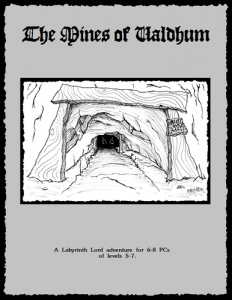
The Mines of Valdhum


By Matthew Evans
Mithgarthr Entertainment
Labyrinth Lord
Levels 5-7

Nordriki, the northern kingdom of the land of Mithgarthr, has been relatively free of dragons for hundreds of years, but recently the locals have been reporting sightings of red, white, and green dragons all throughout the Drekiberg mountains to the north. Recently, a green dragon has taken up residence in an abandoned mine that is close to the city of Valdhum. The surrounding land is rich with wildlife for the beast to feed on, and the lair it has chosen is well protected and secluded.

This 37 page adventure details five levels of a mine, with about eleven rooms per level, as well as a separate abandoned complex/level with another ten or so rooms. It’s got a German/dark forest vibe going on that I can get in to, as well as interesting encounters in the mine. There’s a variety of hints, things to talk to, stuff to explore, and trouble to get in to as you delve deeper to find a dragon to slay for the townfolk/reward. The encounters, both empty and not, are solid, but the adventure needs more focused writing to turn it in to something special. It manages about seven rooms per page, so it doesn’t drone on, but with some focus this could be a REALLY good delve.

The intro/hook is too long, but it IS good. Bear-people tribes live in the forest. If you travel to the town at night you get attacked by them. In town you find out killing them is trouble, as it riles up the tribes, which are under pressure anyway from game being eaten by a dragon that just moved in to a mine/quarry nearby. Thus you are tasked, either as penance (if you killed them) or as a reward to stop the dragon. It’s a nice geopolitical hook and makes sense. It ties in with dark forest vibe thing, which is strengthened further by an encounter with an “evil tree.” Notably, however, you can dig up the tree after killing it to find a buried chest with loot! This pulls HARD at my love of folklore-ish callbacks in adventure.

The mine proper is, well, a mixed bag. The map is linear. VERY linear. It does a good job of noting room features, uses color, and has slopes up and down, but a more interesting map would have done more. Five levels is a lot of room to play with, vertically. Being shoved down what is, essentially, a straight line hallway/path doesn’t do much to enhance the fear of the unknown, tactical, and exploratory things that a more complex map allows.

The room encounters, proper, set up interesting situations. There’s an old mine office with a lockbox with gold nuggets/ore in it … along with the weakened poison trap guarding the lock. There’s a kitchen with a pot growing yellow mold. Disturbing the chimney means disturbing the bats in it, which will knock over the yellow mold pot. These rooms makes sense. There are multiple things going on and it doesn’t feel forced. There are goblins, manning a barricade on an offshoot passage, who can parlay with the party, just wanting to be left alone. There’s an interplay between the rooms, with several empty rooms providing clues, or at least foreshadowing as to whats to come. Warning signs, in the form of heads on pikes, and bones telling of backstory THROUGH THE ADVENTURE. What a concept … The levels are themed, from old mine to sacked cult temple to trogs, to the dragon and so on. The type, variety, interconnected nature, and multiple things going on are all playing in to an environment that feels REAL. Thought was given here and it FEELS natural rather than forced and created. Someone gave some thought to this, but still kept things simple.

It doesn’t meet my standards for a good room description though. I’m looking for something evocative, that scans quickly. While the IDEAS are good, the writing could be better. “A wooden structure has been built in this room” or “this room appears to have functioned as the foremans office” are neither great descriptions. “If the desk is thoroughly searched …” betrays a conversation if/then style description that loads it up with text that makes it harder for a DM to find information. The information transfer beyond the encounters is not great and what there is is frequently not evocative. Almost … “this mine shaft is littered with desiccated woodland animal corpses” betrays spiders nearby. That’s not too bad; a little plain, still, but not bad.

For its problems with information transfer, I’m fond of this. Multiple levels, a great mix of encounters, a dark forest vibe … this one is close.

The PDF is $5 on DriveThru. And, glory of glories, the preview shows you writing! The first page, room 7, shows you the dessicated woodland creatures, and the next the strong odor of death.https://www.drivethrurpg.com/product/128706/MELL007-The-Mines-of-Valdhum?affiliate_id=1892600

Posted in Level 5, No Regerts, Reviews | 7 Comments

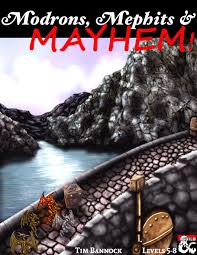
[5e] Modrons, Mephits, & Mayhem


By Tim Bannock
Self Published
5e
Levels 5-8

It is primarily set in a modron-designed research facility that has been abandoned by its creators but retains guardians that are still active. Additionally, two groups have broken into the facility with their own goals in mind; the githyanki and their red dragon cohort are antagonistic and provide the main source of combat in this adventure, while a modron traveling with a few mephits may prove friendly although ultimately troublesome.

This seventy page adventure describes a three-level modron lab with about sixty rooms total. Only thirty or so pages are devoted to the dungeon, with the rest being appendices for monster stats, maps, etc, and it manages about four rooms per page when it is being terse and the rooms are simple. While for 5e, t’s trying to bring in elements of older play, with factions, better (non-linear) maps, interactivity and a generally slower/more exploratory environment. It’s trying to be organized, and succeeds admirably on several points, but the bulk of the text had readability issues, in both clarity and verbosity, which detract from the more interesting room elements which don’t come across well because of it.

A village water supply, from a river, has dwindled to nothing and you go up river to find out what happened. Discovering the water trickling from a (long-existing) dam you explore it to discover some other factions, friend and foe, inside. At heart, this is an exploratory dungeon crawl with another enemy faction (and the dungeon faction proper) already inside, and some allies to potentially recruit. Both the initial village, and another along the way, serve as rumor sources to collect information before venturing in. The NPC’s are all gathered in a small section, with personalities, that makes wading through their (longer) descriptions later a lot more tolerable. In addition, the information you can gather is separated out nicely in bullet-form faction, making it easy for the DM to locate and scan. It’s a great formatting decision.

The maps are decent and the three-level dungeon does a pretty good job of feeling like a lab to explore, without going full on gonzo nutso scifi. There are lots of levers, dials, viewscreens, and so on to play with. Command words to guardians with clues left about, prisoners to rescue to join forces with, simple room puzzles and interactivity. There are things to figure out and use to your own advantage when exploring/interacting. The core concept of the dungeon is a good one and the rooms, while not standouts, hit that bar of “good enough” in terms of variety and interactivity.

The adventure falls down, though, in the actual descriptions used to explain the rooms. They are long. They concentrate on irrelevant things. They try to explain WHY things are. In essence, the descriptions tend to focus on the irrelevent parts of a room, which obfuscates the more relevant portions. What follows is a lack of clarity and a hinderance to scanning the room and running it effectively.
Room D1-2, on page 13, the first level, is a good example. The first paragraph is all background, what USED to happen in this room. “The river originally flowed from X to X and then to Z but is now dry.” and so on. It tells us nothing new and adds nothing to the room. What USED to happen is irrelevant unless it impacts the party NOW … and ancient history seldom does.

The second paragraph tells us the evil faction came through here, heard a command word, and used it, thus the automated defences are still intact. The adventure falls in to this trap, explaining WHY, in a lot of rooms. There’s a decanter of endless water, held by an iron golem, who says the command word over and over again, in order to get a stream of water. It’s currently disabled, hence no water stream. There’s a trap here. The rules, those three books, they are for the players. There’s not a single word in any of them that binds a DM. You don’t need to use the rules to explain or build an effect. It happens because MAGIC. There’s no reason for a decanter until you want the party to steal it (which they will.) A water nymph pieced by a spear that bleeds water, or any of literally a ZILLION other things could create water. Dead unicorn heads, or horns, whatever. There’s never a reason to explain WHY. (Or, almost never, anyway.) All of that just clogs up the room, detracting the really important stuff: the evocative descriptions and DM notes. It’s hard to scan during play with this much text involved.

The read aloud tells us the pool is 40 feet deep. It’s only 20 foot full. It’s 15’ wide and 20’ deep. Steps lead up 5 feet. These are not evocative descriptions. The text should get a vibe across to the DM, so they can enhance it and get it to the players. Steel-walled, a deep clear pool with a catwalk over it. A gleaming glass tube coming from the ceiling and ending in the water. Present a vibe. The map can handle the dimensions.

And there’s another issue: cross-room issues. There’s another room nearby that causes things to happen when you step on the catwalk. But you don’t know that until you get to that room. Likewise, there’s a room nearby (the one with the decanter in it) that is at the end of a long hallway that’s patrolled, with a faction guardroom down near the other end. But you don’t know that until you get to the faction control room. “Uh, sorry, hang on guys, it looks like that hallway is actually patrolled, the one you came down.” Ideally, you integrate this sort of stuff either in to the map (the patrolled hallway) or reference it in another room. “If you step on the catwalk see room 1-3.” or some such. You need a pointer. Otherwise you’re forcing the DM to be INTIMATELY familiar with it or scribble on the map, make notes, etc. And that’s not the DM’s job. That’s the designers job.

I don’t want to come off too harsh. For a 5e exploratory dungeon, this thing is headed in the right direction. It’s got a nice order of battle for creatures in the dungeon, doesn’t have more than sentence or so on monster tactics, and uses bullet points pretty effectively in room descriptions. What is really needs is a stronger focus on the CORE of the rooms. The evocative nature. The text should be terse, but not minimalist. Every line should help the DM run the room. A BIG edit for verbosity and more evocative descriptions (not longer, more evocative) would do wonders for this and turn it in to a really good 5e exploratory dungeon.

It’s $5 on DMsguild.
http://www.dmsguild.com/product/219400/Modrons-Mephits–Mayhem–Adventure-for-Levels-58

There’s a free preview of ALL of level 1. Check out the last page & last column to see room 2/2a, with its backstory and explaining why. The entirety of 2/2A, that is seen here, could be shortened to maybe three sentences and be just as, if not more, useful to the DM running it.
http://www.dmsguild.com/product/215276/Modrons-Mephits–Mayhem-Free-Preview-Edition-Adventure-Levels-46

Posted in Reviews | 8 Comments

Dungeon Magazine #149

Not as bad as I was expecting for issue 149. Nice ideas, poorly implemented.

War of the Wielded
By Richard Pett
Level 5

Well, you don’t see that everyday. I tend to like things stretched to their logical conclusion, or at least I’m morbidly fascinated by it, and this adventure does that. A world with intelligent swords that can ego-overwhelm people? Ok, let’s see where that goes … Two groups of intelligent swords, with conflicting goals, are engaged in a kind of war. The party stumbles on a dead body and one of the swords. ENcouraged by a magic sword, and told of where to find more, they are encouraged by the sword to go rescue his “friends” … the other swords on his side. This leads to a fight in a bathhouse, capturing a rust monster, and destroying all of the magic swords with it. It’s linear, but the setup of magic swords engaged in a “war” with each other is a good one. You meet someone after the first encounter who wants you to destroy all the swords and it’s simply a given that the party will … but this comes out of nowhere. There’s no real motivation, horrific acts, etc, to motivate the party to give up a bunch of magic swords. It’s just the next stop on the railroad. It plays out more like a series of set-pieces with token roleplay to tie things together, and that’s never good. There’s a decent idea here; it needs to be given more room to breathe, with fewer descriptions of ordinary rooms. In particular, the hooks appeal to the PLAYERS, but tempting them with magic swords. Nice job that.

Twisted Night
By Stefan Happ
Level 10

I’m not sure about this one. There’s an abandoned village with a mad dude in jail and a boy under a boat, neither of whom know what happened to the villagers. There’s a sullen, forlorn vibe that I can dig. You eventually find out a tree monster signs after dark, luring people to their doom … which in this case meant slavers. But the slaves are still dying and the only way to save them is killing the plant monster. Good imagery with ogres skinning and hanging meat, the initial village, a drunk satyr, and, of course, the potential for pirate/slaver allies. It’s also very … encountery? Ogres in the village. A centaur slaver on a hill. Pirates on the shore. It all just feels like there’s monsters there BECAUSE. Still, nice adventure concept and some good imagery. It’s just needs a rework.

Enemies of My Enemy
By Wolfgang Baur
Level 19

Meet Charon and journey the Styx picking up allies to attack Demogorgon. Lots of words. Lots of forced combats and “testing skills” and meaningless read-aloud. There’s some decent roleplay in this, in negotiating the various creatures/scenarios of the planes and recruiting demonic allies, but it’s buried in a horrid page count from stat blocks and overworked “aren’t I clever!” text. It’s feel formulaic and repetitive.

Posted in Dungeon Magazine, Reviews | 2 Comments

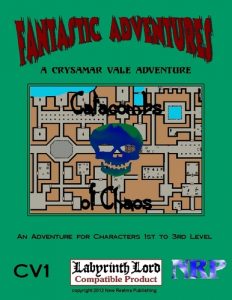
Catacombs of Chaos


By Walter P. Jones Jr.
New Realms Publishing
Labyrinth Lord
Levels 1-3

The trading season has begun and the town of Ravenor is filled with merchants and celebrators looking to enjoy the upcoming Spring Festival. But not all is well in the capital of Crysamar Vale. Tremors rumble through the land, damaging buildings, and fisherman complain that the fish are becoming scarce. And during quiet moments, when the fires burn low and most revelers have long since gone to bed, the rumors grow darker. Tales are whispered of bloodless bodies being found in the streets at dawn, of boats drifting down river in the morning mist, their crews gone, and of strange smells and sounds that make the blood of even the hardiest soul run cold. Something dreadful has come to Ravenor.

This 25 page adventure describes a fifty room “standard” dungeon The map is actually decent, but it is PLAGUED by long read-alouds, boring history and room trivia, and massive amounts of DM text. This reminds me, most of all, of the initial draft of Dwimmermount: minimal keying expansively described.

The start/introduction has a column of read-aloud. The town council, a column of DM text later, has another column of read-aloud text. The rooms have read-aloud. The read-aloud is boring. Here is a masterpiece: “ A small stream of water flows into this chamber from a passage in the north wall, feeding a large pool in the southwest corner. Light debris litters the floor and there is an opening in the east wall.” The focus is on trivia from the map. Where the stream enters. Where the pool is. The detail is uninteresting “light debris.” This is not specific, generic, using boring adjectives like “light” and unspecific nouns like “debris.” This read-aloud has done NOTHING for the DM or the players. Floors have dirt and debris in read alouds. Mounds are “large” in the read-alouds. This is poor writing, evoking nothing but boring genericism. This is then exacerbated by long DM text. It’s long, contains history and room trivia not relevant to running the adventure. “A hidden catch will open the secret door, revealing the passage beyond. There is nothing of value in the room.” This is akin to telling us, in a normal village, that the sun shines or that a door can be opened. Of fucking course a door can be opened. That’s the nature of a door. It’s notable if it CAN’T be opened. Expansive text for minimal keying.

There are bright spot. Creatures with bulbous eyes and webbed claws. And here’s a temple description in read-aloud: “Trailers of mist drift through this large room, diffusing the pale green light that emanates from a crystalline dome overhead. Mottled blue stone forms the walls and floor. To the south, a large object looms in the mist.” That’s a decent read-aloud description, painting a picture of a room in your mind. But there’s FAR too little of it and far too much DM text to wade through. Focus, people. FOCUS!

The map is decent, using color and having themed sections and a nice selection is flopping corridors, the way an exploration dungeon should have them. It’s only half a page though, making it hard to read; a full page map would have been better.

The adventure also has an objectives table You go in to the dungeon at the behest of the town council. As you come out, and share information with them, they will offer you various rewards. Did you tell them about the evil temple? They are pleased to know about it and they’ll pay you a little more. There’s about twenty entries on the table and I think it’s an interesting mechanic to push the party to interact with the council/town, and push them to explore. There’s not really any decent information to help the DM interact with the town, but, hey, the table IS interesting.

Lots of read-aloud. Lots of DM text. It’s a pain to wade through and the bulk of the text just isn’t that creative or interesting. The core of the dungeon, as a “generic dungeon” isn’t that bad, with rats, undead, mist, temples, etc, but the amount of effort you need to get there is just too much for me, much like the original Dwimmermount draft.

This is $6 on DriveThru. The preview is five pages. All it shows you is the massive read-aloud for the introduction/start and the town council, etc. You learn nothing of the actual rooms. Bad preview! No cookie for you!https://www.drivethrurpg.com/product/104138/CV1-Catacombs-of-Chaos?affiliate_id=1892600

Posted in Reviews | 2 Comments

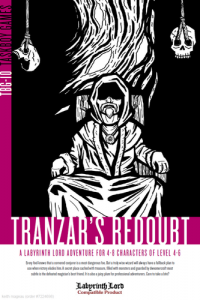
Tranzar’s Redoubt


By Joe Johnston II
Taskboy Games
Labyrinth Lord
Level 4-6

Every fool knows that a cornered conjurer is a most dangerous foe. But a truly wise wizard will always have a fallback plan to use when victory eludes him. A secret place cached with treasure, filled with monsters and guarded by dweomercraft most subtle is the defeated magician’s best friend. It is also a juicy plum for professional adventurers. Care to take a bite?

This 44 page digest adventure describes a twenty room dungeon in about twenty pages, with the rest being monsters, magic items, preg-gens, etc. It’s mostly a linear dungeon with a few branching rooms. I’d call this a funhouse dungeon, with iconic adventure tropes appearing in many of the rooms. It’s got some layout issues, gets long/redundant in places, and generally has bits and pieces of decent descriptions. If the layout/map/etc issues were resolved then I’d say this is one good edit away from being a pretty decent funhouse adventure.

Fair warning: I have a fondness for the classics. Waterfalls need a cave behind them, etc, and this adventure has that in spades. There’s a room with statues that ask riddles. There’s a dragon on a treasure pile that you can talk to. There are damsels on a rock in an underground lake. There’s an etting in a room with three magic fountains. A large mushroom forms a mouth to issue a warning. At times this is a like a who’s who of classic D&D room types.

The rooms have some decent imagery associated with them. A door with an evil fetish of chicken bones, feathers, and a ruddy brown stain. Nice! Odious vines. Statues illuminated with blue light from within. A statue face on a wall of a desiccated zombie with a mouth distorted into a rictus of hunger. These are pretty good descriptions. They get an image across to the DM immediately and these sorts of descriptions are not uncommon in the adventure. “Large” pods is not very descriptive. A common issue with much adventure writing is resorting to these common adjectives and adverbs. Large and big are both boring words. EVen if you don’t go full on Jabberwocky there’s always a thesaurus.

But these descriptions also tend to be buried in the text. “Stairs descend for about 20’ into a 40’ passageway ending in a door. The door is locked. Normal lock picking rules apply.” I wonder if normal combat rules also apply in combat? And it’s somewhat remiss to not tell us that normal gravity rules apply? It’s IS useful to know the room dimensions, since, you know, they are also right there on the map that we just looked at to get the room numbers, etc. You know, the central piece of information for all DM’s that’s almost always the centerpiece of the reference material they use. Oh, wait …. NOT useful. That’s right. REDUNDANT. It’s this redundancy, on both counts, that drives me crazy, especially with an adventure like this that is close to being acceptable.

The number one rule in adventures, published ones anyway, is that they are technical document, a reference for the DM. The implications of that statement will vary based on the type of adventure what section of the adventure, but it always needs to be on the designer’s mind. For room keys there needs to (ALMOST always) be a focus. What’s the DM need to know first? Usually this is the description; the short and evocative text that shoves an idea seed in to the DM’s head where it can grow and flourish and they can then ad-lib and fill in for the rest of the room. It’s. Not. The. Fucking. Room. Dimensions. First, it’s on the map. The map that’s almost always in front of the DM. No, putting it in the key is not good. More is not better. It distracts from the DMs attention. Suddenly there is trivia, useless information, that I must dig through in order to get to the stuff I NEED to run the room. I’m hot on overloading the map with detail because of this; it’s always there and can support a lot of the mundane needs of the DM without detracting from the evocative part of the room. Give me a terse and evocative room description then another paragraph of a couple of sentences that follows up on it. You don’t need tons of mechanics. You don’t need to spell everything out. You’ve got a DM there. Allude to things. Give the DM room to blossom.

I’m being overly harsh on Joe, the designer. This isn’t garbage, he does have some good descriptions and room ideas (and good magic items, for that matter), it’s just clogged up with the mistakes I’ve seen hundreds of times before. The difference here is that those adventures generally had few redeeming qualities, unlike some of Joes descriptions and room ideas. I feel like Joe is close. Take a room. Work it. Rewrite it. Focus. Have the magic click.

I’m also more than a little annoyed that the map is split over two pages in the (middle) of the book. I don’t know, I guess it’s digest sized and that takes some allowance, but I find those hard to read, and reference in play, and print out/photocopy for my DM screen. No, I don’t have solution. I’m just a jerk that way.

This is $2 on DriveThru. The preview is six pages, but it’s all intro stuff. I wish these previews would more often show you an example of the technical writing.https://www.drivethrurpg.com/product/148906/Tranzars-Redoubt?affiliate_id=1892600

Finally, there’s a thread over at RPGGEEK where they are building a community dungeon. I’ve been critiquing their rooms. One of them, username=PurpleBrocoli, had a kind of meandering writing style that they cleaned up quite a bit and turned in something that meets my approval. Several others are rewriting their rooms also, and I do in to detail on most of the rooms, noting the trivia and so on.

Fuck if I know how to direct link to Purple rooms …
https://rpggeek.com/geeklist/228624/lets-make-dungeon-together-critique
https://rpggeek.com/thread/1825853/lets-make-dungeon-together/page/4

Posted in Level 4, No Regerts, Reviews | 10 Comments

Dungeon Magazine #148


The Automatic Hound
By James L. Sutter
Level 4

A beast stalks a village. Killing it just causes it to return the next night. The party has to figure out that the body of a recently dead boy needs to be returned to some standing stones in order to get rid of the beast. The townfolk and churchman won’t want the corpse of the mayors son engaged in some pagan standing stone ritual. The complications of the resisting town, differing and conflicting motivations, could almost make this a Zzarchov Kowolski adventure … if he were illiterate and knew nothing about writing an RPG. The adventure is more like a twelve page outline. There’s very little specific support for the DM, except a six room rooms with lots of room descriptions that don’t matter. The hiring, the investigation, the monster hunt through the village, the troubles with the villagers in returning the body … none of it is supported. It’s just an outline, that should be six bullet points long, expanded endless to twelve pages without actually providing any actual real support for the DM. That’s too bad because if it WERE there then it would be a complex social adventure, with an almost LotFP potential ending.

In the Shadows of Spinecastle
By Stephen Greer & Gary Holian
Level 9

Count Doku wants you to go to an evil town and find his missing spy and/or recover his intelligence information. You go to a bar and get attacked. You go to a house and get attacked. You go to an eight room linear dungeon. End. It’s just set-piece combats linked with the barest pretext of non-combat. Utter garbage. I’d wipe my ass with it but I got a bidet for Christmas.

Wells of Darkness
By Eric L. Boyd
Level 18

Typical computer rpg adventure. Go to market in abyss to get info. Get attacked. Go to palace and talk to demon to get information. Go to prison. Go elsewhere to free prisoner. Have big fight at the end. It’s ponderous, full of the minutia of backstory … I don’t see how ANY person could possibly run this adventure.

Posted in Dungeon Magazine, Reviews | 4 Comments