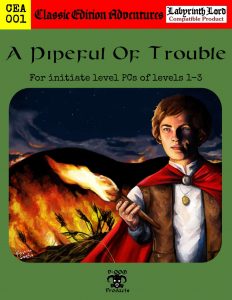
A Pipeful of Trouble


By Bret James Stewart
D-ooom Products
Labyrinth Lord
Levels 1-3

All is not well in Brierfield. The idyllic halfling village has fallen prey to unknown bandits and marauders. These peaceful victims of shattered loves and broken dreams need a band of heroes to save them. Are you willing to help them in their time of needs?

This 51 page adventure describes a halfling village, a small 26 room dungeon nearby where some bandits live, and a trial that (maybe) follows. It’s full of long tedious backstory, long tedious read aloud, long tedious DM notes … and not much else.

Bob the halfling loves Lily. He’s rejected, turns to banditry, and eventually steals a family heirloom. The villagers track the bandits to their lair, then the party shows up and they hire them to take care of the bandits/get the pipe. The bandit lair has them in it, a small sections with gremlins, and an old abandoned dwarf section with vermin. If you bring the bandits back alive then there’s a trial. This all takes 51 pages. You’d have a better adventure if it took five, and I’ve no doubt you do SOMETHING better in one. The problem is that the designer doesn’t know what the fuck he’s doing.

Come to Utah and dream a little dream with me, Picard-san, while you play your flute. Imagine a village. Build it out, in your head, in exquisite detail. The full live of the people, their routines, what they wear, why they wear it. Get DEEP down the rabbit hole. A leads to B because of C, over and over again. Spend a week, non-stop, doing this. It’s alive in your head. Now, run this village as an adventure. Record it as you do so. Village, bandits, trial, the whole thing. Now, transcribe the session. Take your week long dreaming of background and reasons and combine it with the transcription of the session. You would have this adventure. AND.YOU. WOULD. HAVE. WRITTEN. A SHITTY. ADVENTURE.

This fetishizing of REASON is the problem, along with the associated detail that comes with it. The problem is not the dreaming. Or the transcription. Whatever floats your boat to help you be creative and design the adventure. The problem is that this crud makes it on to the written page. It all has NO purpose making it to the buyer. The purpose of the adventure is to help the DM run it at the table. Mountains of extraneous detail does not help the DM do that. Backstory does not help the DM do that. Evocative and terse writing helps the DM do that. The designer is intimately familiar with the adventure. It had lived in their head a long time. The buyer doesn’t have that benefit. The goal of the designer is to communicate a vision to the DM *BAM* fast and deadly. An instant explosion.

Multiple pages of backstory doesn’t do that. Want to include it? Great, put it in the appendix. You know how many cocks I had to suck this week at work? No? Well tonight I have to run a game. And you have given a massive amount of text to slog through. You’re not helping. Then, I get to a new room. And have to slog through more text. “What do you see?” the players ask … well, hang on, I’ve got two pages of read aloud to get through, and we all know EVERYONE will have gotten bored after three sentences. This. doesn’t. Fucking. Help. Get in. Get out. Quick. Evocative.

Here’s a section pulled from the intro to the dwarf caves: “Soon after construction began, the dwarves contracted the plague. The disease was strong and fast acting. All of the dwarves died, including a pair that left the complex intent on travelling to their clan for help and perished in the wilderness.” That does NOTHING. How does it advance the adventure? How does it to lead to fun & exciting play for the players and/or make the DM’s life easier? It doesn’t It’s yet another cock I have to suck in order to get through the day. How about this little gem, pulled from another room: “Although it is not evident, this room was the servant’s quarters for the scullery staff for the dwarven complex.” So … it’s irrelevant? I’m sure whatever little dream you dreamed of the life of generations of people coming through this room was a nice one, but it has not place in the adventure. It. doesn’t. matter. You’ve done nothing.

More is not better. “Just in case the DM needs it” is not a valid excuse. This text bears down on the DM, hiding relevant details, making it harder to pick out the ACTUAL content for the room hiding behind all of that trivia. And that’s what it is. Trivia. This happens over and over and over again in this adventure. The inclusion of trivia and backstory and useless detail. “Mary likes to wear yellow dresses.” Who the fuck cares? Is that relevant? Does it make Mary relevant? If she dressed in a cow costume then at least it would be memorable to the players. One of the bandits says “barely” a lot in conversation. That’s a good detail. It gives him personality. Everything else, almost every physical description, all of the intricate backstory, it’s useless. A page to describe an NPC bandit is not helpful. Putting five bandits in a table with one sentence each for personality IS helpful. It helps the DM find it, it summarizes just the important bits.

There is the occasional bit of nice detail. An NPC personality. A word or two to describe a room. The entire “trial” idea at the end for running a “consequences” portion … including maybe a hanging. That should cause things to sink in a bit with the players. But it’s all fucking buried behind the useless detail of backstory or prescribed actions that read like they came from a session transcript. Detailed juror thoughts are not needed. Just include a few words in ONE sentence, maybe two, and move on. Leverage the DM. The wandering monster tables, for example, do a decent job of providing just a little extra “Umph” to the encounter. Skittering out of weeds, charging through the party, etc. They still take an entire page for six and are about twice as long as need be, but, still, short enough to wade through quickly to the good bits.

Understanding the purpose of a published adventure and the ability to focus your writing via editing, are two basic skills that all designers should have. Almost no one does. This leads to the shovelware industry we have today. Wanna buy an adventure? It’s probably crap. Knowing this you don’t spend much, driving prices down. Steam gives refunds, if the online stores did also maybe the state of the industry would improve. I wouldn’t want to discourage anyone from writing, but fucking christ, before you make us try and play it can you PLEASE make an effort to find out HOW to write an adventure?

It’s $5 on DriveThru. The preview is eleven pages long. You’ll get to see the massive backstory and the massive intro read-aloud. This is fairly indicative of the writing style present in the rooms and areas and should give you a decent example of the detail/backstory problems prevalent throughout the adventure.
http://www.rpgnow.com/product/208342/A-Pipeful-Of-Trouble

(If should be clear that sucking cock is a metaphor, stemming from the Assistant Crack Whore Trainee meme. Hey if you like sucking cock then more power to you. And if you don’t, well, then the metaphor should be clear.)
Posted in Reviews | 6 Comments

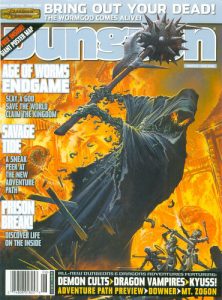
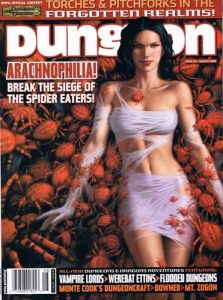
Dungeon Magazine #137


Siege of the Spider Eaters
By Tim Conners & Eileen Connors
Level 1

A short adventure with “good guy” arenae. Arriving at a village, the party finds it encased in webs with giant spiders on it. Inside the villagers relate a large number of them are missing. A lair is found, with spider eaters in it who are attacking the peaceful aranea who live there … and who are also the missing villagers. A guy in town brought in the spider eaters, so it’s back there to free the rightful mayor and kill the other guy. The implied morality is a little lame; it would have been nice to at least have the option of fighting the aranea also. The town sections are massively overwritten. Accepting the morality tale, the fifteen-ish room aranea lair is NOT a disaster. It has some elevation changes, kid hostages, a giant paralyzed aranea queen full of spider-eater eggs, a cocooned hydra, and an old pirate treasure. The variety is nice and while the read-aloud is boring and the DM text too long it is a cut above the usual dreck. Another one that, with some tweaks, could be salvaged. If it were, it would be a good example of the “initial encounter, roleplay, lair, big bad guy/followup” style.

Tealpeck’s Flood
By Peter Vinogradov
Level 6

You ride through an underground canal on a boat and kill things in this mostly linear dungeon-float. The water has piranha swarms in it … which is pretty cool. The dungeon claims 25 rooms, has columns of read-aloud and lots of extra detail for rooms that have nothing in them. It all ends with a large color & symbol puzzle. It’s a Disney dark ride, with combat. It’s hard to get past the linear canal gimmick and rooms stuffer with water-themed ghouls, water themed ogres, water-themed trolls, etc.

Man Forever
By Jason Nelson
Level 15

This starts out well. Kind of. Town is in an uproar: there are rumors the local lord is a vampire. Investigating the rumors via roleplay/town interaction is a major part of the adventure. The local lord is a little fishy. The local ruins point to the lord. Everyone in town, including the minor officials, have a slew of anecdotal evidence pointing to him as a vamp. It’s actually three hags casting charm person, dominate person, and modify memory over and over again, along with their Hagspawn Berserker minions who all wear rings of chameleon power. That parts all pretty lame. The hags live in a little compound under an illusion pond that is probably just one big pitched battle when discovered. The whole “town in riot” and a mob marching to the lords manor with pitchforks and torches is great. The concept is great. The social portion is quite cumbersome to run, being not organized very well, and the hag stuff at the end is a big break from the rest of the adventure … it could have been handled in town or something better rather than just a lair hack/pitched battle. And I can’t see ANY reason for the dominate/charm/modify memory garbage. Subtle events, rumor, and innuendo would have been a much better method.

Posted in Dungeon Magazine, Reviews | 5 Comments

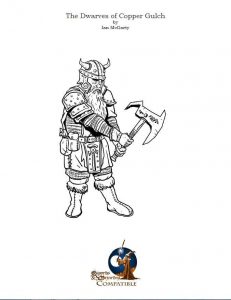
The Dwarves of Copper Gulch


By Ian McGarty
Silver Bulette
Swords & Wizardry
Level 1-3

The Dwarves of Copper Gulch have returned! They seem to be a bit less industrious than before and you will have to figure out why.

This is an eleven page adventure in a small dwarven hold with around 28 rooms on two levels. It’s been taken over by goblins, who think they are dwarves. If I’m being generous, then the content is marginal. From layout to encounters to the core elements, there’s just not much thought.

Most of the adventure takes place in five pages, with two more for maps. You find a journal, or heard a rumor in a tavern, or find a map. All centering around hearing about an old dwarf hold that is rumored to be full of treasure if you can get past the traps and labyrinth of rooms. There is no labyrinth of rooms or even any traps. Instead there are goblins who think they are dwarves. Quick to anger, quick to laugh, and able to be reasoned with.

The formatting changes from one column to two. The rooms all run up against each other with no paragraph break between rooms, or bolding of their titles, making it difficult to pick out the individual rooms. The wandering monster table intro implies multiple creatures … but the table has one entry, labeled “1.” The front door is, evidently, locked with a puzzle lock. It’s not clear. There’s a handout with letters and numbers on it, but no indication of what the handout represents. There’s just this handout titled “Door Puzzle handout” that is a matrix of letters and numbers.

The treasure is all +1 axes and shields and so on, with no effort to describe or make unique. The final room has a silver statue of a bulette in it, with full stats. Does it do something? Does it come to life? Is it underneath the pit in the throne room? Absolutely no indication of any of it.

In summary: an “adventure” with no real efforts at hooks, no real efforts at formatting (Fuck man, just spend 15 minutes more on the layout to bold some room names and stick in some whitespace!) The “adventure” consists of, essentially, looting the place without getting caught by the “dwarves” …I guess? There’s just nothing here. A few monsters, some boring old room descriptions … nothing. It’s almost incoherent.

It’s Pay What You Want on DriveThru, with most of the adventure available in the preview. Page two shows the wandering monster table .. with one entry, while the bottom of the page shows the puzzle door with handout following. Page five is a GREAT example of the formatting. Whitespace on the previous page, none on this one and everything running together.https://www.drivethrurpg.com/product/210391/Dwarves-of-Copper-Gulch-a-Swords-and-Wizardry-Compatible-Adventure?affiliate_id=1892600

It’s 9:12am and I need a fucking drink after this.

Posted in Reviews, The Worst EVAR? | 7 Comments

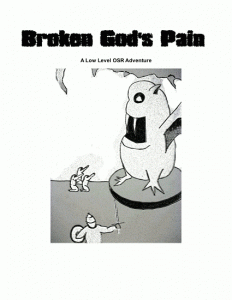
Broken God’s Pain


By???
Unbalanced Dice Games
OSR

The Old God has awoken. He feels the pain of being broken and wants to be free again. He has cursed the party to find his body and make him whole again. They must venture into the caves and face foes who will thwart their every move. If the party has the wits and the will they will succeed. The Old God demands success!

This is a 64-page adventure in some caves with about sixty rooms in it. There is some pretext about an old god and a new god and worshippers, etc, but it’s really a funhouse dungeon with a large number of mini-areas with almost no relation to each other. Charming, a product of madness, youth, or a fantasy education that stopped at age twelve without any hint of Tolkien or D&D. Fantasy as written by Tom Sawyer. Overly written, no effort at layout, unrelated encounters … and the type of pure simple imagination that I’m not sure anyone is capable of once exposed to “mainstream” D&D. Troll? Art project? Youth? I have no idea.

There’s no layout to speak of. It’s all single column with a large font. Room names are bolded. Monster stats indented. A few pieces of art in a simple, charming/amateur style. The hook? You dream, and are transported at fantastic speed over the sea past seas monsters and ship to find yourself on a rocky shore next to a village with a voice having said “Come and find me.” The starter village is a mess, with events mixed in to keyed locations in a small eight keyed location that takes four or five pages to get through. They worship a sun god the priest knows nothing about, there are bat themed (The New God) hints all over the place and the people grow hostile when the Old God is mentioned. This is all crazy … except the village god setup IS a good one. The kids play “bat and mouse.” There’s an old bat mask in the church. People get angry at the talk of the old god. Eventually a girl leaders the party to the caves. Inside they get a vision/voice telling them to find the old gods eight parts and join them together. It’s completely obvious with no attempt really at a serious pretext. The old god/new god thing isn’t really going to come up again, except in the form of a few cultists you fight.

There’s nothing from the books in this. No treasure. No monsters. All fresh content. It reminds me, in a way, of the writing style of Tracia, Dungeon of the Bear, and of my favorite adventure The Upper Caves from Fight On! Magazine #2. Treasure? How about a cup that burns water like it’s a torch. A little doll the size of finger. Held in the palm of the hand, it does a little dance that heals 1d4 hp once a day. A green gauntlet that causes plants to wither. A stale loaf of bread whose crumb feed you for a day. A stick that turns in to a shovel and back when you will it. What the fuck? For real? A fake eye that glows red … if you stick it in an empty socket you get infravision. Almost all of them are non-mechanical; describing effects instead of the mechanics they produce. +1? That’s boring. I’ll take the fucking stick shovel ANY day over a +1 sword. It preserves a sense of wonder and mystery. There’s cursed armor in Upper Caves/Fight On #2 that shouts “Here I am! Here I am!” when you get close to undetected enemies. No mechanics. Just a description of what it does in plain english, just like in this adventure. The treasure is MAGNIFICENT!

The encounters proper, have little reason to them. Two or three rooms at a time might be related, like a trap that deposits you in to a room, or the three rooms related to shadows: in one you pass through a weird wall that mucks with your perceptions, in the second you fight some shadow monsters, in the third you’re offered the chance to rid yourself of your shadow. Or a vampire hunter which you meet in one room, see a group of slaughtered bodies in another one, and an empty vampire coffin in the third. The relationship between the rooms and the pretext, the old god and new one, isn’t clear at all … if it’s there at all. I get the feeling this is more a funhouse dungeon. Not with puzzle rooms, per se, but with a series of rooms that exist BECAUSE. Why is there a piece of the old god in a bird cage hanging from the ceiling? Because that’s cool. That room, the cage shocks you. If you break it to get at the part inside then you lay 1-2 normal chicken eggs every 12 hours for a week. When the hell was the last time you saw a curse like THAT in an adventure?

Here’s a section of text from the tempt in the caves. There are fourteen sentences in three paragraphs and these are the middle three sentences: “The men attack with their knives while the large manunbat shouts orders at them. When half the men have been killed it will reveal its true nature. The arms and legs will fall away and it will become man sized. It will remove its head to reveal that it is a plant skeleton that was wearing a costume.” They attack with knives. It shoults orders. It’s plant skeleton in a bat-beast costume. It’s a simple on-forced style of imagination that’s going on. And room after room after room delivers this style of imagination. A board/plank bridge that breaks under weight, of course! A crazy guy with one arm and leg that fires blow darts from a ledge and hits you with his crutch. A bald hermit sitting in a chair in a glass globe. Vignettes in a cave … it reminds me of one of those lost childhood adventures, with Pirates of the Caribbean and so on.

Based on my standards and continually harping on usability at the table, this is hard to recommend. Ignoring the hook/village, the encounters can be arbitrar at times, with a plank on the bridge breaking and the character left hanging. Or an earthquake sealing the party in. It’s text heavy, and the encounters CAN be inconsistent with many working better than others, but they ALL are imaginative.

It’s $4.50. The preview on DriveThru shows the table of content and the last page shows the “dream” hook. I wish it had also shown one of the encounters, so you’d know more of what you are getting in to with it.https://www.drivethrurpg.com/product/138421/Broken-Gods-Pain-A-Low-Level-OSR-Adventure?affiliate_id=1892600

Go buy it, if for no other reason that I have someone to talk about it with!

Posted in Reviews | 3 Comments

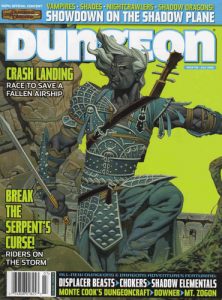
Dungeon Magazine #136


Hey, I’m on vacation in California! I finally get to go to Death Valley!

Tensions RIsing
By Ryan Smalley
Level 4

An airship has crashed in a hollow mesa and you’re sent to get some papers from it. The mesa entrance splits and goes three directions. There are two factions, and some random monsters, in the mesa caves with goals ranging from “kill the other guys” to “fuck up that airship.” The airship captain lives and refuses to leave, repairing his shit, you all take off and have one last encounter as the two factions launch an attack as the ship takes off. The map is kind of “trident linear” and does a good job privind a path/ways to engage with the three factions. One factions betrays the party while the other … doesn’t? It’s unclear, based on the finale encounter. There’s nineteen rooms and the adventure sometimes manages to put four on a single page, a singular accomplishment for Dungeon Magazine! A shit ton of text is taken up with prescribed tactics with some “Mr Bob had intended to use this room for X but instead Y and Z” nonsense. The basic setup with wounded factions trying to off each other is a nice one. You could probably have a nice adventure on one page, or one sheet.

And Madness Followed
By Greg A. Vaughan
Level 10

Iconic setup. Iconic location. Iconic situation. Shitty padded text making it all hard to run. I REALLY want to like this one. Raiders appear when big storms arise, according to the shitty hooks provided/dying man in the caravan. Tracking them back (100 miles … uh … that’s a bit long ..) has a massive temple appearing out of thin air at the end of a valley during a storm. That’s suitably classic! Inside are some monsters, intelligent foes, and the raiders. IE: MAYBE some factions. At some point while exploring the temple the storm ends, the raiders come back, and the place disappears from the material plane. Killing the raider leader breaks the curse/solves all problems. The map is excellent and reminds me a bit of the garden level of barrier peaks, with its mixed indoor/outdoor space, balconies, and so on, along with a shit ton of roof entrances to the temple. The switch from “exploring the temple” to “being hunted inside by the raiders” is a nice switcheroo also, changing the tone. It also includes an explicit section about who will talk to you … although starting everyone as hostile and those creatures being displacer beasts and chokers (when the fuck did D Beasts become intelligent? Talking chokers were some underdark nonsense, I think?) will both make things a little harder. Paragraph read alouds and long unfocused DM text sections detract from getting use out of it. “The other six hold only the barest bits of bone and shreds of cloth. This displacer beasts that occupy this room licked the lacquer from the corpses like giant candies before consuming the bodies.” Great. Does the adventure take place while they are doing this? No? And they’ve completely consumed the bodies? So everything in the LONG background paragraph is irrelevant to the adventure, as well as those sentences? Perfect. Glad you were able to pad out your Pay Per Word score. This needs a complete edit with a magic DELETE key, then you’d have a decent adventure.

Gates of Oblivion
By Alec Austin
Level 18

There’s nothing to this. Go to a shadow plane, visit three clearings and have a fight at each. Then you go inside a monolith and have a bunch more fights. Then you have a boss fight so you can save the world from darkness. It looks like it’s just an excuse to have a bunch of nightshades/nightwalkers in an adventure. It’s just mini’s combat.

Posted in Dungeon Magazine, Reviews | 5 Comments

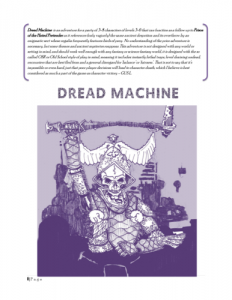
Dread Machine


By Gus L.
Self Published
Labyrinth Lord
Level 3-6

This 52 page adventure describes a cavern and the machine at the heart of it, that can resurrect the dead. Three’s a small region presented around it, with the cavern locale having about five encounter areas, each with about five more keys, and then the main area with about twenty-one keys. Gus has a very descriptive and evocative writing style, although it gets verbose. The maps are cramped, but the entire thing is imaginative and full of interesting rooms to get in to trouble. He does a great job on imagination but this could use a good trim to make scanning/use at the table easy.

I sometimes talk about hooks appealing to players, and this adventure is a good example of that. Anything can be a quest, but if you can integrate your adventure in to what the PLAYERS want then they’ll be a lot more motivated to not jack around and be involved in the adventure. At some point resurrecting the dead is going to come up, either because of some plot of the characters or because one of them died. That’s where this adventure comes in to play: it features a giant machine rumored to bring back the dead. And it does! Instead of it being a screw job the party can instead find a machine that uses souls to bring the dead back to life. The ‘souls’ thing is going to limit it’s power, but even that opens up more hooks for the players. This is more than the usual fetch quest or hired by blah blah blah to do something. There’s personal interest at stake.

Gus does a good job with creating evocative environments with his writing, interesting things in the room/areas to interact with, and encounters in which there is potential energy. Farmers, hunting the party for a perceived slight, led by Pops Bonder. Zombies lurching hungrily, trailing eviscerated innards. A black pueblo under a curving cliff wall. A room braced with massive tree trunks waxed to a high sheen. An artificial wall covered in a maze of gears, pistons and metal plates. Gus presents a situation and dares you to go forward, giving the players a choice in their doom. An obvious blade trap over a door invites you to climb the wall and try to disarm it. A room has a whirling vortex of blue energy. A catwalk is covered with a slick oil … with a tantalizing view at the other end. The encounters invite the players in to them, almost daring them, tempting them.

The entire place feels coherent, alive. The farmers in the surrounding barren yellow plains make sense. The caves around the Dread Machine fit in with the farmers and the machine. The rooms of the machine are tied back with theming that’s obvious and not buried. The place feels different but not in a gonzo manner … at least until the machine proper is reached. The treasure, both mundane and magical, get just enough description to make interesting and more than throw-away items. A destroyed staff of the magi with some power remaining (inside a blast crater in the mud), a lump of golden metal (formerly a delicate thaumaturgical calculator), a gold ceremonial shark mask inlaid with mother of pearl.

The writing, colorful and evocative as it is, is also verbose. We’re not talking Dungeon Magazine standards, but it’s not uncommon for there to be two encounters per page, each being about half a page. There’s a header/summary at the start of each, so it’s not quite as bad as I imply, but it is still quite lengthy. The Secret Shrine has four paragraphs of text to describe a shrine with a treasure hidden in an idol. Two paragraphs paint a rich picture of the room while two more describe the hiding place and the treasure. “If the totem’s head, a twenty pound hollow ovoid of iron plate with indistinct features, is placed on the altar, the altar’s secret compartment slides open with a hissing gush of steam” That’s a great description. Or “Above the altar is a rough metal totem cobbled together from plates of black iron, welded and joined with thumb sized rivets.” Again, another great description. Almost EVERY sentence is a great description. But there are too many. It makes it hard to scan the text and find what you need to describe NOW.

There’s an attempt to mitigate this with a header section for each room. It describes the rooms appearance, smell, lighting, traps, treasure, and inhabitants in a little offset section. In theory this would be great. In practice … not so much. The summary attempts/descriptions are not particularly strong. “A dusty shrine to evil gods. Racks of skulls line the walls around crude totem and alter. Secret door on East wall to #3.” Both the initial “dusty shine” sentence and the “secret door” sentence are redundant. Instead telling us it’s a “crude black iron welded crude humanoid totem” and an “chromed sacrificial altar with pipes”, or something similar, would have helped. The players just walked in. What do I need NOW? Then the summary can kick in. And while they debate I can then scan the main text, which can call out important features with bold, or underline, or reformat so the more important sections are near the front of the sentence. That there fancy font don’t contribute to readability either.

The maps are a bit of a pain also. They range from half-page to third page creations. “The Black Pueblo” gets a little half-page isometric thing, trying to show the interior and exteriors of a location with ceiling access on moth rooms. The shading used to do that makes it seem a little busy. The map of the main location, a traditional map, has four levels snugged in to about a third of a page. It’s readable, but just, and a squinty chore that doesn’t exactly contribute to ease of use.

This is grade A highlighter fodder. It’s evocative. It’s got loads of interesting encounters. But it’s too verbose, which tends to hide what is going on in the rooms. The writing needs more focus on the editing side. I LUV those painting with a lot going on in them, every time you look you see something new. This adventure is like those paintings. Wondrous to enjoy, but if I tried to give you directions using the painting you’d get lost.

It’s free at Dungeon of Signs blog. Take a look at page eight for a nice wandering monster table, full of color. Pages eleven and eighteen have good sample maps to illustrate my points. The Secret Shrine room is on page twenty. Take a look at the summary section and then revel in the descriptions underneath.
https://drive.google.com/file/d/0B_4yfZaJH0e5Y2k5RzEtSURjUTA/view

Posted in Level 3, No Regerts, Reviews | 4 Comments

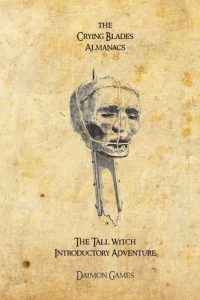
The Tall Witch


By David Pigndolli
Daimon Games
OD&D
Level 1

It presents a classic adventure, with a mission assigned to the characters by the priest of a small village, and rumors of the coming awakening of the terrible Tall Witch.

This 26 page Pay What You Want “adventure” has five encounters, each with a witch, filling about twelves of its pages. The witches are interesting. The magic items are interesting. I just can’t get over the page count.This is wrong of me. It’s Pay WHat You Want.

Every 333 years a witch hatches fully grown from a giant egg near this certain village. The villagers then get terrorized. The time has come and the local priest has declared a big rock on the sea shore to be the egg. The party needs to go fuck it up. On the way there you either meet a young lady who’s mule is broken or a young lady drowning off the shore, if you approach by boat. You find the egg missing. On the way up the cliffs you meet three more young ladies, all witches.

The witches are fairly interesting. All dressed in strangely nice gowns … a tip off if ever there was one. The first pretending to be lost on the road, her mule having a broken leg nearby. SHe leads the party in to quicksand, the purple flower in her hair allowing her to walk on quicksand. The second pretends to be drowning near the shore, wearing a gown of sea algea. They come off as more sorceresses and have a fine OD&D feel; they’d fit in great in Isle of the Unknown with their weird powers and such. One, when she dies, leaves a pool of water that never dries up. Nice. Each witch encounter takes two to three pages to describe, with a generous margin, font, and random tables.

Treasure includes the aforementioned flower that lets you walk over quicksand, eggshell pieces that could allow you to teleport, and the bronze head of a child that talks to you and if you feed it blood can do more.

The location of the witches is the most confusing part. One on the road, one at the base of the cliff, and three more on the way up to the top of the cliff? This is more of a point-crawl/scene based adventure, but I found it impossible to visualize the witches in relation to each other. IN a 26 pages adventure you’d think that even a small ¼ page map could be included.

It’s hard to bitch too much about a PWYW. Yanking the witches and/or the village to dump in to something else would be nice; I do find the OD&D nature of the witches nice. Then again, this could easily be a 1-pager, or 1-page front & back, STILL be PWYW, and lose very little of its flavor

Is it your bag baby? Fuck it, It’s PWYW and I’ve paid a lot more for a lot less.
The preview on DriveThru is 26 pages long: the entire adventure. Page 7 has the “hook” with the village. Page 8 has the first witch and the first few paragraphs are worth looking over to get a feel for the “airiness” of the witches. The next page, none, gives a good example of the extra detail that bumps up the word count: tables for attack & disease.https://www.drivethrurpg.com/product/209714/The-Tall-Witch–OSR-adventure?affiliate_id=1892600

Posted in Reviews | Leave a comment

Dungeon Magazine #135


I have a headache and I twisted my neck last night. This issue isn’t helping.

Funeral Procession
By Mark A. Hart
Level 1

This is one of the stooopidiest things I’ve ever seen. You’r guarding a funeral procession. There’s a diversion. The hearse is diverted. The body in the hearse is replaced. The original is shrunk. A raven familiar flies away with it. The town is in an uproar because of it toso the watch can’t search for the famous escaped serial killer. How much fucking crap are you going to engage in to push forward your crappy plotline ‘story’? It gets better. The hearse drive is paid off and there’s a thug in the back of the hearse. In spite of all of the dire warnings the party gets i the hooks, about worries of the body being stolen, etc, I guess the party didn’t ride the hearse, burn the body in advance, drive the hearse, or anything else. I guess that don’t jive with the ‘story.’ At there are columns of read-aloud, long NPC motivations and backstories, and and it’s event based … For some reason the party cares and gets lead by the nose to a slaughterhouse stuffed full of baddies. The … passivity that a party would have to engage in in to not derail the adventure … I can‘t imagine.

That gives me a good idea. I should start a ‘DERAIL” events at the gaming cons. Take a linear adventure and the META rule is to derail it, while the DM tries to keep it on track. Or the DM rolls with it. “On track” makes it a fun contest but, of course, the DM always wins.

Chains of Blackmaw
By Nicolas Logue
Level 10

A mess of a prison break adventure. You’re hired t go to jail and watch the back of a new prisoner. Event-based, with long room/key and even longer NPC stat blocks and motivations. It needs a table summarizing the NPC’s, about 60% less text with the room keys, a table showing events and timelines. I can’t imagine the tenth level party who says “Yes! Let’s get rid of all our gear and go to jail for little to no reward!” Ok, fess, up, who has waded through all the text in this adventure to run it? What do you have to do to? How many pages of notes?

Dawn of a New Age
By Tito Leati
Level 20
Oh god … Age of Worms adventure path. At least it’s the last one: Kyuss shows up. You’ve got the Hand of Vecna. You’ve got two parts of the Rod of Seven Parts. You’re given a Sphere of Annihilation. You’re given three opportunities to undertake quests to weaken Kyuss before he shows up. He’s AC 59 and has 660 HP … a 3e Level 20 creature in all it’s unwieldy glory. Note that nothing you’ve done thus far will prevent Kyuss from arriving. That’s impossible. All you can do is kill him. As an exercise for the reader: Rewrite the entire Age of Worms adventure path to be a sandbox/regional thing using only 20% of the words. Your reward is a Cease & Desist.

Posted in Dungeon Magazine, Reviews | 3 Comments

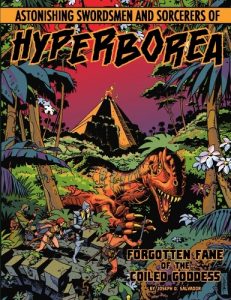
Forgotten Fane of the Coiled Goddess


By Joseph D. Salvador
North Wind Adventures
AS&SH
Levels 5-7

More than a month ago, your party found itself in Port Zangerios, where you heard of an Esquimaux thief selling a treasure map. Low on wealth but high in courage, you sought him out. The man turned out to be a fearful ex-slave who had “acquired” the map from his Ixian master. The map is incomplete but shews the Isle of the Serpent in far-off Lemuria, where rests a fabulous treasure called the Feathered Crown of Nanasa (or so thought the Ixian). Pooling your money to purchase the unfinished map, you bought passage on an Amazonian trade ship. After passing through tempests and torrential rains that shimmered with auroral light, you have come to the great city of Jhaman Ket. Now you must seek out the location of the Isle of the Serpent.

This is a sixty page hexcrawl/lost temple adventure on a jungle island with dinosaurs. It has a short eight page section on Lemuria, ten pages of new monsters appendices, etc, and the main hex crawl and titular temple in thirty four pages. It follows an “expansive minimally keyed format”, falling in to some of the usual traps with expansive text. The snake temple map is interesting enough, looking like a “main hallway with room s off of it” design but offering multiple entrances and the “Conan hole” in the ceiling. It comes off as bland.

I won’t cover the Lemuria fluff. Fluff is fluff and you either like it or you don’t. It does an ok job describing the general region of Lemuria, politics, towns, etc. It tends to the historical and overly specific “Round shields of iron and bronze are both in use …” I like my fluff different, driving action and all full of mystery.

For the main adventure, comparisons to Isle of Dread are inevitable. Be they inspired by the same Appendix N texts or simply hitting on the same themes, Dread was the first hex crawl many saw, it was on a jungle island, and had a ruined temple. Combine those elements, as this adventure does, and Dread comparisons are inevitable. The island hex crawls are, essentially, the same. Dinos, jungle, etc. There’s no friendly villagers and the temple at the center of the island, on a plateau, is more organized and less abandoned. Otherwise, you hex crawl through the jungle, see dinos, and try to not die.

The wandering monsters are rolled once an hour on a d6, with a 1 indicating a monster. That’s four encounters a day, on average. Certainly not EVERYTHING is hostile, there are some herbivore dinos, for example, but the rate is high, it seems to me. The island IS only 3 miles across, with six hexes to the mile, so a party with their ass in gear should mitigate most of that. Camping is going to be a bitch though.

There are heat rules. I have an ancient enmity with environmental rules. They always sound great but they tend to be cumbersome in practice. In this, every two hours you need to make a CON text or be exhausted and rest an hour, if you are encumbered or wearing metal armor. That’s one way to get people out of their armor: tedium. I don’t disagree with the theming, just the tedium required to get to the end result. Which brings up an interesting point. Given the focus on the wanderers every hour, and the heat checks every two hours, it seems unusual that movement rates are not covered. Each hex being 275 yards, it seems natural that a movement rate chart would be included on, say, the island hex map. Movement, and what you can see from your hex, are key elements in a good hex crawl that are missing here.

I think we can all agree Dread was minimally keyed and tersely written, except perhaps for sections dealing the customs of the villagers. I think the adventure here is also minimally keyed, but in contrast to Dread it’s verbosely written. Common elements are expanded upon in at text style that emphasizes plain factual data. Some North Wind adventures have a very tortured writing style that feels forced. I’m a fan of esoteric words and larger vocabulary in adventures, but I’ve come to expect to see this implemented in a cumbersome way in the usual North Wind adventure. This one has the opposite problem. The descriptions are plain to the point of being a killjoy … but the text goes on forever. The wandering monster table is three and half pages long, each monster getting its own stat block and short description. “Weighing up to 500 pounds, these seven- foot-long chamæleonic amphibians catch prey with their sticky tongues and can swallow a full-grown man whole.” Uh huh. You mean exactly what’s included in the stat block below that description? Occasionally there is a bright point like “giant ticks drop from trees”, but it’s generally this kind of non-useful text. It doesn’t really drive the adventure anywhere.

Similarly, there is an emphasis, in places, on historic uses for rooms. “This room USED to be used for …” or “In antediluvian times there were runes here …” These don’t help. They instead obfuscate other words which MIGHT help run the adventure. Now. Right Now. What’s of use to a DM running a party in the room RIGHT. NOW. A room that says “Study: Sometimes Bob used to read books here.” is not useful. That’s what a study is, a place where you hang out and perform study-like activities. We know that from the room name.

The encounters can be LONG, to little effect. Room three of the temple is a normal guardroom. Nothing really special. Snake-man pictograms on the ceiling. The text is a column long. An intro paragraph telling us the room is 20×30 (which we know from the map) and it’s got a 15’ ceiling (irrelevant to the adventure and doesn’t really set a mood at all) and then three GIANT stat blocks that look like they came straight out of the bad old days of 3e and/or Pathfinder. It ends with another paragraph telling us where the exits lead to which, again, we already know from the map. A column of text. This sort of expansive use of text for “normal” things is perhaps the adventures greatest fault. The temple has interesting layout for what is, essentially, a linear hallway, but the emphasis is on the mundane instead of the unusual. There’s a giant jeweled idol in one area, the kind every adventurer dreams of prying the jeweled scales off of. We’re told that desecrating the idol should causes curses and misfortunes as the DM sees fit. But, THAT’S what the fuck we’re paying the designer for! We’re not paying to be told that a room is 30×20 feet. We can see that from the fucking map. We’re paying for the unusual, the interesting, the imaginative. A constructed world of interlocking parts. We’re not paying to be told to roll for our treasure or make out own snake-god themed curses. A cult village doesn’t need to have gonzo elements to be good. But it doesn’t need five pages, as this one does, if all you’re going to tell us is the mundane. Placing an emphasis on how the party will interact is where the effort should have been spent. Guards. Patrols. Things to thwart sneaking around. To get to the temple, and so on.

The preview, on DriveThru, is only four pages long. It doesn’t really show you anything of the text you’re likely to encounter in the adventure. That’s not a very effective preview. It does include the table of contents, which is helpful, such that it is.https://www.drivethrurpg.com/product/156193/Forgotten-Fane-of-the-Coiled-Goddess?affiliate_id=1892600

I’m disappointed with this adventure. Thus far, I’m pretty sure that the best AS&SH adventure I’ve seen has been the Crypts & Things adventure Blood of the Dragon. If you know of a better one then stick it in the comments. I don’t feel like anything I’ve seen so far lives up to the potential of AS&SH and I’d like to make sure I’m giving it a fair shake.

Posted in Reviews | 8 Comments

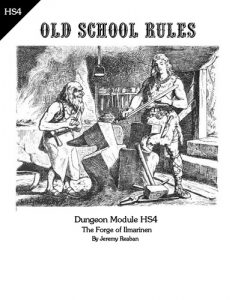
The Forge of Ilmarinen


By Jeremy Reaban
Self Published
1E
Levels 5-7

Ilmarinen the Eternal Hammerer was once widely worshipped by primitive people, whom he taught how to work metal. But once they had his knowledge, his worship was largely forgotten and his temple declined and was of course overrun by monsters.

This sixteen page adventure in an old “smith god” complex has sixteen encounters spread out over four pages, with another for the map and the rest of the pages being appendix material in the rear: new monsters and magic items. It is mostly a hack with only a couple of exploratory items. Nice treasure and all new monsters make this smarter than your average bear. The text has a weird thing going on where it is both to the point and padded out … a seeming contradiction.

Too many magic swords? Come on down to Big Ilmarinen’s temple and we’ll take care of it for you! We’ll destroy two of your magic swords and channel the power in to a third! The +1 sword glut can be a common game problem for some. Combined with the lust over higher ‘pluses’, the existence of a place like this temple is almost a hook unto itself. It motivates the PLAYER rather than character … and those are the best hooks of all. The actual hooks are pretty shitty: stumble across it, hired to investigate, or hear a rumor about it. Ok, the second one isn’t that bad since its related to that quality of player power envy. Just dropping a rumor, or crafting some failed expedition or some such is a decent way of introducing the place. You’ll get little help from the adventure through; the entire introduction is a column. I love a terse introduction and this one has it. Three sentences on background, three on hooks, and a short section on general dungeon conditions before the adventure keys start at the top of the second column. Perfect for an adventure like this. I might have suggested tightening it up even more, cutting the lame hooks and hook intro paragraph, and using the space freed to add a bit of color to the “tavern rumor” hook. But, still, terse and doesn’t get in the way.

The encounters are almost all straightforward hacks. Enter a room. See a monster. It attacks. There’s a place for this, but the over reliance on it detracts from adventures. All but one of the non-trivial encounters is a hack. Had the rooms been layered a bit more it would have been much better. What I mean is having additional elements in a room. If the room has monster then maybe it also has trap. Or there’s something unrlated to the monster to investigate. Or the monster attacks WHEN you do something … like fucking with the hole its living in. There are skeletons on a table in this adventure. When you come in to the room the skeleton heads detach, flame on, and then attack. That sends the wrong message. If, instead, FUCKING with the skeletons caused their heads to fly off then you’re closer to room that works better. Better yet, if you put an obvious ruby in the skeletons mouth THEN you’ve got a great situation. The players want the ruby. EVERYONE knows what’s going to happen when they fuck with that ruby. They get to make the choice. A very tempting choice to push the shiny shiny red cherry button … Madcap plans are created. D&D happens.

The writing is also a bit weird. It’s pretty fact based, which is what I think I mean when I cite it as “straightforward.” But it’s also got a pretty loose writing style that I think detracts from the adventure. Room four notes that: (bolding mine)

“Along the eastern wall are a stack of twelve kegs, three rows of four each. The curious thing is that the kegs are made out of an unusual metal, not wood. Half of the kegs are empty. The others may be opened, and if so, out comes a very skunky beer, long past its prime.

Along the western wall are two crates, both made of wood. The southern crate is opened and inside is empty, save for some straw like material. The northern crate is unopened. If opened, it will reveal 8 smaller sealed cases, each containing 50 rolls of summer sausage (1 lb. each). Amazingly, it’s still edible.”

What this entry does is describe a typical storeroom. We all know what a typical storeroom looks like. There is no significance to the crates being on the western wall, or being made of wood. There is no significance to the southern crate being open. Looking at those first three sentences, if they were replaced with a different description, or did not exist at all, the adventure would be no different. I can make a halfway decent argument for the same being true of the first two sentences of the first paragraph. If the text were removed, and it has no impact on the adventure, then the text has no impact on the adventure and should not be there in the first place. Don’t get me wrong, there is ABSOLUTELY room for painting a vivid picture in the DM’s mind (in a terse way.) That’s a legit reason for text. But bare fact-based statements seldom accomplish that. I would argue that most of the room descriptions in the adventure fall in to that category.

I do want to note the treasure and monsters in this adventure. Both are excellent. Jeremy has created an all new slew of monsters, relying on nothing from the “normal” books. Long time readers will know I love this. I love it when a party encounters something that they have to struggle with. New monsters represent the unknown, mystery. The party doesn’t know what special attacks or defences they have. There is an element of fear. There’s a place for returning favorites, but almost nothing generates anxiety like meeting some beasty with unknown abilities. The treasure is also a cut above. Room one has a bag with a mitten, stained with blood, with a gold ring inside. A monocle with a crack in it. Green troll jerky wrapped in a dirty piece of cloth. These things tell a story; they make your mind tell a story. They make you want to know what happened. There’s an eye, ripped form a gnome, that you can use for true seeing. The amount of extra work to make something more interesting than “state: 100gp” or “sword+1” is pretty small and I wish more designers would add value that way.

There are a few other misses. Two statues grab people and go jump in to lava. Great encounter! But the text refers you to the magic pool room instead of the lava pit room. Not huge, but indicative of the need for a second read through.

It’s PWYW on DriveThru. The preview on DriveThru is a good one. You can see the treasure for room one at the top of page three. The storeroom text is on the same page. In fact, the entire adventure is available in the preview. https://www.drivethrurpg.com/product/209706/HS4-The-Forge-of-Ilmarinen?affiliate_id=1892600

Posted in Reviews | 4 Comments