By Thomas Denmark
Night owl Publishing
Labyrinth Lord
Levels 4-7
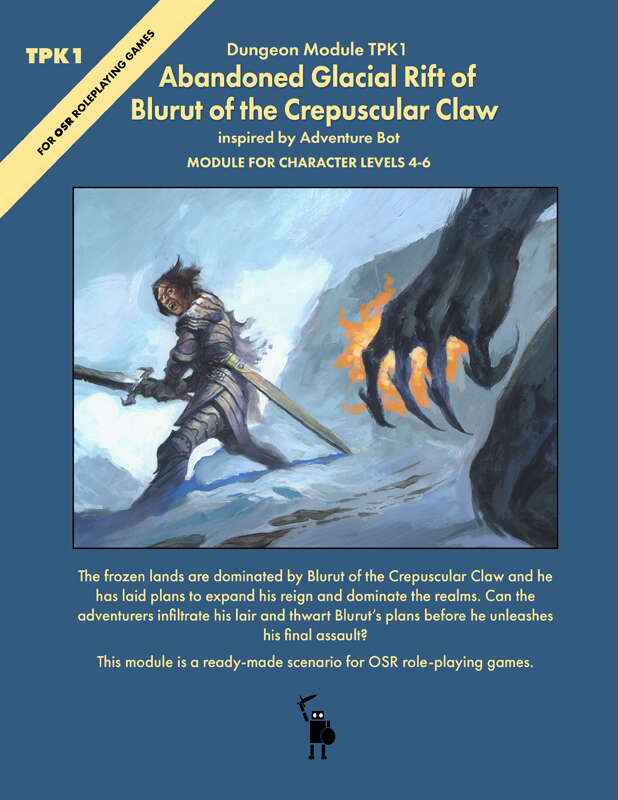
The frozen lands are dominated by Blurut of the Crepuscular Claw and he has laid plans to expand his reign and dominate the realms. Can the adventurers infiltrate his lair and thwart Blurut’s plans before he unleashes his final assault?
This 24 page adventure uses six single-column pages to describe a sixteen room linear set of caves at the bottom of a rift. Stefan says: This adventure has it all! Single column, low content to page count ration, linear, & disorganized and long writing.
This is a stunt dungeon. There’s this twitter bit, evidently, that creates rando dungeons. The designer took that and then augmented it in to a dungeon. I have no idea what kind of job the twitter bot does. I’m a big fan of “using inspiration” to create something. I find that “anything is possible!” generally results in a THX mindlock for me. Give me just a little bit to start from and I can create connections and expand content seemingly at ease and on demand. I’ve experimented with this a bit in the past and thus was interested to see how someone else does it.
Meh.
Long introduction describes a slightly generic northlands. Long appendices detailing monster stats and a couple of ideas for adding to the dungeon. Single column throughout in a decent font size, hence the high page count and low content count.
The actual dungeon is linear. There’s a connecting passage from room two to room sixteen, the last room, but it’s filled with rubble and you can’t dig it out, it keeps collapsing. So why is it there? I don’t know. This is a cave system map, fully linear with just a couple of off shoots. There’s little extra detail, elevation changes, of anything else in it. It is, essentially, a linear set of dungeon rooms with some yeti’s and ice. I would have wished for some elevation stuff, but, maybe that’s a feature of the bot? Oh, no, I just looked it up. It creates a name, that’s it. Hmmm. I now regret my choices.
The rooms are full of history text that add nothing to the adventure. “This room was once a …” “This room was as far as they … “
Combine this with the conversations style and if/then’s. “After the fight, if you dig through the rubble …”
Combine this with boring word choices and abstracted descriptions. “There is a large block …” “Mysterious runes are carved …”
Combine this with a lot of “it seems to be …”
And then add A LOT of text for the most of encounters, like some wolverines attacking. Or a room with a ghost.
There’s just not much going on here. The design is linear. The rooms not very interesting. The rooms not described very interestingly. What there is is either abstracted generalisms or LONG abstracted conversational writing. It doesn’t feel like much of an effort was made at all. Maybe there was. But it doesn’t feel like it.
There is no hope. The bread and circuses are over. All that’s left is the mundanity.
This is $3 at DriveThru. The preview is six pages and shows you nothing of the dungeon, so it’s a bad preview.
By Ben Barsh
Pacesetter Games & Simulations
S&W
Level 3
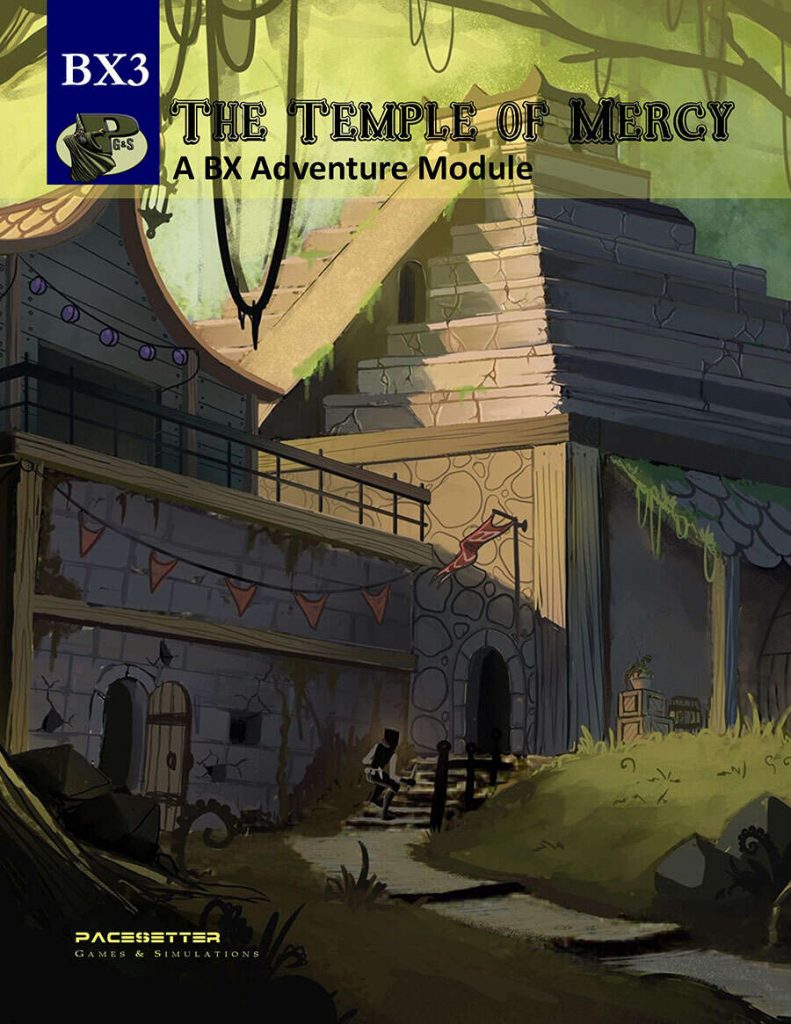
Many years ago, a fanatic cult claimed a sanctuary as a base for plotting their wicked ways. They named their redoubt the Temple of Mercy because it is where new followers would journey to repent of their sins and be granted mercy. It is unclear how the cult was defeated, but they vanished nearly 120 years ago. The temple has been quite since the disappearance of the vile clan. Recently, a religious order of holy priests has been interested in claiming the temple as their own. They are looking for bold adventurers to slay sinister monsters, evade treacherous traps, and bring glory to the forgotten Temple of Mercy!
This 24 page adventure has 22 rooms over two levels in an old temple. Long DM text and middling read-aloud confuse encounters with a lot of notes and temple statues puzzles.
There’s a lot of backstory that can skipped over in this. Pages of backstory, DM’s notes, and flavourless village, etc. This shows up in the rumors as well, with generic “a brother and sister guard the entrance” type rumors. These abstracted and generic items add little to any adventure. The village is the typical village with the details that are presented being the usual ones for the tavern, etc and have nothing to recommend them. Likewise the rumors are of the abstracted sort. Better to gmake the rumors longer, and perhaps fewer, and give them a voice with the brother and sister being Mary & Frank, bad seeds from birth, etc, told by the tocal farmers etc. There’s a skill to adding flavour without necessarily adding much text. That’s missing here in both the village and the rumors, with everything being this kind of abstracted and generic fantasy ideas that are not given much life at all. It can all be safely ignored, but it’s … sad? To me that they exist in these adventures and add little to them. All of the time and effort wasted on them to little effect. It would be better, i think, to simply note that a village exists and let it go at that, without wasting efforts on them, if they are just going to be generic things. The rumors also; either do some good ones or leave them out. These generic abstracted things add little. I’d rather see a half dozen done well than two dozen short sentences without flavour. On the plus side, the hook has you being given a quest to clean out the temple … which isn’t great, but at least you’re offered 5000 gold to do it, so it’s a little more than the usual light treasure pretext.
There’s one wilderness encounter. While crossing a river you spy a wrecked rowboat on a sandbar in the middle … with a bag in it spilling gold. Now that is how you tease an encounter! These sorts of setups always get my DM juices flowing, tempting the players with something to take a risk for. A couple of dire wolves show up, which is a nice bait & switch from the typical “bad fishies” stuff one would expect in a river, which, again, if a nice bit of design. They even have “evil temple” brands on them, which is a good touch also. I might have played up iron collars, beaten and abused, etc with them, but, it is a couple of steps above your typical generic wilderness encounter.
The temple proper, has map that is essentially lines with a few off shoots. It’s a nice LOOKING map, but offers little in the way of exploration play. Treasure is on the lighter side for S&W, meaning you’re going to have to do four or five adventures of this type, maybe, before levelling.
The read aloud is generally ok. It makes an attempt, and largely succeeds, in being evocative. Doors are stout and rivers rage, water drips from ceilings. And then it switches to large rooms that are “strangely empty.” This is a cut above the normal read-aloud. It also has a tendency to over share. “Upon closer inspection the chair is covered in dried blood.” I believe that the soul of RPG’s is the interactivity between the players and DM. When the read-aloud over shares then that interactivity is cut down on. Better to note a chair, or a ruined chair, or even a stained chair, maybe. When the players follow up and question and/or examine then the DM can share a read stain, and then further follow up with “dried blood!” When the read-aloud shares too much up front then the ability of the players to interact with their environment, and the DM, is diminished, to the detriment of the game.
DM text tends to be long and conversational in tone, with way too much backstory and “this room used to be” mixed in to the text. This is, of course, on e of the worst things a designer can do. By making the DM text long and hard to scan then you’re impeding the DM’s ability to find information in the room and run it during play. I can handle poor read-aloud, and even uninteresting design, but these “also ran” adventures of short length and slightly generic nature, it needs to really distinguish itself by having good DM text. A statues can’t just have ruby eyes, of no. It has to be done as “if you climb the statue and pry out the eyes then the will find that they can take home …” Genericism returns as well, with an insane acolyte, for example, instead of Zed the paranoid.
Interactivity is above average in this, with statues that need repairing and pools of water to play in for attribute, etc, effects. There are a variety of notes laying about (too many …) to give the party hints on what to do, even though what to do s pretty obvious in most situations. “Oh, replace the X that is missing from the Y.” Nates are an easy out. A well written description, or other ways to communicate information is far, far, preferred. Still, better interactivity in the dungeon than most adventures like this.
The interactivity in the dungeon would place this adventure above average, if the read-aloud and DM text could be better managed. And I’ve just about given up on everything outside of the dungeon by now, thinking about it as just taking scissors to it and pretending none of it ever existed helps me sleep better at night.
This is Pay What You Want at DriveThru with a suggested price of $5. The preview is three pages, showing you some of the rooms of the dungeon, so that makes it a good preview. (Even though, with PWYW it is essentially a total preview.) Rooms one and two, in the first page of the preview, are fairly typical of the writing. Generally above-average read-aloud with long DM text void of formatting to help scanning.
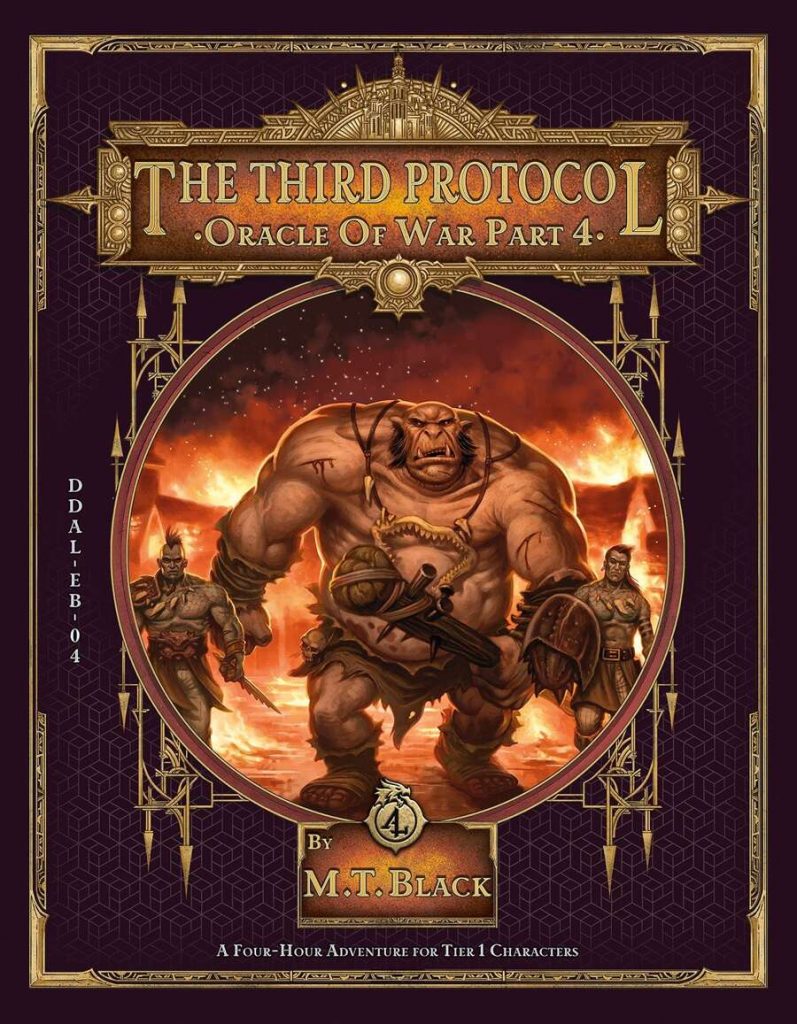
The Oracle of War has been recovered from the Mournland. Its creators respond by activating the third protocol, an instruction to recover the device and eliminate all who know of its existence. As night falls, a posse of assassins step off the lightning rail with orders to raze Salvation to the ground and retrieve the Oracle. T
This thirty page adventure uses eleven pages to describe a cat and mouse combat situation in a small town. The series begins to pull at the seams as the if-then’s on previous events begin to get complex and inconsistencies begin to multiply. It does an ok job of presenting an environment, but could be significantly better in how it arranges the cat and mouse play. I expect better.
The newspaper handouts continue to be a standout with this series. It presents a kind of frontier/western small town of scavengers very well. Reminds me a lot of Deadwood. I want to adventure in this place.
The town is under attack from a group of assassins and the players have to sneak through it, finding advantages and taking out the NPC attackers one by one. NPC’s give hints on where to find advantage while the party attempts to take out the attackers one by one.
Four adventures in and the series is starting to pull at its seams. There are a lot of previous events that the players could have participated in. This results in a lot of if-then statements. If the paty did X in a previous adventure then Y also happens, and so on. These take up a decent amount of space and feel a little perfunctory.
Logical inconsistencies also creep in, as well as lost opportunities. A huge pack of death dogs prowl outside of the town and attack anyone who tries to leave, wich serves as a good example. If this had been foreshadowed in earlier adventures then it would have come off better. Likewise, the sheriff of the town, which the party has had little to no interaction with and is seldom mentioned, dies very early in the adventure, off screen. Without any sort of bond to him it lessens the impact. And your series ally, Kalli, who is listed as loyal to a fault for her friends, betrayed you in the last adventure. But f you write her a letter she appears outside the town to make up with you. How did the letter get to her, since you’re on the way to town? Who knows. The letter thing is a good idea, but the timeline just doesn’t support it, since you start on your journey back in to town. It was a perfunctory addition to the end of the last adventure and is a good idea, but the adventure just doesn’t support it.
I’m left to wonder just how much planning of the story arc goes in to these beforehand. It would be much better, running it as written, to wait until the entire thing has been published, buy them all, and then plan out a campaign. But then you wouldn’t be playing week to week as they come out, as the AP is intended to be run. And you’d have to do a lot of work. Getting these things written beforehand and then doing an edit pass on them and THEN releasing week by week would have been a better release methodology and resulted in a more integrated and natural adventure, since the foreshadowing can be done right. As written, things just happen without the full payoff. Foreshadowing the death dogs, a chance for the letter to be delivered, better integration of the sheriff and the town elements, etc.
You enter the town, go to the market and have a couple of fights to get the artifact back and/or try to sell it. Then the assassin gang shows up on the train and yells for you to give the artifact over to them, or they will start killing people. And they do, every ten minutes and then every minute at the climax. That’s good. There’s no focus on it, and guidelines could have been better, with more detail, but it’s a decent idea for an event timer.
The map of the town is simple line drawings, with a p[layer handout with locations noted by key, but it also would have been better if the town building labels would have been put on the buildings in addition to the key. It’s a more natural way to present the town key. “Whats next door?” well, let me consult the key … Likewise the NPC summary table at the back is ok; it’s got some good entires that describe a personality or goal, but also has a lot of bad ones with just facts like “retired adventurer” that doesn’t focus on actual play.
It’s nicely cross referenced, but there are some misses, like referring to “the provisioner” instead of listing his name. That mean that, during the conversation, you have to go look up his name.
The specificity is an issue. The adventure does well when its specific and is less well when it does not. One dudes got wolverine claws that he scrapes along buildings. That’s good. Another possibility is the characters come in to a shop and it has one of the assassins drawing the shopkeep in a tub of water … a shopkeep that then will assist you. This is all great and the adventure could have used more of it. A short little table for each of the (solo) assassins that has them doing something despicable or some such, for the party to interact with. That would then present the town key and support the DM in running the more free-form environment tha the adventure is trying to achieve. (For the second time in this series … episode 2 also had the party sneaking through a town tryin go take out overwhelming odds.) A little advice to get the townspeople on your side would have been nice; as is they all wait around to be killed.
In another part of the adventure, before the assault, the party is at a market, with three shopkeeps, but only the general series overview of the shopkeeps is presented instead of a better “this is how they react to the situation of the party trying to sell the box.”
This feels like multiple authors were involved. The first chunk is more disconnected and has most of the consistency and if/then issues. The main section is better put together, and has the specificity that there is. That main section could have used a better edit to take care of what issues there are, while the first chunk is terrible. I assume that part was done by some “guiding hand.” A guiding hand that need to find a better way to preset things. A MUCH better way.
It’s better than the AL stuff in the past, but that’s not saying much. I expect better of MT.
This is $5 at DMSGuild. The preview is six pages. The last two show the kind of mess of the first chunk. A better preview would have also showed an encounter description or two from the main adventure chunk.
by Carlos 'the Rook'
CASL Entertainment
OSRIC
Levels 5-9
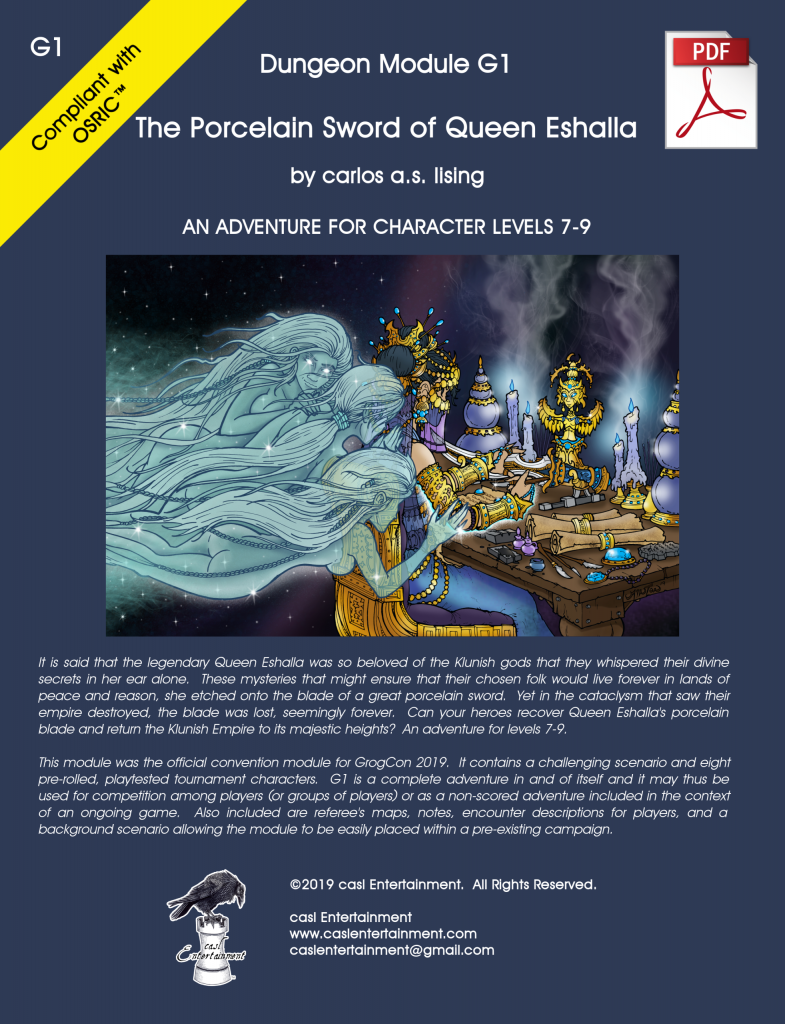
It is said that the legendary Queen Eshalla was so beloved of the Klunish gods that they whispered their divine secrets in her ear. These mysteries that might ensure that their chosen folk would live forever in lands of peace and reason, she etched onto the blade of a great porcelain sword. Yet in the cataclysm that saw their empire destroyed, the blade was lost, seemingly forever. Can your heroes recover Queen Eshalla’s Porcelain Blade and return the Klunish Empire to its majestic heights?
Ok, so I tries. I tried to find something that was not a journey into a nightmare, or high level, or had a zoo with rust monsters in it or had “9 gnomish monks riding off to save …” or finding monster pets for kids in a city or was high level. I ended up settling on this thing, even though it’s a tourney adventure. It doesn’t look like there’s much mainstream and it’s mostly tourney/con/gag stuff.
This 62 page adventure contains a 21 room linear dungeon described in about twenty pages. The rooms really do take up about a page each, on average. That means long read-aloud, longer DM text, details history and backstory for everything, no matter how simple. The overwriting in this is to an extent I have seldom seen. This adventure is unusable.
Opening it up, the first nine pages are a massive Massive MASSIVE wall of text. Just about non-stop two-column. I counted ten bolded headings, which averages about one per page but they are clustered together. This is all background, introduction, more background. Still more background. Notes for the player characters. Notes for the DM, notes for convention play, and then multiple multiple multiple campaign notes.My main takeaway, I mean after recovering from the stunning effect of nine pages of text, is wondering why “im a caravan guard for a group of religious pilgrims” is still relevant when I’m a level 9.
The first read-aloud is three pages long. THREE PAGES. And then a page of DM notes all related to the players accepting the hook, in a tournament module made for convention play.
There is then about a page of details on an overland journey, which involves two wandering monsters tables for “Plains” and “Arid Steppes.”, consisting of men and possible humanoids. That’s it. Humanoids. Anyway, that shits for campaign play. The tourney starts at the dungeon you are travelling to to get the magic item to save the kingdom. Ok. dungeon starts on page sixteen.
Read aloud for each dungeon room is MASSIVE. Dm text for each dungeon room is MASSIVE. It takes a long paragraph to note that the dungeon is unlit. And then other rooms also take a long paragraph to tell us that they are unlit. It takes a paragraph of DM text to tell us that the stairs in are steep. And of course it has to also say that it has no game effect. This is a common issue in adventures like this. They do all of this build up, taking a long paragraph to describe a set of steep stairs, and then tell us that it has no game effect, since they’ve spent a paragraph implying that it does. There are multiple things wrong with this. First, just describe the fucking stairs. Stop flagalating over them. Then, just leave it at that. Do you need to tell us that the air in each room is not poison? Do you need to tell us that every 10’ section of floor is not trapped, over and over and over again? All this does is pad out the adventure text and make it FUCKING. IMPOSSIBLE. To wade through while at the table running it. Every adventure is, first and foremost, a tool to used by the DM at the table running it. These long sections of text bloat make it impossible to do that. When people complain about adventures they ALWAYS complain about how hard they are to prep and use. It’s because of overwriting. Not like this adventure, because this adventure takes it to an extreme seldom seen before even in the annals of Dungeon Magazine.
Each room has to drone on in detail about what it was once used for. It’s generally the first paragraph of DM text. You know, the single most important thing in each room? The thing that tells the DM what is going on so as to orient them? Not in this one, in this one it’s backstory for the fucking room. God, I fucking hate this shit.
Massive read-aloud. Massive DM text. Backstory upon backstory. How bad does it get? Room two takes two pages to describe because it has six statues in it, four of which attack. You gotta have extensive backstory for the room, extensive descriptions IN MASSIVE DETAIL for all of the statues. For a room in which, like, four of the statues attack and one hides a secret door. This ain’t how you run a railroad.
And then there’s the explaining. The trapped hallway has three book spells in it. First one goes off to lure you in, then another, then another. This careful construction of room effects through the use of chained spells is indicative.
The evocative writing in this, generally the read-aloud, is not in and of itself bad. It avoids the use of words like “large” and “huge” and “empty” and instead chooses more descriptive words and does an ok job of creating an evocative description of a room. It just does so with a number of words that is WAYYYYYY too many.
I don’t know. This one can’t be saved. It’s likely that the others in the series are written similarly.
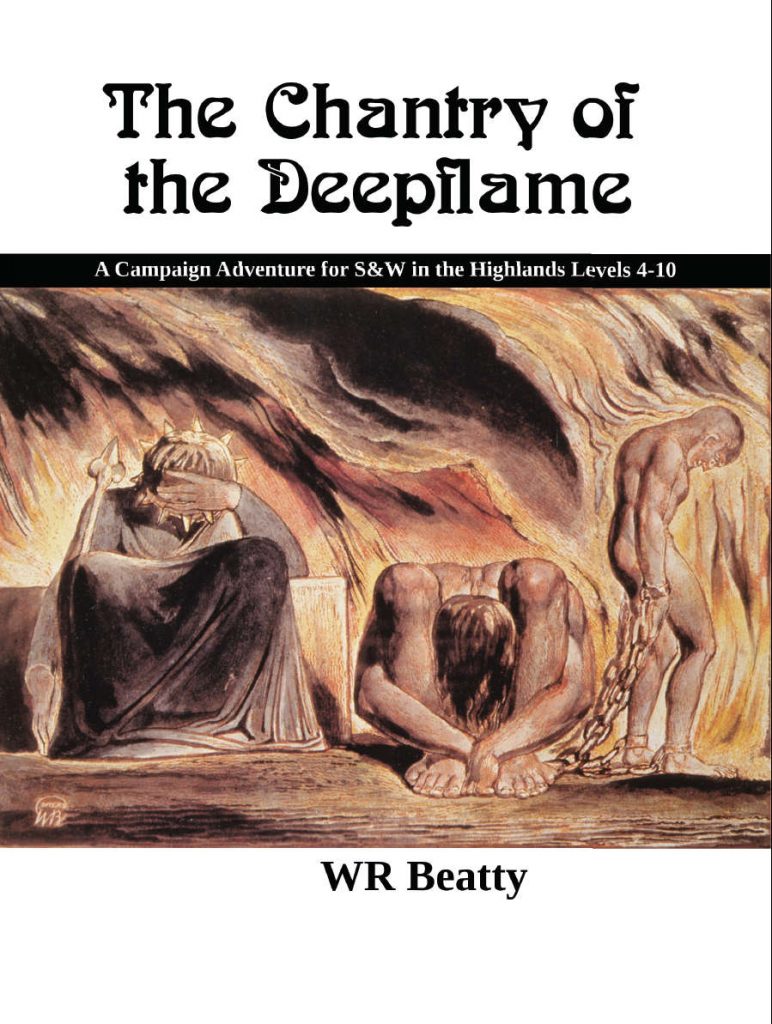
A legendary Dwarf temple in the Endless Mountains, north of the Rosewood Highlands, The Chantry of the Deepflame was abandoned generations ago when a plague decimated the Dwarf people. Now overrun by a particularly nasty tribe of Goblin-kin in service to their powerful Godking, the Chantry ruins call to the brave and the foolhardy, treasure seekers and glory-hounds who will surely find what they seek in the dark and crumbling ruins of this once glorious Temple.
This 244 page adventure is a fairly well done description of a moria. The above ground portion/wilderness journey is confusing but you can tell it’s magnificent in its scope. Below ground, also, is great in scope, and more comprehensible. Writing can be long, though whitespace and bullets mostly help. The writing proper can be a bit on the dull side and the interactivity feels a little combat oriented, maybe with some faction play roleplay elements. Puzzle-ish/things to mess with feels sparse. Reworked, it could be quite an interesting achievement. The closest thing to this would be that big harback Rappan Athul
So, it’s a big underground dwarf complex, with “deeps” and is full of goblins/and their ilk. Also, they are ruled by a balrog-like thing. Also, some of them don’t like being ruled by that thing. Also, there’s an entire area ABOVE moria that is pretty damn large and complex, which adds to the complexity of the place. Also, that portion feels like a confusing mess.
This thing. I don’t even know how to start.
Ok, so, to get to a moria you have to travel to it, right? And it sits in the mountains, right? So, obviously, there should be an overland journey, right? Well, there is one in this. Tunnels, cliffs, waterfalls, bridges, towers, keeps along the way. There are, I don’t know, a dozen maps pages all related to the “overland’ journey? And even after studying things for half a day I still don’t really know how they all work together. There are two primary overland “overview” maps. One is hand drawn in pencil and scanned in with computer-added numbers. It’s legible, but you don’t really get the sense of the topography. Another one is in full color and show the landscape well, from a kind of iso-metric view. I’m STILL not certain is they are meant to show the same places? Maybe? Then there’s all the sub maps. I have no idea. I have no idea how they fit together. I have no idea how they go on the map. The maps themselves range from little hand drawn things, to nice cave and dungeon features drawn on them, to complex maps with no numbers on them that are then textually described. The map variety is great, both in features and some elevation/fitting together and overall complexity. Things are substantially better once the action moves in to moria-proper. I feel like, inside, I can keep a better handle on how the mpas fit together and work together. The variety and complexity is GREAT, that much is immediately obvious. But man, it needs a serious re-work for comprehension, in how it all works together. That’s MOSTLY an issue with lack of summaries/overviews in the text, but the titles for the maps to help contribute to the issues . “Area ten map two.” “The Riverwalk.” Uh. Ok. I have no clue.
The sections really needs a little more overview and or summary attached to them to aid in comprehension, how they work together, and how they are to be used. As is they feel like stand-alone vignettes. I mean, they all are related to the ongoing goblin situation infestation, and have some inline notes about warning other/other areas, and their relationship to the whole, but HOW the specific area fits in to the whole seems to be missing. Or, maybe I’m just still bitching about how the maps fit together?
It feels like the outside portion was written at an earlier or later time than the core moria-part. Even the formatting and layout looks different. The outside section is extremely bullet point heavy, in fact so much so that I’d say that IS the format chosen. The interior portion is more of the traditional paragraph form with decent para breaks and use of bolding (for creates, mostly) and bullets to highlight lists of things. Both are fine, in theory.
In this case it seems more like a fire and forget writing attempt was made with little to no edit for better comprehension and usability. Things are bullets that I would have combined with another item, or things are included that could have been left out. The ORDER is generally ok, with most obvious things first, but it still feels like the writing is substantially more expensive than needed. Simple encounters take a quarter column while an entire page is not unusual for some.
In spite of this length there are still comprehension issues. I mentioned the lack of summaries/overviews, and even map connections are an issue. The first “underground” portion that leads to moria ends with room 18. The map shows a dead end in that room but the text says it can be approached from either direction. It implies, as strong as possible, that moria’s that-a-way, but it doesn’t tell you where or how it links up. In other areas entire numbers are skipped over. Basic, basic editing issues combined with the lack of a “agonizing cut” edit combined with alack of an edit to add to the evocative nature of the descriptions.Large chambers abound,
Other things left out include general notes about a rebellion, with most of it being left to the DM to wing, beyond some rough “factions alliances” data. Given the degree a rebellion is name dropped then a page of how it throws down would be nice.
It does do a great monster stat sheet. Wanderers are doing something. There’s a NPC summary section well laid out. Treasure decent to good both in new mechanics and in descriptions. There’s even a “shit going down in Moria” table, like, the watcher in the water is loose in the dungeon and how the goblins react, etc. Great emergent play possibilities.
But this needs a hard hard edit. One for comprehension, one for usability, one to punch up the writing. AT its bones this is a really really great environment, but you’re gonna have to study the outside, and take copious notes (on at least reactions) inside in order to run it. It DOES approach mega-dungeon territory in it’s size, or at least “major campaign tentpole” and thus putting some work in to it would yield repeated results.
Look. You can actually see me try to waffle on this and talk myself in to it. The ideas here are great. Some of the interactivity and setups are magnificent. A little combaty, but still great. I really really really want to like this. And maybe i DO like this, at least in theory. But I can’t see myself ever actually running this. It’s going to be too much effort for me to prep. It feels almost like a first draft, in the quality of its writing. (Layout wiseiots ok.)
This is $7 at DriveThru. There’s no level range anywhere in the description, but at least it’s on the cover. The preview is seventeen pages. You get to see the first underground area, the bullets, the writing style and layout and quality, the unnumbered keep map, and “the crevice”, which Istill can’t figure out how it works. This is a good preview of those sections, representing the quality of what you’re getting. It doesn’t show “moria proper”, and as I said I think things improve quite a bit there. You could buy it just for the insides, but you’d loose all that glorious outside, and still have prep issues.
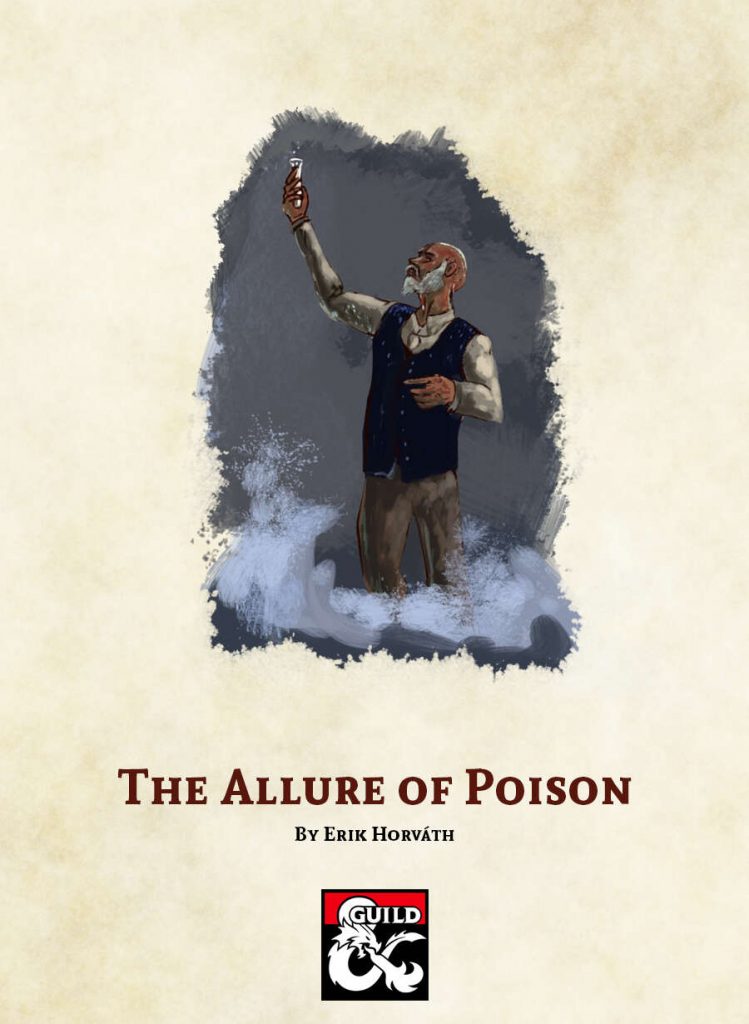
Meet Navo Purebrew, a master distiller with a new way of distilling spirits. But when something of extraordinary quality is produced it is bound to draw in trouble. Navo could never have imagined that trouble would find him in the shape of a huge elemental spirit made up of his very own beverage. Visit the renovated chapel / bath house of Sharess, deity of indulgence, and help navo defeat this power-drunk creature alone.
This twenty page adventure describes a three level site with about twenty rooms. Mixed read-aloud and long DM text could be much better. Much. The designer is a reader of the blog, soon to be former reader, and asked for a review. It’s really that simple.
Genre warning: this ain’t my thing. Quest dude made friends with a genies, was given two water weird helpers, who in turn have a bunch of kua-toa buddies who show up? And dude lives in an abandoned temple to the god of hedonism, which he’s renovated back to perfect form? I don’t think my preference in this area impacts the review, but be aware.
There’s a magic ring of protection in this that is in the form of two arms hugging. That’s good.
You come across a drunk man on the side of the road. He says ice and water monsters have invaded his home. Could you please? There is no reward. I understand that, no matter what happens, the players are having this adventure tonight, but, still, just a bit more a pretext would have been nice. The outcome is the same, the party goes on the adventure, but I do prefer not pushing the suspension of disbelief this early in the adventure.
Many of my reviews concentrate on the read-aloud and DM text, and this review will be no different. There’s a basic usability issue that most DM text and read-aloud make up the primary cause of. The ability to quickly scan the adventure and find the information you’re looking for, at the table, is what theis scannability enables, when the DM text and read-aloud is done well. Further, the read-aloud generally touches both in interactivity and evocative scenes. Done well the adventure is joy and done poorly it comes off as bland. Using words, as this adventure does, like huge, and such. Unbearably strong smells, and looks of horror on peoples faces. These are boring words and descriptive text that features conclusions rather than descriptions. The read-aloud also has a touch of that overly flowery and conversational style that one associates with novels rather than adventure read-aloud.
DM text is similar. It tends to mix in background information and has a conversational style that adds little to the adventure. East is the seating area and west is the entrance room, just as the map shows. This room used to be … and this room held a battle between X and Y. Mixed in to the middle of all of this is a great sentence: Tiny ice shards cover the floor and blood is sprayed across the southern wall of the entrance area. More like that, please, and less background and trivia and needless padding. “This room shows signs of a battle” No, it doesn’t. It has those little ice shards and blood splatters. “Before you stands …” No.
A noisy room is hard to hard in advance. Brush that is meant to hide a wooden fence, and provide an actual in play obstacle, is not shown on the map and only buried in text. Bullets points are used … in the initial adventure background information, where it’s not needed and paragraph form is ok. But then the rooms, where it would stand out, it’s not used. Weird. It’sd use in NPC information, the quest giver is good, but that’s essentially it.
Other than that, how was the play Mrs lincoln?
This is Pay What You Want at DMsGuild with a suggested price of $2. The preview is six pages and shows you the intro and a few of the encounters, so, good preview.
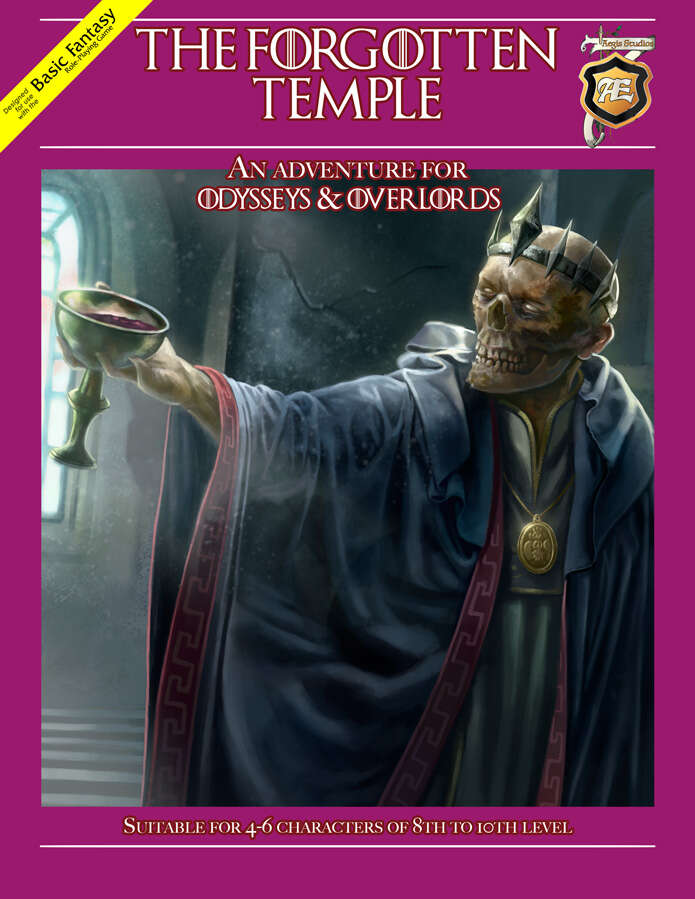
[…] Pravus was a dedicated follower of Ragnar and decided to keep hold of the temple. Pravus and his fellow priests headed under the temple to wait out the war and maintain prayer to Ragnar. With continued dedication to Ragnar, the god bestowed upon Pravus the knowledge of a ritual called Everlife. The Ritual of Everlife was a guarded secret that wasn’t widely shared with mortals. This ritual grants priests that Ragnar deemed worthy the ability to gain an everlasting unlife to continue their worship.
This fourteen page adventure features a two level temple complex with nine rooms, three above ground and six below. It has a couple of gnolls up and the usual shadow/wights/lich below. It just seems like someone wanted to write a short adventure with a lich in it. The read-aloud and DM text could be the platonic example of how to not do things.
I don’t know what to do here. It’s coherent; I guess that’s good?
Yet Another Abandoned Temple. And a small one at that. Your level eight party is going to kill seven gnolls, to start with. Is that a challenge? Do you even try at this level or do you let your torchbearers do it?
The upstairs is a ruined temple with three rooms with those seven gnolls in it. The adventure, proper, is behind a secret door. The entire adventure of six more rooms. So you won’t be going on the adventure unless you find the secret door. Which means that if the party doesn’t find the secret door then the DM is going to fudge the roll and let them find it. Which begs the question: why have a secret door? Don’t put your fucking adventure behind a die roll of any kind. You have to succeed on a spot/secret door find/negotiation/diplomacy in order to continue the adventure? Don’t do it. A treasure room at the end is one thing, but the main fucking adventure? No. This is bad design.
The DM text is full of useful information like “The characters can arrive from any direction and at ay time of day.” I am now empowered. It’s full of things like explaining what an ossuary is, what it was used for, how it was used, and other trivia that has no bearing on the actual play of the game at the table at all. It’s nothing. I’d say it gets in the way of the useful data ut I’m not sure there IS useful DM text. It’s just a monster listing, that attacks when you open the door, and some treasure, separated by the background trivia.
The main baddie, the lich-priest, granted eternal life by his god for being a good worshipper, lives in a locked room behind a metal door, with the key to open the door in another room. Why s the main priest, granted unlife by his god for being a faithful worshipper, locked in his room? Who knows. As in, I’m not looking for (more) backstory here, but the set up makes no sense. Why would he be locked in?
Gnolls grunt and yelp at each other upstairs, according to the read-aloud. Given the ruined nature of the temple, with no roof and broken down walls up top, shouldn’t we be able to hear that before we enter their “room?” Noting things like this, things that impact other areas of the dungeon, in their own room tiks me off. It shows an lack of thought for how actual play works. People listen. They hear things. This shit needs to be noted elsewhere, or on the mpa or something. If you’re in a 1000 floor wide cavern and something as bright as sunlight is glowing on the other side then you don’t wait until you get to the other side’s read-aloud to tell us there’s a light in this area.
But, the read-aloud. It is, perhaps, the most magnificent ever. You get evocative writing like “this large area …” to describe a room. Don’t use common adjectives and adverbs. English is a very descriptive language. And you can steal words from other languages. And you can make up words and use them in wrong way. You can do ANYTHING to get your vision across. Was your vision really as boring as the word “large” implies?
The read-aloud is quite bad. It explains backstory that the characters would not know. It provides details that should not be provided. “When the temple wasn’t in ruins, the lower level of the temple was used as an isusuary for patrons and a crypt for the priests.” What the fuck is this? Is that what the party is experiencing right now? A monologue from a lecturer? Another room goes in to detail on what the party sees, what frescoes look like, their damage, detail on what statues look like. This DESTROYS interactivity in the game. You provide a general overview, then the party follows up with questions, searing and examining the frescoes and statues. Of you tell them all of this up front then there’s little reason for them to look at them further. This back and forth between the DM and players might be THE key mechanic in a RPG, and yet these sorts of overly-descriptive read-alouds destroy that.
Let’s see, this is four to six characters of levels eight to ten. Let’s say five level eight characters, an average of, say, 120,000 XP needed for level 9, each. The haul from this adventure is going to be about 15,000 in gold, divided five ways, that’s going to be about 3000 XP per adventurer. If the party goes on forty more adventures like this then they can make level nine! So, look, I know. Walter wanted to put in a cleric lich and worked backwards from there, to a short adventure Travis would publish. But it doesn’t work, not in a campaign.
This is $2 at DriveThru.There’s no preview at all. Why would you deserve a preview? So you can determine what you’re wasting your cash on beforehand? I think not!
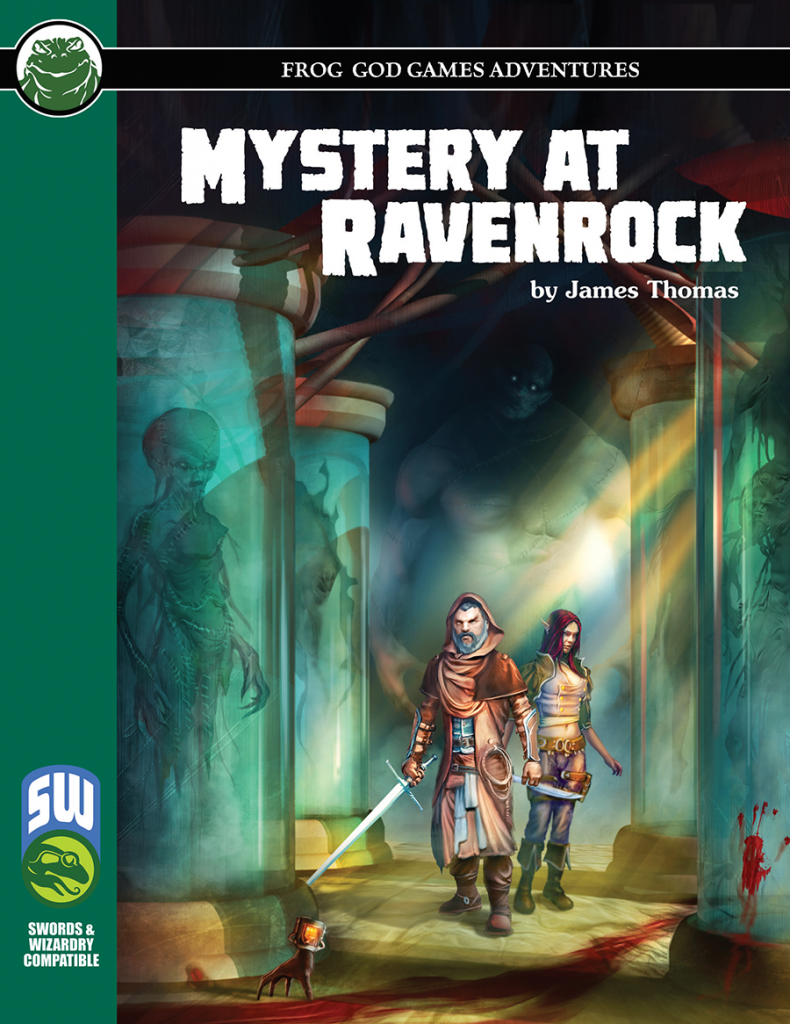
When our heroes return to Ravenreach all is not well. The castle is in lockdown and the town hasn’t heard from anyone there in days. Worse, our heroes learn they are wanted for attempting to assassinate the baron. Sneaking into the castle through a secret entrance at the bottom of the hill they find a way in via a slippery sewer drain. Snaking up through the dungeons below they unearth ancient secrets, encounter deadly monsters, nasty traps and twisted abominations. As they piece together the sinister plot to frame them, the party must take care to avoid killing friends while fighting foes as they navigate through the dungeon and castle. At last they encounter the usurper and his guard of monstrous henchmen for a final boss fight!
This 24 page adventure is a tangle of forced combats, ineffective read-aloud, long DM text and, of course, no treasure. Because it was probably a conversion. Great art though.
I try to learn something from everyone I’ve worked for. I once worked for a guy that was utterly incompetent in everything he did. But he still managed to get an AVP job and hold it for almost two years. So, you can be totally incompetent and still succeed. Why is this relevant in a Frog God Games review, you might ask? At least they use different covers now. Also, both the layout and cover style have been refreshed sometime recently. They are cleaner and easier, nice job! The art in this is really top notch also. It’s quite evocative of the scenes, from the cover to the interior art. And it seems to walk a line in art styles that I find appealing, not going too far in any direction without seeming to pander to a middle of the road approach. In fact, I’d say the art is the best part of this adventure, and I don’t mean that as an insult. Later on I’m going to comment on the mess of text the rooms are. But, the artists have taken that and really imagined the hell out of it. I would have NEVER envisioned that room on the cover that way. I doubt anyone would have. Except for Joshua Stewart. Interior art also, especially a scene with characters exploring a dead dragons cave by torchlight, skeletal bones in the background. Not actually in the adventure, I think? I think the text states the bones are elsewhere, but, still, nice art. Art art art. Are you sick of me talking about art yet? Well, what the fuck else nice am I going to say?
I guess the inn in town is done well. It’s described in about two sentences, which is about the right amount of text to describe a building in town. A small appeal to a description featuring animal pelts and bones and the two people that work there, with a couple of words on their personality. Just about the right length. And the rumors from the inn are easy enough to scan, using bullets. The adventure also does a pretty decent job in trying to integrate itself in to your campaign. Used as a sequel to another adventure in the series or as a standalone, there are bits of advice on how and why to do things to fit it in. And then, unfortunately, the adventure starts.
The maps a mess. It’s scattered through the book and I still can’t really figure out how the dungeon connects to the ground floor and first floor and reconcile it with the text descriptions. “They will come up in the great hall …” but it looks like to me like the dungeons connect elsewhere? I don’t know.
And all that “how to integrate the adventure” advice? It includes a nice little “if the party kill bob & Ted in the last adventure then they were Raise Dead’d to appear in this adventure.” Yeah. No. Seriously? Are they that important to the adventure that they show up again? It didn’t look to me like they were anything other just someone else to hack down. I guess there’s some “recurring villain” thing that’s appealing? But I remember a Warlord comic (fuck Conan. Travis Morgan bitches!) where Deimos shows up resurrected for one issue just to be killed again. Like, what’s the point? I mean, if Bob & Ted show up in EVERY adventure from now on, then, maybe, but the whole Deus Ex to shove in a villain … and then on top of it they don’t really do anything? Uh, no. Bad design.
The read-aloud can be long in places, going in to great detail. That’s not good. Read-aloud should be short, I’ve harped on that enough by now, but overly detailed read-aloud also takes away from the interactivity of an adventure. When explaining too much in the read-aloud you remove the players ability to go over and read the text on the wall, or see what the pillar looks like, and so on. Besides “A storm subsides as you row across …” is a lame ass style. It’s failed novelist syndrome. Don’t to this. Or, read-aloud that says something like “the carpet is worn away because of all of the fights the regenerating knights have gotten in to.” Seriously? How does the party know that? Was that a fuck up in the layout, and not supposed to be read-aloud? (Oh Frogs …) or just bad read-aloud writing? Also, who cares about why the carpet is worn if it has no impact on the adventure?
The adventure does this over and over and over again, explaining WHY. “This gold is the last of Evil Iggy’s treasure from his kingdoms down south.” So? Does that matter? No? Then why’s it included? No one gives a shit. And, all this background shit creatures a wall of text (Oh Frogs …) that makes it hard to actually use the room encounters.
You walk in to a room and things attack. This, I suspect, if the main conversion error from 5e/Pathfinder, the appeal to the linear dungeon map and “they attack!” sort of interactivity. And the light ass treasure haul. There is NOT enough loot in this for a part of 4-7’s. S&W means Gold=XP to level. Who the fuck does these conversions? Not that it matters, the level range isn’t actually in the product description or on the cover anyway, so you don’t know it’s for levels 4-7. But, hey, speaking of treasure, you, the DM, do get to pick out your own treasure because the designer can’t be bothered to select which scrolls to put in.
Your reward, if you save the Baron held hostage in the castle, is that he gives you 5k in gold. Ok, sure. But there’s no treasure vault in the castle. Where’s the 5k come from? Cause if it were here I’d have looted it. But, alas, no. Deus Ex. I’m not a simulationist. I think that shit sucks. But you gotta at least appeal to a light pretext.
Do not be alarmed. The new cover style, cleaner layout, and better art is not an alarm. This is the same old same old from the Frogs. When Zeitgeist gives it 4 stars you KNOW its not good.
This is $8 at DriveThru. The preview is five pages, three of which are worthwhile. You get to see one page of the maps, andone page each of the intro and the “hook” encounter scene at the inn. Those two are indicative of the writing. Imagine the encounters were in the style of the long-ass intro. And then, the inn encounter, with it’s two sentence inn and bullets, if the high point of the design and layout.
The forces of Law and Chaos engage in open war across the continent of Dorangar. Will your players choose a side or walk the tightrope between warring factions until harmony and peace prevail?
*sigh*
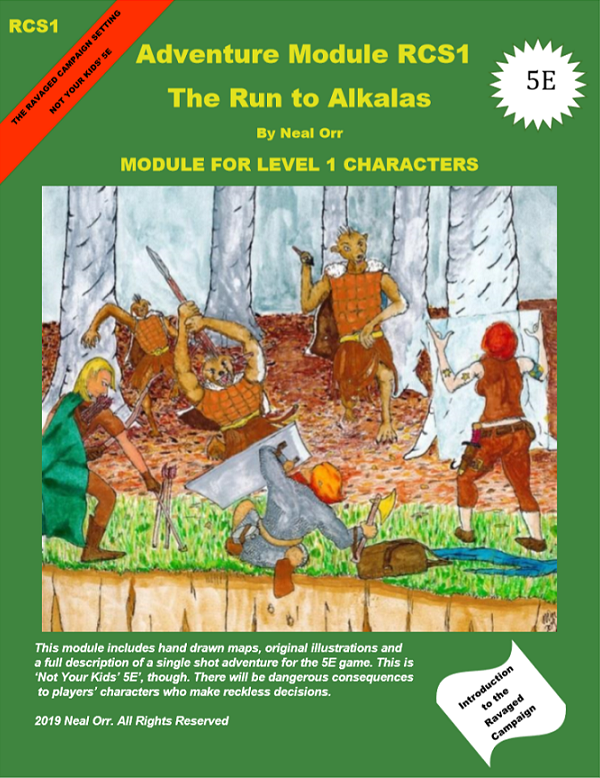
This twenty page adventure features ten-ish adventure locations, mostly in a cave. It’s full of page long read-aloud, first person read-aloud, and an emphasis on physical dimensions in the read-aloud. “Not your kids 5e” and “harken back to the days you remember of TTRPG’s” are the marketing lines used. Dis-a-fortu-nata-mente, it’s not the glory days that you’ll remember, but rather the 2e-3e era. It makes me rethink the choices I have made in life.
There’s a ring of regeneration in this. It lets you get 1HD of HP extra back after each short rest. And every time you use it it shortens your life by one day. That’s a fucking kick ass magic item! It’s specific. It has a downside. It tempts the players to use it for the bonus at the cost of something bad. I fucking love the tension it creates!
In short: you wake up in your army tent as your camp is under attack by gnolls. You run in to the forest and fall in to a pit that have a seven room cave and then emerge in to a bullywug village.
As I pondered my life choices that led me to this point I was diverted in to two other tangents. First, what is the breakdown of “I use numbers on my dungeon mamp” versus “I use letters to key my dungeon map?” What’s the percentage breakdown and what chooses one designer to pick letters over numbers? I mean, there’s nothing wrong with it (I think?) but I’m curious.
Second, I now know why lair dungeon are popular and they all have seven rooms! A revelation! Also, “PC stands for personal computer, I just got that” remarks Killface. It’s because that’s what you can reasonably get through in one session of 5e and everyone writes adventures for one session of D&D! I know, it’s fucking obvious! But, I just got it. It’s ok Megatron, I would have brought Starscream back also.
Ok, I’ve avoided this adventure enough now. It’s written in single column format. Single column is hard to read. SSeriously, studies have proven it! Your eyes have to travel ALL the way from the left side of the page to the right side of the page and that causes more eye fatigue than a two column format, as well as it being easier to lose your place as you track back to pick up the next line. Don’t use single column indiscriminately in your writing. It’s a pain.
The read-aloud sections in this are long. I mean REALLY long. Like, four or five paragraphs each. Or a page. Or a page and a third of another. In one long chunk. Players don’t pay attention to long read-aloud. They get bored. They pull out their phones. They stop paying attention. You get two to three sentences of read-aloud. Maybe four. That’s it. Again, there was a study. WOTC did it! They watched a bunch of tables in the 5e room at GenCon, iirc.
[It is, at this point, that regular readers will be complaining about the repetition of this point. It seems like every weekend, or even every review, mentions this point, in almost exactly the same way. I know the RA rule. Almost everyone who has seen this blog know the RA rule. But Neal doesn’t know the rule, otherwise why would he have done it? Someone once suggestedI just write some articles on it and just put in a hyperlink to it when it happens, but that seems unfair to Neal. Disrespectful. Yes, that’s right, I said disrespectful. I, the potty mouthed asshole, don’t want to disrespect Neal. Because Neal is different from the thing-that-Neal-wrote. Neal is not a bad person and deserves respect. Unlike the-thing-that-Neal-write, which is total crap. This is fun. Hey, am I actually a review blog? Am I really just one of those “don’t really talk about anything useful in particular” blogs, but I disguise myself as a review blog, all Cute Little Bunnoid On A Stump style?]
Ok, so, four or five paragraphs of read aloud, three sentences of DM text, and then another four or five paragraphs of DM text. And the read-aloud is in first person. YOU are dreaming that … YOU are listening for sounds. YOU open the door. This assumes the players have their characters do things. It assumes that they have written their characters a certain way. It takes away agency from them. It’ TELLS them what is going on instead of SHOWING them what is going on. I’d explain more but right now that “link to the article thing is looking for and more appealing. Also, I’m now out of whiskey. (Remember: contemplating life choices? And you thought I was kidding.)
Agency Agency Agency says Marsha Marsha Marsha. The read-aloud tells you that listen cautiously, even if you don’t want to. As you flee some attackers you don’t get to climb down a cliff, or be cautious, because if you do then more gnolls attack. You WILL do what designers script tells you to, or else you will be attacked! Shut the fuck up and do what he says! He knows best! Fuck you and fuck your players agency! Jump off the cliff in to the damn river like I want you to!
Read-aloud (why the emphasis on read-aloud? Because it makes up up a hefty chunk of the adventure, that’s why) also tells you that “the bulk of the gremlin tribe resides here” or that “2 gremlins rush to attack anyone emerging from the tunnel.” In the first, the read-aloud is revealing too much information. This is a conclusion and not information that the players would have knowledge of. By stating it explicitly you’re removing the uncertainty that drives the decision making inherent in the tension in an RPG. The back and forth between DM and player is what RPG’s thrive on and read-aloud that is too in-depth removes that. Second, I just don’t even know what to say about that other sentence. There seems to be a fundamental misunderstanding about read-aloud? Or DM text? Or … something else? “They rush to attack anyone emerging from the tunnel.” I guess maybe, in the Bryce taxonomy is sins, that’s abstracting a description? They should instead rush to attack when they see you emerge? Which is still embedding PC actions (But we were invisible!) in to the read-aloud, but at least it’s not abstracting it to some … fourth-person viewpoint? I don’t even know what to call it.
This is $2 at DriveThru. The preview is five pages long, with only two being relevant. Those two show you the read-aloud and DM text that is typical of the adventure. Not exactly easy to intuit that this is what the entire adventure is like, since it’s the intro scene, but, it IS what the entire adventure is like.
The sorceress Shar’Almana built a vault long ago to hide some magical items that her Lord had no use for, intending to sell them once her service was no longer needed. However, for unknown reasons, she disappeared and her Vault laid unclaimed for centuries.
Well, so, I guess the jokes on me.
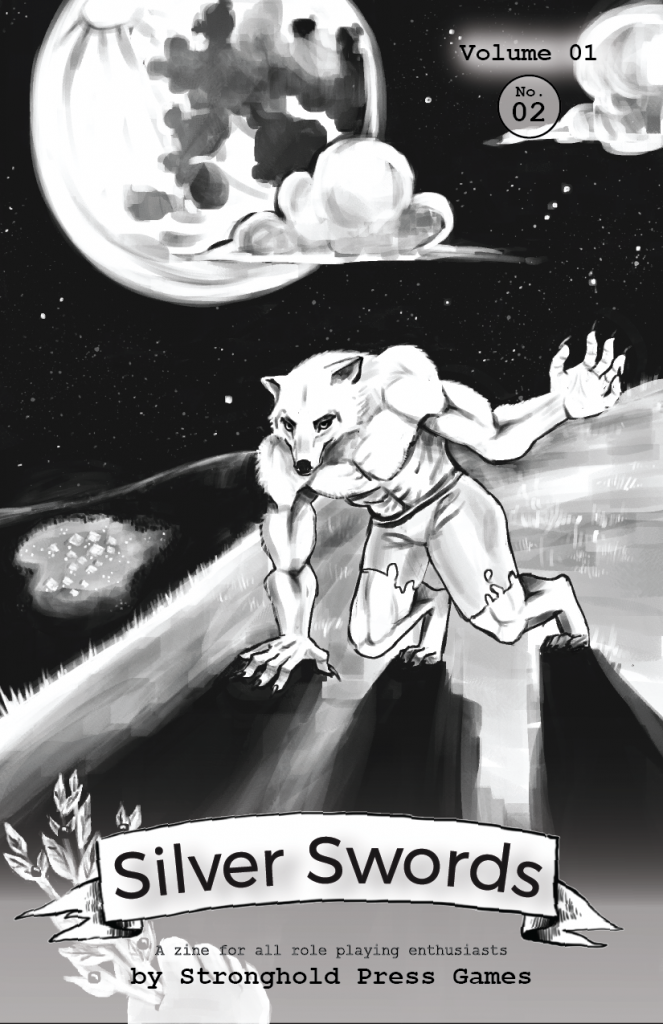
This is a review of The Secret Safe of Shar’Almana, an adventure in Silver Swords issue 2, a forty page digest zine. The dungeon has two levels, thirteen rooms over three pages (two digest pages having the keys) and … is minimally keyed with abstracted treasure. It is a non-entity. A nothing. One tenth of one step above Vampire Queen.
I’ve got an excuse. I saw that this issue had a setting where the Sun kills the Moon and the entire campaign world revolves around that. Arise fair sun and kill the envious moon! If you wanted to make the worlds best pessimist how would you start? Well, with an optimist full of joy. Duh. Of course.
The adventure here has nothing to do with that. That’s some other article. This adventure has thirteen rooms in a large font spread out over two pages, which includes the map on one of those pages and the intro on the other page. This leaves little room for the room keys. Never fear though, they are minimalist. Yeah, I know, I already said that. Hang in there. It will make sense.
The map is one hallway. There are doors off the hallway. Open the door and see a room. No other exits from the room. So you go down the hallway and open the next doorway. To the next room. There are several map styles that one could use. This one is, without a doubt, the worst possible. Yes, even lower in my mind than a strictly linear map. (Hmmm, maybe the “long hallway map” is a sub-genre of the linear map? I’ll have to think on that.) Anyway, the linear map at least can make the claim that it’s part of a plot based adventure and not exploratory and thus is aligned to the assumptions of that plot-based adventure. (Wrong! But it IS an argument that can then be debated.) THis don’t got that. It’s just a hallway with rooms hanging off of it. Minimally keyed.
How about that abstraction? Go in a room. Find a chest. What’s the chest have? The DM consults the text: “Give rewards appropriate for 2 levels higher.” Or how about “locked chests have at least 1 magical consumable.” Is it becoming clearer, now, how a pessimist is made? Arise fair sun and kill the envious moon! Oh, wait, it’s minimally keyed. Room 4. Goblin Warren. 4 goblins. [stats]. Yes, I feel all of the power of the poetry of the language exercised in that brief statement. The long line of adventures stretching back to Vampire Queen. Lo, I see them. Lo, they call to me!
Well, no. They don’t. It’s minimally keyed. They don’t do anything.
So, you’ve got rooms that have maybe seven or eight non-statblock words in them. And those words are abstracted, pushing the work back on to the DM.
This has two things in it. First, it has a talking brazier in the first room that is chatty and is you feed it 5# of food it will answer questions. Second, it’s got a room with shattered mirror glass on the floor. If you bring in a big mirror it shows a passage through a blank wall to the treasure room. You know, the one with a treasure 2 levels higher. That’s good content, both of them. There’s something fucking going on. It’s not described evocatively at all, but you can least see some interactivity there, a chance for adventure beyond “4 goblins.”
There’s nothing here. My inner child is, once again, wounded to its core. And I have only myself to blame.
This is $3 at DriveThru. The only preview is the little flip-book preview, which doesn’t let you see what you are buying. Put ina real preview, so we can get an idea of what we are buying beforehand!
FCA quality is not good. But the removable wrangler roof means that the tent access is through the INSIDE of the Wrangler since it’s a full Wrangler replacement roof. Ranger is 2 feet long, which causes me a little anxiety in town, but that also means 2 extra feet of storage space for STUFF. Wrangler will let me go more places and NOT having a Wrangler leads to some anxiety about “what if I can’t get someplace I want to go in the Ranger?!?!!?” Realistically though, I can probably get every place within my (non-existent) skill level with the FX4 XL Ranger? And, the Ranger is, I think, substantially cheaper? I’ll do the full cost breakdown today. You can assume KO2’s, winch, recovery gear, etc on both.
Yeah, that’s right, I just ended my shitty Dungeons & Dragons review is a #vanlife post. Suck it! (Are you a pessimist yet?)
The link to the product in this review is probably an affiliate link. If you follow the link and buy the product, I make some money. Just thought you should know.