
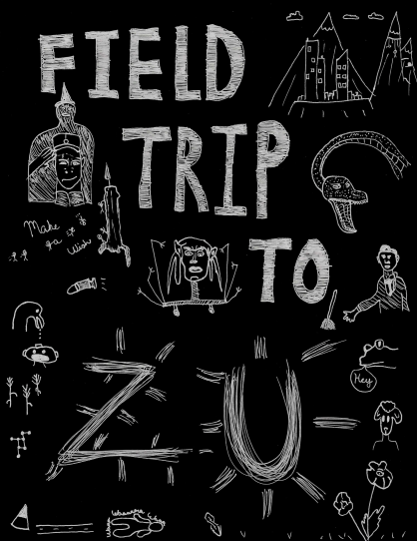
By Operant Game Lab
Self Published
OSR/Rovers & Riches
Level ??
Even the most ignorant children know the realm is divided by a massive, transparent wall. Everything outside the wall is “normal.” Everything that lies inside is “wrong.” The “wrong” lands are called Zu. Today, we take a field trip into strangest Zu…
This 35 page decently-sized hexcrawl adventure presents a bunch of hexes in Zu, a weirdo land full of bizarre things going on in a fantasy/post-apoc/PoMo mashup. The hexes can be interesting and are certainly creative, but they lack tension.
Let’s call this a farcical Rifts setting. A giant glass wall separates the Normal lands from the Weirdo place beyond the wall, which everyone calls Zu. There’s a break in the wall at Happy Town, to let you in. Tonally, a giant mecha made of junk is on the wanderers table and is described as “It powered by a dozen subjects running on human treadwheels. Six troopers (p. 24) with scoped rifles float from balloons lashed to the giant’s shoulders, poised to rain down leaden death.”
This thing has a niche audience and it’s not me. And I mean this in two regards. First, the setting. It might be closest to that 4e D&D version of Gamma World, the Paranoia Zap of gamma worlds. Those things like Troika and Mork Borg come to mind as well.There is a strong element of absurdity here, maybe even Theater of the Absurd if I get a little meta. There’s an old school with a janitor in it and a teddy bear that needs stories read to it. Or, a water slide aqueduct trickling water to an empty pool where cleric chicks covered in sponge suits dole out the water to bedraggled people standing in line ala Fury Road. Happy Town itself is ruled by a little twilight zone Anthony with a wand of transmutation who turns people in to stuff if she doesn’t get her way, so the people there only make candy and cakes and force smiles here in Peaksville. Tonally, you’re going to have to be ok with this kind of content being your game if you want to use this, and I suspect the more niche sides of the OSR are where this is aimed. You not gonna be happy with this if you don’t like zaniness.
I’m struggling to find a way to frame this second point. There is, in my mind, a difference in game play in certain systems. D&D, of the classic OSR style, leans more towards a game. You are typing to stay alive and level. There’s an inherent tension in that, and staying alive and leveling is ‘winning’ at D&D. It lends itself to campaign play well since there is continuity, your character. This is one of the reasons that ‘museum adventures’ are so frustrating to me; you are actively discouraged to interact, which works against what you are playing. Other RPGs fall more in to an Activity. Baron Muchausen is the classic example. Your enjoyment comes from something different. And that, I think, is where this adventure lies.
The hexes in this have two general types of encounters. First there are some filler hexes, making up about half of the hexes. Short, with only two-three sentences, they provide some flavor. A hex full of wines, walking through them wakes them up, and they feel the party members and pat them on the back before opening up to allow them to pass. Freaky? Absolutely. But nothing else going on.
The second type of hex, representing the other half of the hexes, take about a page or so each. There is more text and whats happening is more involved. But, i would assert, to the same end. There’s nothing really TO DO. Oh, you can get involved, but why? Touching things and getting involved brings trouble. And there’s not really anything to exploit, as one might in a traditional hex crawl game. If you were just trying to interact to have a good time then you’re chill, yeah, freaky things will happen. But no one is going out out their way to gack you (other than perhaps the wanderers) and there’s not really treasure to loot to exploit, at least in a traditional sense. Some of the hooks DO send you on the hunt for something. Happy Town wants you to go get a candle. Ok, so, I guess we can explore and look for that. SOme hexes ARE mentioned in other hexes, but they are not really interconnected, either explicitly or, I would assert, implicitly, in that you can, say, break the dam in hex X to flood the orc caves in hex Y, or some other wacky scheme that the party were to come up with. You enter a hex, have a wacky encounter, and move on to repeat.
For the more Activity-based RPG”s this is going to be a great adventure. I think it serves everything they need to get in to wacky situations. But for a more campaign/game based game I’m not sure its overly useful. (Not that you can’t campaign Mork Borg or Troika or DCC, but I don’t think it works out that way in practice.)
This is Pay What You Want at DriveThru with a suggested price of $5. PWYW and then preview is the entire thing, so good preview.
https://www.drivethrurpg.com/en/product/483434/field-trip-to-zu?1892600
This is not something I would ever want in my regular game. Just too strange. I could see placing this in an isolated area of a post-apocalyptic setting. I could also see this being interesting to run, as a change of pace, if the PCs in a regular game went through a portal and ended up here.
Otherwise, hard pass on the content
I hate products like this. Once the pretensions of fantasy are punctured all you have left is silliness.
You are wrong to hate this. Its just not your cup of tea. Or mine.
Lets save our hate for cynical and/or utterly incompetent slop.
Some people hate anchovies. But they’re WRONG.
🙂
Excellent review. Thanks, Bryce!
Checking out the preview . . . Wow. This really is something.
What we’re talking about here—the quality that is difficult to describe but is somehow lacking—is “player agency.” For TTRPGs (and video games, etc.), “agency” is the capacity and freedom of an individual or group to act independently and make their own choices—choices that have an impact or influence on the environment and creatures within it.
The key word is impact. It’s not just about being free to make choices; it’s about the impact those choices have on the game world.
For people who want to kill monsters and take their stuff, where parley is just a prelude to combat, this product is easily fixed: just salt in more antagonistic, malicious enemies that guard treasure. Boom. It’s great now. But this was never made for that crowd.
The problem is—and Bryce stated it clearly—even in a beer-and-pretzels game where relaxation and socialization are the main goals, you still need enough of an antagonistic force to create “agency.” Sure, you’re going to have fun without much agency because you enjoy spending time with your friends around the game table. Good GMs and good players make a good game.
But the product needs to facilitate that, and while this one might be a great sandbox with plenty of jungle gyms and merry-go-rounds for players to do as they please, it sounds like it’s lacking enough playground bullies to beat you up and take your lunch money.
The real and true threat of loss—be it PC death or otherwise—is what builds excitement. Thrill. Suspense. The highs and lows that follow the outcome of events in the game are what make TTRPGs great.
Losing your PC that you’ve played for the last 24+ weeks should feel like a kick in the groin. Slaying the chaos sorcerer to save the princess and kingdom should leave you with a buzz of exhilaration. If the bad doesn’t feel really bad, then the good won’t really feel so good.
It sounds like this one suffers from the same problem I see in a lot of these imagination-first products: a lack of a strong antagonistic force to create a drive in the players to interact with and have an impact on the environment.
Thank you for attending my TED Talk.
Can you tell I’m procrastinating? 😉
I’m going to hit “Post Comment” and not even read what I wrote! Haha!
“You are typing to stay alive and level.”
All too true, I fear.