
By Kirk Kahoe
Crimson River Games LLC
Generic/Universal
Levels: Any
Warning! This is as close as you can get to being a Heartbreaker without actua;;y being a Heartbreaker.
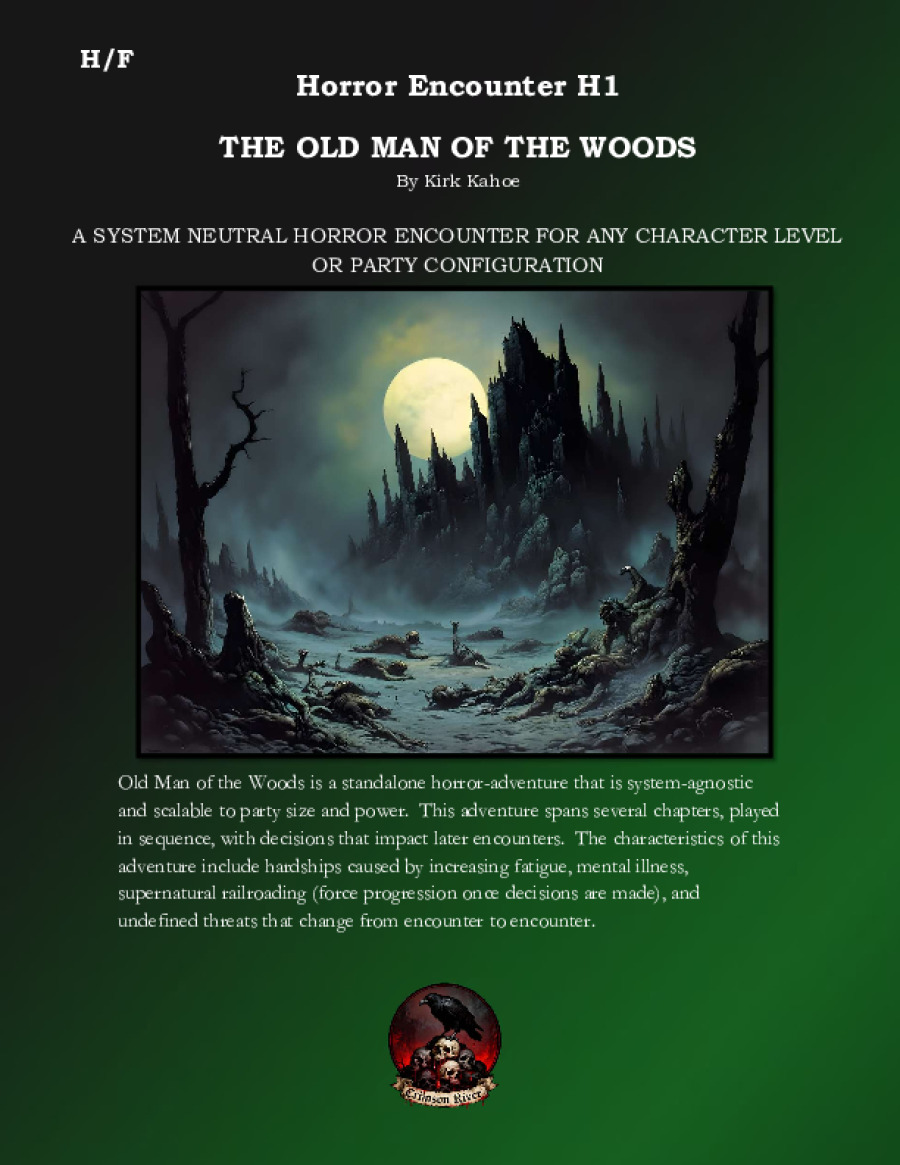
An eternal horror haunts the woods, reaping an endless harvest of woe from those foolish or desperate enough to travel through them. Tired and injured, the party will have to not only face an endless onslaught from the horror but fatigue and madness as well, for there is no sleep in the Old Man’s realm other than the sleep of death.
This 169 page adventure is an overwritten railroad in which the best solution is leaving the table to have explosive bloody diarrhea in your hosts bathroom and then going home. Ok, that was mean. It’s a 169 pages of railroaded atmosphere in which you have no choices to make as a player and the DM must wade through an excruciating amount of text to run even the simplest encounters.
Page twenty of the intro text tells the DM that they should Describe, not define and then follows this statement up with “A shambling and decaying humanoid creature that stinks of ammonia is scary. Labeling this creature “Zombie” and adding specific statistics is a game mechanism. It is thus no longer a scary monster but a set of numbers to crunch and probabilities to consider.” This is 100% correct. Not only does it follow the show and don’t tell mantra, but it adds that air of mystery that RPGs thrive on. I’m a big big fan of this attitude and it bolstered my spirits seeing it.
Oh! Oh! I forgot! You can get Hep! That’s right! Hep! That’s BAD AZZ! “So, what did I get? Another plague? Yellow squirting zombie fever or something?” “No, you got Hep.” Fucking christ ma! That’s great! I love it! Next time you roll through a village you find out 15% of them are dead from cholera. That’s nicely visceral and I do love a reaction from the players. Which, I might note, is exactly what the adventure is trying to do with its horror.
Great, I’ve said something nice, even if I did include the backhanded “page twenty” reference.
There’s a dude who is the only worshipper of a god and he’s constructed this obtuse parallel reality death trap in a forest to select sacrifices worthy of his god. As the adventure tells us “Due to the depth of role-playing required to deliver the Old Man and the complexity of fatigue’s impact on gameplay …” It’s a test/challenge dungeon. That’s it. 169 pages of test/challenge dungeon. You know how those things work. It’s an alternate reality blah blah blah, you can’t leave, blah blah blah, he controls everything blah blah blah. “In the event (which happens often) that the Old Man (or his copies) are somehow killed in any of the encounters before the final encounter at his hovel, he is instead fully healed and moved to the subsequent encounter.” Cause hes wearing this fucking ring that brings him back. Worry not, DM afraid the railroad will stop, “In all cases, the presence of the ring should not be noted due to the grime and darkness until the last encounter.” Ain’t nothing like having no choices that really brings home the immersion. Time and again we see this. This reliance on a test/challenge environment as a pretext for all of the setup the baddie has done. Time and again we see these mechanical contrivances, like the ring, used as an excuse to justify an effect. Time and again we see these railroads as an attempt to tell a story and get an effect. You can’t fucking do it that way. One of the keys to a roleplaying game is the ability to make choices. Once you take that away you might as well be watching a movie with a predetermined outcome. Sure, I can roll a die. Will the DM let me die or force me to suffer through the entirety of their story? Players check out when they can’t do anything. When they can’t make a decision. Sure, there’s a time and a place for “the RPG adventure as an Activity” instead of “the RPG adventure as a Game”, but, Baron Munchhausen did this a long long time ago.
In spite of the adventures words implying it’s a show don’t tell piece, it relies on mechanics and read-aloud to bring the horror, telling instead of showing. A fatigue mechanic. Mountains and mountains and mountains of read-aloud. No one wants to listen to your half page read-aloud man. You don’t set a mood by using a lot of read-aloud. Yes, the writing should be evocative, but it should not be lengthy. You get a few sentences, three or four, and that’s it. You need to really work those sentences to bring the effect, the impact you are going for. Yes, it is not easy. It is, I think, the hardest part of adventure writing. More is not better. Player attention drifts. You make it harder on the DM to focus. You can’t use mechanics to fill in either. Sanity, in CoC, is just another pull of hit points, campaign hit points, as to say. It is up to the designer to put something together that FEELS like fatigue without relying on mechanics to accomplish that.
So, yeah, railroad. The adventure starts at a little trade town. Caravans leaving, to go over the pass. Wanna join? SURE you don’t want to join? Ok, so, no, you decide to wait at the trade town over the winter? Ok, then bandits keep attacking. Eventually you see over a 100 bandits about to attack and the entire town, whats left, flee in to the hill. Along the caravan route. Heh. So, yeah, you’re going on the adventure. Then you’re in the alternate reality shit where the dude controls everything and you’ve got exactly one path to go on. Just follow it and make skill check after skill check as: there’s a rock fall. There’s a bridge collapse. The wagon is stuck. Blah blah blah. I don’t know, there’s about fifty locations, between the overland and like a manor and such.
There is an EXTENSIVE amount of information presented for each area. There’s a section for environment, then a section for topography. Then a boxed text section for the read-aloud, then a section for monsters/traps, then a section for encounter mechanics, then a section for notes, and a section for treasure, and a section for game master notes. There is EXTENSIVE repetition, which is great because with so much information, a long paragraph or more for each section, the area is then spread across multiple pages. There is NO WAY a DM can keep this shit together for a meaningful encounter. And this stuff is present for almost every area. Time and again, DO NOT use such a rigid format. Leave shit out if you don’t need it. Do NOT do shit like tell us the door, walls, light, smell, taste for each and every room. The purpose of formatting is to help bring clarity and help a DM when they scan the adventure looking for pertinent information. Used in mechanical fashion though, as it is here, is instead obfuscates and works against the goals it is trying to achieve.
It’s just weird, the way things come together in this. In one read-aloud section it says “They have knowledge of the mountains and what supplies are needed, and they can provide basic information about the mountain road. This sound slike DM notes, not read-aloud. And that’s not an isolated example, I’m not cherry picking. In another section there is a Treasure heading that reads “Treasure – Supplies from the abandoned wagons (See Treasure section).” Isn’t THIS the treasure section? (Turns out, no. It’s _A_ treasure section. FLipping to an appendix we can find a Treasure appendix with a listing for “Wagon Contents” which is full of mundane supplies.)
It’s just crammed with so much extraneous and repetitive information. And then the encounters are so humdrum. Oh, make a skill check! Ok, get a fatigue. Yawn. The final battle with th dude is anticlimactic as fuck. He attacks, eventually you drive him off. You find him in his hut and kill him there. End. Given this is 170 pages long and like almost fifty railroad encounters I would have expected just a little more in the way of flavour than a couple of sentences saying “he attacks you.” The horror element here just doesn’t work, hardly anywhere in the adventure. Mechanics and read-aloud doesn’t do it. The Hep C cant save an overwritten adventure in which the horror element is reduced to mechanics.
This is $5 at DriveThru. The preview is the first seventeen pages. Which doesn’t show any of the encounters because there’s a LONG intro and background info and so on and so on and so on. A preview needs to show some of the encounters so a buyer can make an informed decision about the purchase. That’s the purpose of the preview.
https://www.drivethrurpg.com/en/product/564568/the-old-man-of-the-woods?1892600
There have been occasions when I’ve been very successful at having a scenario follow an expected sequence because I knew enough about the players and their characters to push the right psychological buttons.
There’s no need for rails when people aren’t interested in changing course in the first place!
If I were to publish a scenario, then I would be in ignorance of the needful information. A preordained plotline in that context works only if the players are in the first place on board with that being what it’s about.
Spielberg and Lucas don’t pretend that we’re going to the cinema to play a game; they’re very frank about us being passengers on their rollercoaster (like The Outer Limits intro “We are controlling the transmission. …”).
Is it a game, or is it a passively consumed narrative? Choose one or the other, and save a lot of wasted words trying to solve a problem while actually making it worse!
The Narrativist School is not my preferred cup of tea, but it’s a sounder paradigm than the Hickman Railroad ‘Trad’ School.
Want both a game and a coherent dramatically structured narrative?
The make the game about the challenge of creating the latter, and equip the players with appropriate strategic tools. Their sharing of “authorial stance” with the GM (if any) works against the surprises, the kind of exploration, that a traditional RPG facilitates.
But that’s the necessary trade-off; you can’t have your cake and eat it. It’s like the difference between a combinatorial game like Chess and the closer modeling of war that necessitates hidden information and vagaries of chaos (and even of chance, in view of the abstraction of imponderables needed to keep a game feasibly playable if we don’t simply ignore them).
Fuck yeeeeeeeeeeeeeeeeeahhhhhh! I’ve never heard this song before! It must be needed after reading an adventure like that!