
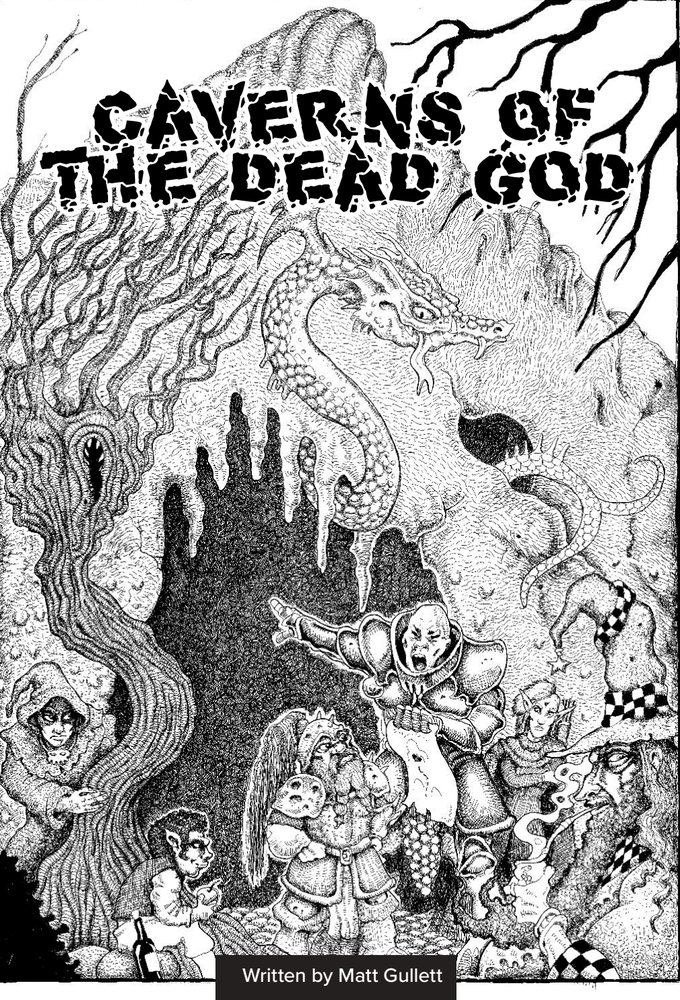
By Matt Gullett
The Long Con Press
OSR
Levels 1-2
The adventure starts in the rough-and-tumble port city of Warrenburg during the revels surrounding the imminent hanging of a notorious pirate. The Player characters are enlisted to explore the enigmatic cave system some locals refer to as the Caverns of the Dead god.
This 28 page adventure uses about thirteen pages to describe a cave/dungeon full of cultists who just LUV insects. It’s heart is in the right place with a decent amount of interactivity beyond stabbing, supported by a some weirdness and some good use of language in places. It’s lacking just a little in the setup vibe, but the major pitfall is layout nd the need for a HARD edit to bring the rooms in to better focus. Your highlighter is going to go a LONG way with this one.
First off, while listed as OSR, this is clearly a DCC adventure, down to Luck and other terminology. That’s not such a high hurdle, and I used to review many a DCC adventure before finding them a little linear. There’s nothing inherently linear in DCC though, and its nice to see a more traditional crawl trying to cross game system boundaries.
The setup here has some interesting qualities. We’ve got a town of 3,000 people which has swelled to 4,000 for some festivities: an infamous pirate is about to be hanged. At the same time a group of teenagers has gone missing, including the son of a local magistrate. Did I fail to mention the new priests in town who are giving out food and items to the poor? The swelling of the towns population gives a decent enough pretext to why the town isnt looking for the teens; a riff on the old “the kings armies are engaged with a neighboring kingdom” thing. The hanging and town swell offer a nice slice of life to the adventure and are great examples of specificity leading to things that the DM can riff on to add local colour. The hooks, or perhaps “quest givers”, also have a decent mix, from the magistrate to the sheriff to a do-gooder to a local worried that HE’LL be blamed if the kids show up dead. A nice mix of chaos and town “factions” I guess you could call them. Beyond the verbosity of the town/background section, my only complaint here is the lack of a few more specific situations for the DM to riff on during play. Hirelings and rumours are well covered, but a few street scenes would have gone a long way to helping reinforce the chaos of the town swell, the jubilant and chaotic atmosphere of the hanging, etc.
The caves are a relatively simple affair, in a mostly star layout on the map. Nice use of things on the map to lend information, like curtains and statues and the like, but noting lights and sounds on the map, as well as creatures, would save me the trouble of having to note them myself. Entry is through a hole with a rope, always a personal favorite of mine. Unrealistic, but fun! This also seems like a good place to note that the cultists inside don’t really have an order of battle. There is a general note that they will prepare for return expeditions and set traps, but nothing more beyond that.
Interactivity inside is decent. We’ve got status and curtains and porculii to mess with. There’s a spinning gizmo, like a gem, in one room, and a smokey archway in another. Riddles are present, which are NOT a favorite of mine; I like my riddles a little more engrained into the adventure and more subtle than the old say the answer thing. But there’s no question it’s a classical element. Also present is a gem inside of a skull … that you feel a certain compulsion to swallow. I think the last time I saw a swallowed magic gem was in, what, Dungeon of the Bear? Wonderfully non-standard! You do get your fair share of stabbing here, cultists and bugs, but this leans heavy in to the non-standard OD&D vibe. I wouldn’t want to say it goes too far down that path, but there is a sense of wonder here and there that I generally only get from those OD&D centered adventures.
Language use is generally good as well. It’s hidden, sometimes, in the verbosity of the entries, but you do really get the sense that a scene has been painted and/or situations have been brought to life. In one room, were you find captives, “The door here is barred. This darkened cavern reeks of the eye-watering smell of filth. A dozen gaunt, reeking individuals huddle here, shielding their eyes from your light as you fight back the urge to gag.” (There’s no real read-aloud here, in spite of the use of the word “you” in a couple of places. I’ll forgive it as poetic license.) The cavern REEKs. Eye-watering. Gaunt. Huddled. And then, with one of them, “wet, rattling breaths speak of imminent death.” Just a couple of words to really bring home an awful situation. The usual “captive are here” is done more with, and then a situation is introduced, tersely, and not elaborated upon. This is what specificity buys you. Not only a great mental image but also one that you can then riff on as a DM. And this is not a cherry picked example, the use of language can be startlingly good in many of the areas.
But I’m not going to recommend this. It’s because of the layout, formatting and editing. I want to give you a mental image. Imagine a full page of text that is all center justified. So you have both a wall of text issue and the center justified issue to contend with. Now, this is NOT what the adventure layout is doing, but I think it’s the closest mental image I can describe that relates to the issues. This is all a single column, which of course contributes to the issue. When a paragraph is a sentence or so long and it ends a word or three in to the newline then you get this weird effect that almost mirrors a center justify. Especially when combined with a CRIMINAL lack of blank lines to help separate thoughts and sections. Almost a complete lack of bolding, or other elements to help orient the reader and help them locate information. And then a certain verbosity. It’s not appears to be, or room histories or motivations or anything like that, except it is all of them, and more, contributing line after line in very small ways. Things that build up, word after word and sentence after sentence, combined with the lack of formatting and single column.
This needs a REALLY hard edit to focus in without losing the specificity and vibrancy hinted at, combined with some small efforts in formatting, bolding, white space and so on to call out aspects of the rooms, combined with nearly ANY other layout style. Were that done this would be a pretty decent adventure. As if, though, you’re gonna need a box of highlighters.
I am hopeful. The interactivity is decent and the language use, what I think is the hardest aspect of writing, is good. Layout and formatting and ruthless editing can be learned easily enough.
This is $9 at DriveThru. Alas, there is no preview. A good preview of a dungeon room or two gives potential buyers a chance to judge the adventure for themselves before purchasing.
https://www.drivethrurpg.com/en/product/566897/caverns-of-the-dead-god?1892600
I’m intrigued as to how you might feel, in general, the system might affect the feel of the module? I find I like modules written for OSRIC because it seems to have the AD&D 1e spirit. 1e being the system I like best. I’m not sure if it’s because it says “OSRIC” that automatically makes me feel positively about it before reading, or that folks have that system/spirit/feeling in mind when writing it.
I know some adventures are just plain good, no matter the system, but figured I’d ask if you get different feels for modules written for different system. Thanks!
> First off, while listed as OSR, this is clearly a DCC adventure, down to Luck and other terminology.
Is DCC not considered an OSR system?
No, it’s based on stripped back 3E.
“There is a general note that they will prepare for return expeditions and set traps…” Scant, yet indicative of an adventure written by someone who’s actually played, and “gets”, proper dungeon delving DnD, Matt Gullett seems one to watch.
DangerousPushon “Is DCC not considered an OSR system?” Duck before the “What is the OSR?” war begins!
It’s a genuine question though – why would DCC not be considered “OSR”?
You could maybe say that something like Pathfinder shouldn’t count as OSR because it’s more of an offshoot of 3e D&D, but Dungeon Crawl *Classics*? The system that was invented during the OSR heyday and prides itself on “returning to an older, original style of play” is somehow not part of the Old School Renaissance? That makes no sense.
I thought Bryce was talking about generic vs. specific. If it’s written for DCC then market it as such. If it’s written generically, easy to slot into most systems, then you list it as OSR. If you write it for DCC and then say that.
Of course that’s just my two coppers.
But “OSR” doesn’t mean “compatible” – it means “it’s like D&D but it’s technically its own thing that we modelled on older versions of D&D”.
If Bryce’s concerns are with specificity, then yeah – adding “DCC” to the labels would help. But calling it “OSR” is also not wrong, per se. It’s like releasing a module for 3e D&D under the label “D&D” – technically not compatible with other editions of D&D, but it’s also still a D&D module, you know?
Totally get you! I was just guessing what he might have meant. Though, specific to your example, I wouldn’t buy a module simply listed as “D&D”. But I’m one person in a niche of a niche, so it doesn’t matter much. 🙂
Specificity > generality.
If a module is built / statted for DCC, say so. If it is built for B/X, say that instead. Tell me (the potential buyer) what kind of work I am looking at to get this to the table.
I am currently running an OSRIC-statted adventure in (modified) OSE. The choice to take on the work is mine, and in places has been painful, but I knew what I was getting into. Since we can likely all agree that no one agrees what the OSR is, telling me it is an “OSR adventure” is meaningless. Instead, be specific. The people that know will know, and the people that don’t know, won’t know anyway.
Yeah. In the context of these reviews, I assume OSR means compatibility with 70s/80s DnD – the retro-clones and retro-hacks. If it’s say Shadowdark or DCC, it’s nice to have it pointed out.
I’m lazy, and happy to simply fudge most adventures into the system I want. I only tend to hit real issues with 3e onwards, where the underlining assumptions and mechanics really start to differ.
It’s now listed on DriveThru as ‘DCC, OSR’ so somebody’s been paying attention!
Yet still no preview- I’m on the edge of buying it as some elements fit but I like to check and see if it dovetails with my campaign first. Previews help sales!
Yes, that makes me unwilling to buy it as well. A good preview really is important.