
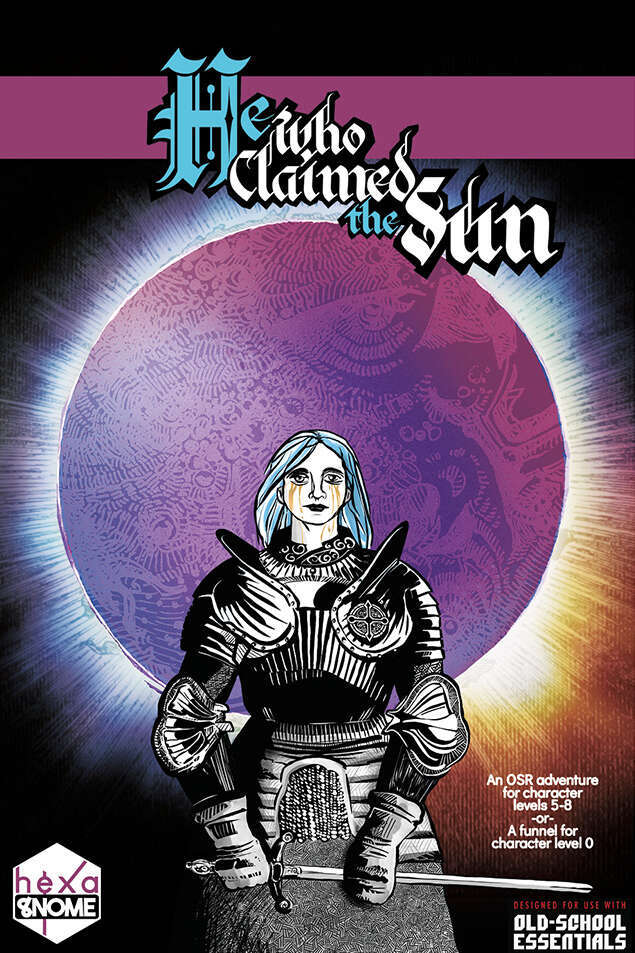
By Hexagnome
Self Published
OSE
Levels 5-8
When the One God’s faith washed over the world, the Old Gods of the forest fought back. They fought back with fire, with blood and with ice, and with every season. And they lost. Last night, the cathedral built on the site of their defeat burned, unearthing forgotten stairs… A journey begins, from that unholy crypt through a hellish fairy realm, to the deadly, blasphemous truth.
This 80 page adventure presents a recurring abbey location for your game world that turns in to a complex dungeoncrawl with campaign ramifications. It is deep, full of interactivity, and maddening in its presentation. This will require study and is worth it.
SPOILERS. Have I ever done that before? If you think you might play in this then maybe bail out now and try and get your DM to use this. I don’t think that’s my audience, but, hey.
To give you an overall vibe here, there’s a little designers note at the beginning that finishes up with “This was done for three reasons: its obvious, hegemonic role in sanctioned and unsanctioned syncresis; the fact that it is also a formidable folklore machine; and because it is, as a white-label concept, familiar enough (at least through parody) that most referees can adapt it. Other themes include how beliefs inform communities and societies, how crises of faith impact these groups, and how individual interests impact beliefs.” And then it goes on to actually finish up with “Above all else, this adventure is about solving problems, casting spells, talking to and bashing the skulls of freaky little guys of all sizes, genders, and numinosity.” Fuck yeah man! A designer that knows what D&D is. Let’s raid that keep on the borderlands! And it accomplishes that first goal, the complexities of the themes, while still keeping true to stabbin and lootin. Further, the adventure is noted as being suitable for your level eight party OR a level zero funnel. I’m not so sure completely about the funnel concept, given a few of the encounters and the wanderers/events table, but I think that also gives you an indication of the vibe here. You can explore and accomplish things without necessarily having to turn to high level magics or stabbing everything in sight. Maybe. 1d6 boars that can spit firewalls from both ends is a rough encounter for wanderers. But the overall exploration vibe is there, as well as, perhaps, a real world vibe. In our day to day lives you don’t get randomly attacked on the way to the grocery and maybe make polite conversation along the way.
The first twenty pages of this presents a small abbey. The intent here is that the abbey be a part of your game world and exist until the party reaches a level in which you want to run the core of the adventure. It’s a rural site, the home base of the highest honored paladins of the main religion, The One God. That’s unusual, and people acknowledge it, including the other holy orders who are not always pleased that they play second fiddle to this little abbey in the role of the honored. And yet the abbey is grounded and down to earth, a rural place, not teeming with super-powered clerics and paladins. Grab a heal, a cure disease, maybe a raise dead for the recently departed. It’s a resource for the party to take advantage of. When you’re ready, the church burns one night, which kicks off the adventure/dungeon portion of this thing. Again, as notes by the designer, this is targeted right at the beginning of domain play, with the events then transpiring kicking the world, almost certainly in to a kind of religious schism for which to spice up the domain play elements the party should just be getting in to. Broodmother Skyfortress indeed! Excellent use of the right kind of thing at the right kind of time in a campaign to leverage.
Here’s your spoiler. The One God is a foreign god, who showed up long ago to become the dominant religion. At some point the religion reaches this neck of the woods and comes in to conflict with the two primary deities here, the autumn/spring equinox gods. They did the Persophne thing a while ago and did a merge/dual citizenships thing. They lay a trap, which involves perpetual suffering for one of them, and depose the one god, with the remaining solstice god taking his place, imitating him and stealing his worshipers faith/power. And that was done at the site of this little abbey, and no one remembers it except as the site of a battle where the One God defeated the solstice gods/fey (who had a strong fey/pagan/old world influence.) The discovery that the one god is the solstice god, and perhaps the freeing of the original one god, is going to cause the religious schism of the primary religion in the game world and a whole thirty years war thing with people splitting in their allegiances. The adventure isn’t taking sides, and the One God thing, and rites, play on the complexity of catholicism and its rites and rituals, but it’s not rooted in any real world religion beyond that comparison. Once the church burns down you get access to the first dungeon, which leads to the second. The first is the place where the two solstice gods transferred power back and forth twice a year, with some rituals involved. This has some stronger State Church theming with the rituals clearly being all Wicker Man and their obviousness to more pagan religions in a dungeon with the trappings of an established church with hierarchy. The second dungeon is in the fey realm of the suffering god, a kind of fiery portion of the fey realm, with the theming being more fey-like.
The first twenty pages support the abbey as a location in your lower level campaign world. A brief overview of the immediate environs around the place, some description of the abbey compound buildings and church (Loot!) and more importantly the people there. The monks, the paladins, some lay people who work there and eventually some stone mason who show up a few months before the fire. These NPC’s are relatively terse written with some little details that help them fit in to a game. Emphasis on fit in to the game. Trivia is avoided and instead the emphasis is on detail that could help add color to the game. One chick, who has emotional blowup, has this “This time, her father got engaged to her childhood friend, two months after her mother’s passing” or “She’s likely to fall in love with the next stranger who shows her kindness.” Or, for one of the principal monks, in full “Father Batty- Second in the Order, the prevost is formally in charge of the cathedral, as the bishop’s proxy. Hawk-like features and slick platinum hair, he moves quickly and wastes no words. He plans to become a bishop, and will do whatever is needed to nip any budding scandal.” I think we can see how his little details would play in to both the lower-level interactions before the fire and then, once the fire happens, the ensuing potential for schism. The church descriptions might be a little long, but their heart is in the right place and the NPC’s descriptions are all quite solid. The events table, along with some rumor tables, are nice little petty dramas and things that help the abbey come alive. A wedding! Or “ Frau Gavarn may be seen, sneaking a bowl of hot soup to Brother Lefftish. “ Someones drunken brother shows up and may punch someone. IThey are great!
One night the main church burns down in a mystical/weird way, revealing a set of stairs uncovered leading down. The head abbot organizes an expedition down. The Paladins, inexperienced, will investigate, says the abbot. They let the party take charge, recognizing their greater experience, and a few stonemasons and monks join. And maybe some ley/etc based on past events with the party. The lovestruck and wannabe adventurers impressed by the party sort of thing, sneaking in.
The first dungeon is thirteen complex rooms. This is the site where two gods performed a ritual to swap power twice a year. In addition to that you’ve got some stuff mixed in, the consequences of the plan that deposed the One God. Once you’re in then you’re in, a stone mason forgets his tools and tries to exit only to be burned to ash when crossing that weird symbol on the threshold. There’s a ritual to perform. One of the room has a depression in the earth floor, which is itself unusual here, this is a stone place. There’s a cold iron dagger. A humanoid has to lay in the shape and spill blood from the dagger. Then hundreds of stems sprout from their body, growing in to daffodils and their body vanishes. Fat angry flies swam out and then swarm down the mouth of an effigy also in the room. The effigy then gives silent birth to the reincarnated person. This is, of course, the Vernal Equinox room. How’s that for a themed ritual? Recall, these rituals are being performed by gods, and fit in quite niocely to that fucked up kind of immortal power thing.. One of the rooms has The Night Sky (literally) trapped in it which can, in its own fucked up way, provide some assistance by answering questions. Another strong impression was made by the Autumnal Equinox room, where a loved one (“They look like deceased loved ones: lost PCs, beloved NPCs, parents, lovers, friends, pets… “) rises from a sacrilegious to embrace a party member lovingly and then vanish. “4 kind specters”, notes the stat block. The embrace causes an energy drain. And gives a boon. There are a few real traps here, like a save or get turned in to wood trap, that careful play could avoid, and this also hints at the higher level/experience play required in some places. Utility spells, auguries and the like are gonna come in handier than lightning bolts. Or a funnel of level zeros. 🙂 There are also some “well what did you think was gonna happen dumbass?” things. Walk through a wall of fire and get burnt. Walk through the other direction, the right way, and don’t get burnt. This is a puzzle dungeon.
You will eventually make it to a fey portal, the realm of the Huntsman. We transition then from mostly puzzles to mostly NPC”s in fucked up situations and a complex web of hatreds and goals to be negotiated amongst the ten locations, mixed in with a little fey absurdity. (There’s a Castle Amber like “you can also go visit the rest of this realm” type thing going on also, a page of locations and some notes for running them, for a party who insists on coloring outside the lines.) Encounters here, particularly the potential for wanderers, are going to involve more combat, potentially, and this is where my skepticism of a funnel come in. “Red hands, hanging from a tree, 1d4 drop on those approaching, stats as wraith” or “1d2 Torchbears, flaming, ignivorous bears (stats as owl bear).” Noice! Good retheming to whole fire motif of this area. While the first dungeon may contain some implications of uncomfortable truths, when thought about, this second dungeon is where we can free things will results in godly manifestations in the real world. It’s one thing to kind of guess your religion is a lie, it’s another to then have several new/old gods reborn/freed and KNOW things were a lie.
Theming throughout is spot the fuck on. From the mundanity of the abbey and its petty dramas, organized towards actual play, to the first more Organized Religion dungeon to the second more Fey World/horrors of paganism dungeon, it hits over and over again. Both in the overall theming and in the little things going on. “Now and then, a rumble: bits of high masonry falling” Yup, that’s what happens after a cathedral burns down. Blind Satyrs, drinking, hiding from an avatar, with a 10,000 step stairway leading down to the base and the rest of this corner of the fey realm, if you want to.
Descriptions rock. “A lumped corpse, mummified inside a hoarfrost-coated armour; angry flames erupt from her chest cavity, pierced by a blackened spear “ That’s Saint Larme. There’s a sword, frostburnt black at its feet. Cursed, but, the Witch can turn back in a holy avenger. The witch is a mega-cunt, though, in the worst possible ways. Classic “friendly” hag. The entirety of the dungeons are sprinkled with little sayings that the Paladins might drop in. “We CANNOT leave her thus! We must carry her hallowed remains back, and Any give her an honourable grave! “ Uh huh. Immersion here is VERY strong. We’ve got a drider type thing in place with this “A pair of eyes that shine with hunger, above mandible-arrayed lips. Four more eyes that betray pain: she’s been pregnant for decades. Things crawl inside her gravid belly; it swells; bulbous— it rivals her arachnean abdomen in size. “Ey can feel dem, yoo kno? Mey tsildren, hatsing. Devooring eats other. Breeding. Starteen, all over egein.” “ Ewwww! Cool as fuck.
Treasure is strong, both in the mundane quantity and descriptions and in the relics/magical. Overall value is applicable to the adventure if you can loot bulky things. There are boons in places like “Deliver a Truth: let the player read a random page of this book for a number of seconds equal to half their WIS score.”
The adventure is rewarding, figuratively and literally, and complex. And therein lies my primary grievance.
The meme of “running it without reading it first” is just that, a meme. The goal is something easy to run and the designers work to make that so. This adventure, while it’s going to get a Best, is complex to the point that it is going to take some study and thought. And by “some” I mean “a lot.”
You have the personalities of the hangers on. This is NOT an escort mission, in any way, but those folks are there and have some reactions to things, yes? The first dungeon has a non-trivial ritual and The Consequences of the Depose and a lot of effects, including holy days, urns, effigies, and runes on the floor, all to understand, as a DM, and navigate for the players who are going to try and do player shit. There is a complex set of relationships in the fey realm, none of which are going to be really straight forward in their solutions and/or navigation. I’m not really bitching about this. The environment is deep and complex and I wouldn’t have it any other way. That’s what gives it the soul it has and makes it rewarding. It’s just not presented in the most comprehensible manner. Or, maybe, in a manner that lends itself to easy comprehension to the degree needed to it easily.
There are summaries, but I found them a lacking and not really covering the overall situation. After three read-throughs I’m sure I don’t fully understand the first dungeon, it’s relationship to the second, and how to navigate the entire thing. There are sub-systems here, like the NPC’s and the floor wards and a tangled flaming wood path, that you need to keep in mind that are critical to the adventure. Maybe there’s a little too much exposition on these topics, or an emphasis on the mechanics? I’m not sure. The Hexagrams of Anniliation, the floor wards, take up a column and while I get the gist “wrong way bad, right way good”, there’s a lot going on here. As with some immovable rod locked doors and the 8 spectral votive bowls, attuned to holy days, which control a Planar Shield which gimps the usual spells but you can maybe do something about?
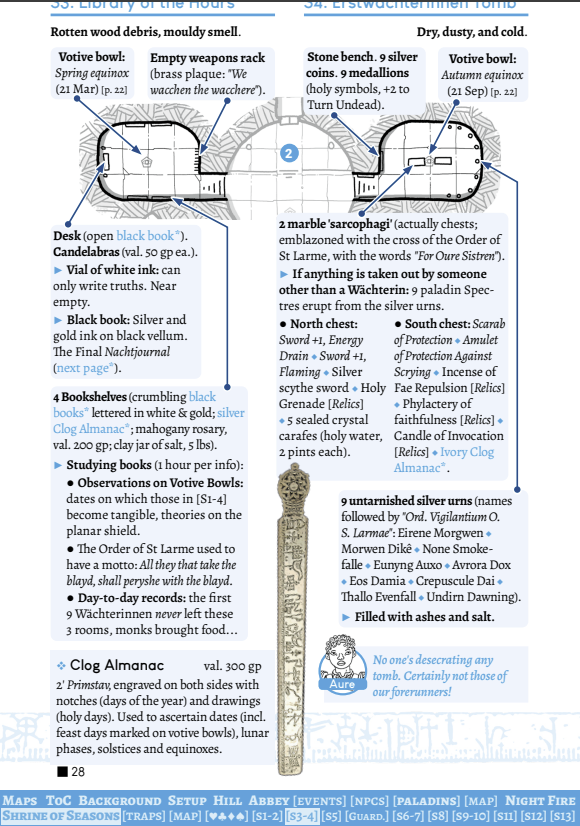
This is not helped by the chosen format, especially in the first dungeon. A mini-map, taking center stage, with little arrows pointing towards things that leads to explanatory paragraphs comprise the descriptive/layout style. There’s a hyperlink thing going on that mixes in a blue font that will take to that detail, but I think maybe that distracts and I suspect isn’t needed most of the time. I found myself wishing for a traditional layout, or, perhaps, wonder if a more traditional layout wouldn’t have made comprehension easier.
Still, absolutely richly rewarding. Excellent job on theming and in creating an environment to explore and overcome through intelligence, wits, roleplaying, and dumping in a fucking fireball on those fucking blue babboons. (The witch ain’t gonna like that! And she’s a central figure …) Great tie in to domain play. No right or wrong or morally grey, just a place, with consequences, depending on actions you take. It rewards a thoughtful party both in avoiding death and in gaining great loot/relics. And you are gonna have to study it to get there.
This is $10 at DriveThru. Fucking thing is a steal at $10. There’s a preview, which is currently broken. (Seems like it might be a DriveThru thing, I’m getting XML back.) And there are some thumbnail pages on the blurb page. There’s also a fourteen page “toolkit” included with time trackers, npc’s, and other shit on it to help you run it. I’ll dump in a page from the first dungeon to help you understand the layout issue I’m having trouble with.
https://www.drivethrurpg.com/en/product/573023/he-who-claimed-the-sun?1892600
Hexagnome is running three for three. I’m going on vacation soon so I’m written out until Mid-August and rescheduled things so this review is dumping sooner than that.
The OG (One God) gets a best. Haven’t you done a list of who has the most “bests” before? Three seems pretty decent for sure.
Thanks for this enthusiastic review!
Re: the funnel, alternate values are given for some key elements (like level drains/damage, etc.), but if a party of level-0 characters randomly meets an owlbear *and* its reaction roll is BAD, I’d expect one of them (or a paladin!) to heroically cover the retreat… If 10 other schmucks decide to stay and fight too, I’d say they earned their TPK 😉
Looks great! I assume you’re planning a PoD of this? Any idea what the timescale for that might be?
Thanks! A POD version is available on lulu and rpg-trader (which prints through lulu). There are, however, no plans for a drivethru POD at this point.
Thanks. I’ve already bought the drivethru PDF, assuming it was just a time issue, but that’s no problem. I’m planning to run HWCtS as a delayed follow-up to Peril in Olden Wood (which has a related Old vs New Gods theme and has been a blast).
The Yochai sniffer has another adventure out.
Are you sure it passed the Gal purity test?
We don’t want anything or anyone that’s ‘problematic’ in it, do we?