The ‘Toymaker’ has gone missing – and nobility across the realm are scrambling to get their hands on his highly sought-after dolls. Hauntingly beautiful, and scarily well made.
His workshop is hidden, deep within the ‘Whispering Woods’. A dark and desolate forest, that locals warn all who dare enter, never return… that is, all except the Toymaker. To find his workshop, you must navigate the pitch black wood, haunted by imprisoned demons, zealous lumberjack wardens, cursed werewolves, possessed dolls, an entitled elf prince and a gaggle of other monstrous horrors. The balance of power in the woods is shifting – will the evils that lay trapped here be released unto the world?
This 52 page adventure presents about thirteen hexes and a couple of dungeons with about thirty rooms total in a dark forest kind of fairytale vibe. Sinister plots abound while the party tries to navigate a lot of competing goals in an adventure built to run.
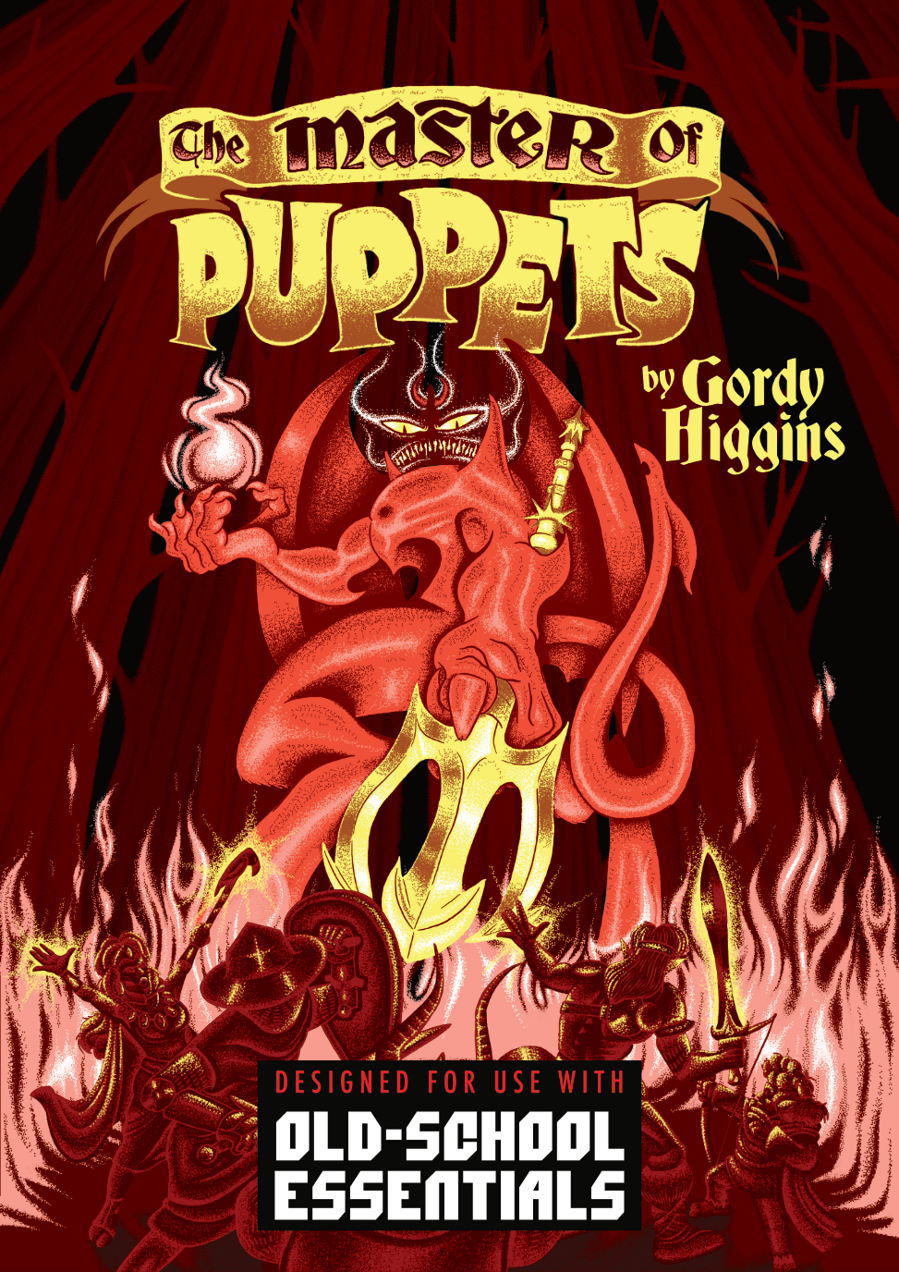
Ok, so, as I’m describing what’s going on I’m going to have to ask you put aside certain feelings you have. Like, when I say “toymaster” or “puppets.” I know we’ve all been indoctrinated to expect certain things from the use of those themes. I promise this one isn’t like those others. Also, I suspect that the cover art might be a bit offputting. The designer is also the artist, so, hey, sorry man! I think the interior art is fine but the cover, along with the title “master of puppets” both sort of lean in to some tonal and historical implications that we are ALL bad people for having but which are true nonetheless.
Let’s think of a dark forest fairy tale vibe, maybe with a touch of farce in it, similar to Gone Fishin. And there’s a lot going on in this place. The Whispering Woods are a kind of dark forest/mirkwood stand in. All ancient and old and dark and foreboding with rumors of ancient battles and demons. And that the woods will whisper to you. There are woodcutters in the forest, who were once a kind of border guard keeping an eye on the woods but over time are perhaps a little financially focused. Especially since their funding was cut. Funding? Yes, the elves used to fund them. Let’s think a more Fey-like elf than a Tolkein-elf. ANyway, the border guards get their funding cut and now the mission has degenerated. Why does it need border guards it’s a literal demon forest, the trees are demons. Some old elf king defeated an invading demon army long ago and turned them all to trees. His magic axe, along with his bloody handprint, is embedded in a tree stump in the middle of the woods. Also, the trees can’t be cut down. Let’s think a super strong ironwood. In to this comes the Toymaker, who lives in the woods and makes wooden dolls. Expensive wooden dolls. That everyone just loves to get for their rich ass trust fund kids, like some fairy tale stanley cup. Yeah, he figured out a way to cut down the trees and makes dolls from them and lets the border force sell the remaining wood. Also the dolls whisper things, an attempt by the toymaker to embed his little chukies in to the nobility in order to influence them and gain power because, yeah, the demon from the tree is now in the doll, kind of, bound by the doll clothes. A couple of the dolls get loose and the toymaker goes looking for them, only to get killed by some werewolves in the forest. Werewolves that are turning the border guards and whose curse starts from a different fey-elf that was kicked out of elflandia, is 143 in line for the throne, and now wants to take over the wood and thinks that a perfect way to start that is kicking everyone out starting with the border guards. I think I just wrote a page on that shit? And theres more people/groups running around in there. A slightly different framing of the toymaker would have hit better, but it all kind of makes sense in an evil consequences kind of way and is not as “pretext” as the length of description might otherwise imply. These are just things following from others naturally, if pushed just a little.
The hooks are the usual lame hired/dream shit, but the first one reads “A local Count wants the doll he ordered for his daughter’s birthday, but the Toymaker failed to make his delivery last week.” This one, I think, could have been pushed more and be the center of the adventure, much the way Gone Fishin was. A little expansion, a little more farce. And it’s gonna fit in well with people you meet in the forest, cavalier mercenaries who are sent by THEIR patrons to get toys for THEIR kids. A little push here in the writing, the absurdity, a tinge of evil, future chukie foreshadowing, insane offers, this would have lent a nice opening vibe that would frame the rest of the adventure instead of having just some genero stuff.
There are a decent number of NPC’s in this. They are well organized with wants, needs, knows, offers to the party, along with short little descriptions like “Wild red hair. Always shouts, unable to speak at a reasonable volume” or “A nude, 2’ tall, crudely made wooden puppet. Exclaims ‘oh boy!’ frequently.” Perfect little nudges for the DM. You can talk to a lot of people and things, including a termite queen who can be particularly useful in a forest full of evil wooden chuckies. Not everyone is friendly, and a lot of the situations are tense and almost all can lead to some combat, but the talky talky option is there for a smartie partie. Think of the cavalier mercenaries, as an example of talking and fighting.
Magic items are decent. “Royal Ceremonial Sword – +2 Elven Glass Blade, with gold leaf details. Used in knighting ceremonies. On a critical hit (19-20) it shatters, doing maximum damage. Repairs itself in 1d6 turns” and “Thief’s Lantern – Emits an area of light only visible to the wielder, and others that touch them.” These are nice little examples. Interesting effects to be sure. Useful, fun, unusual. They FEEL magical, especially the lantern.
The entries start with a little overview that could be a read-aloud (In fucking italics! Don’t do that!) with certain words underlined and bolded (I’d do one or the other, not both) and those bolded/underlined words are then followed up with in their own sections with more details. A Sentence or two for each keeps them each to scan and run. Descriptions are not winning awards but are still pretty good. “A large open-cut marble quarry. Filling with water from a spring on the northern cliff face. A dull glow emanates from the loudly bubbling depths. Red handprints cover a nearby marble boulder. “ I don’t like “large”, but, not a bad little description and it hints at many things to follow up an examination on.
There is A LOT to get in to trouble with in this, mostly from the party fucking around. Not in a Museum Tour kind of way but just the party doing normal shit. The locations can be fantastic, like a buried titanic statue you enter through a mouth, filled with stac/tags inside. Some of the wanderers seem rough, like 2d6 werewolves, but, hey, it’s OSR. You’re going to be doing a lot of freeing people, questioning them, and so on to get information you need to find the workshop, itself a twenty room dungeon. All without getting screwed over by the captives and/or people you meet along the way. Can you, having discovered termites, put together that this is an excellent resource to take advantage of in a wood themed adventure? If so, the designer was ready for you. Or, you can just stab them. How shall you navigate the mercenary knights? “Contract knights, mounted on warhorses. Equipped with expensive weapons and armour. Annoyed they couldn’t just pay someone beneath them to fulfill their quest “ Overemployment has always been a thing man.
This is $10.50 at DriveThru. The preview is four pages, showing rooms keys. Great preview.
By ND Hobbies, Ulises Martinez, Mauricio Rosel
ND Hobbies
1e
Levels 7-9
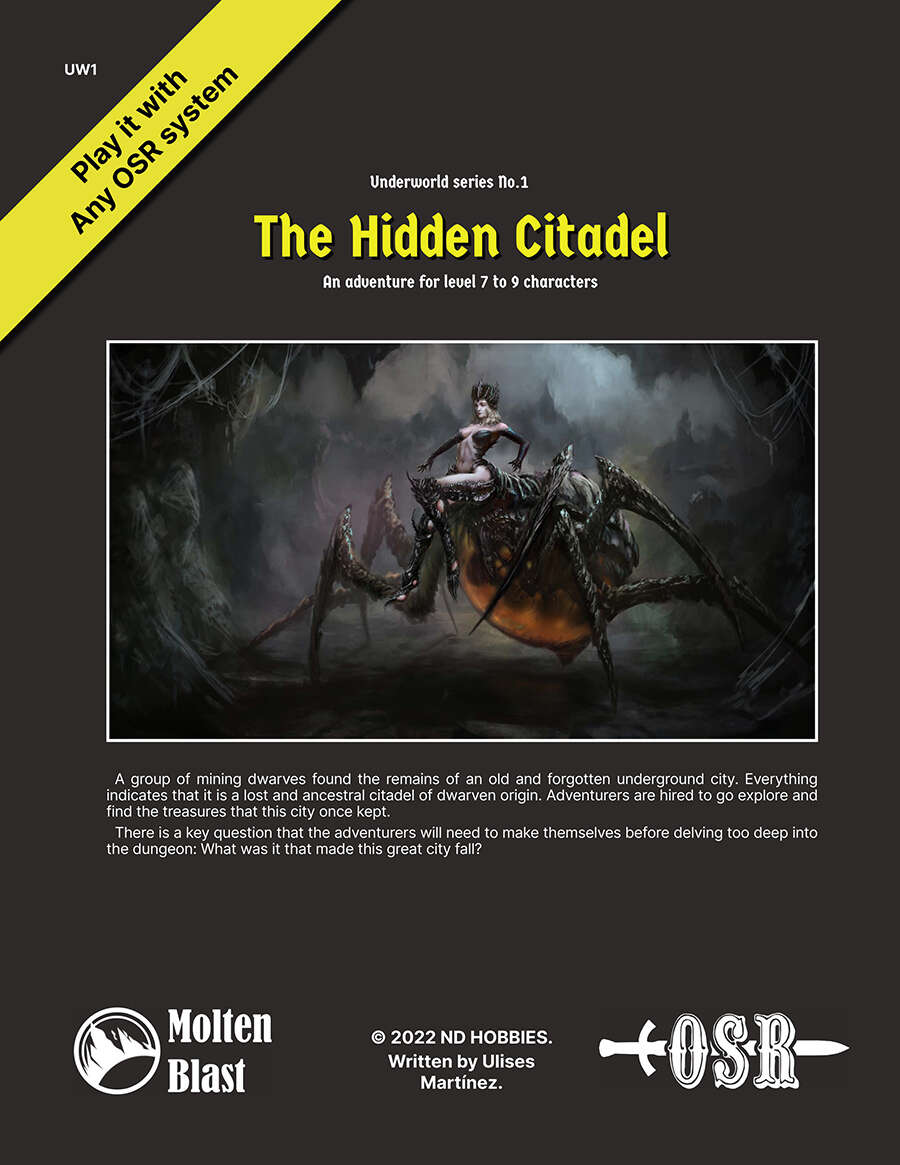
In the majestic dwarven capital of Runekaatara, the miners’ guild has made an unprecedented discovery. What are these dwarven miners hiding from the city authorities, and why are they desperately seeking the help of a group of adventurers who have just arrived in the capital? In The Hidden Citadel, adventurers will embark on a classic dungeon-crawling subterranean adventure to discover the secrets that an ancient citadel holds, the dangers that protect these secrets, and the reason why the citadel fell into disgrace in the first place
This 32 page adventure is a simple hack on a simple simple map with underpowered monsters and a weird tonal imbalance. Grist for the gristmill.
The cover blurb here says “A group of mining dwarves found the remains of an old and forgotten underground city. Everything indicates that it is a lost and ancestral citadel of dwarven origin.” So, of course the heads of the dwarf mining guild, in the dwarf capitol city, looking for the dwarf ancestral citadel of dwarven origin, hires non-dwarves to go find it. Also, the dwarf ancestral capitol and origin is like six levels, each with, I don’t know, about six rooms? Anyway, we’re gonna forget about all of that and look at the rest of the adventure.
So you end up in dwarflandia and in the marketplace you overhear shit like “The governor doesn’t have to find out” “They say the pay is crazy” “It’s the discovery of the century, whoever goes there will be remembered forever” “What if Is there something down there?” and most importantly “They are in the Anvil tavern. Shall we venture?” This is from people in the market, all members of the miners guild, who beat the characters away from them. But, also, direct them to the Miners Guild inn if they need a place to stay. I do like the overheard snippets of conversation; it smacks of the in-voice rumor tables that I love that I think add a lot of color and framing for a DM to play off of. Arriving at the inn a dwarf, who turns out to be the guildmaster in disguise, drops a bag of gold in front of the party while passing through the room. If you return it to him then you’re honest and he wants you to go on the adventure. If you steal it then it shows daring and he wants you to go on the adventure. If you ignore it then a thief picks it up and runs over the parties table to get out, no doubt prompting the party to intervene, which shows the parties [something] and the guildmaster wants you to go on the adventure. Tell me again, is the illusion of choice a good thing or a bad thing in an adventure? I guess it’s just the hook. Hey, also, they only want 10% of the loot you find in the ancient dwarven capitol origin. For realisies. Anyway, we’re gonna forget about all of that and look at the rest of the adventure.
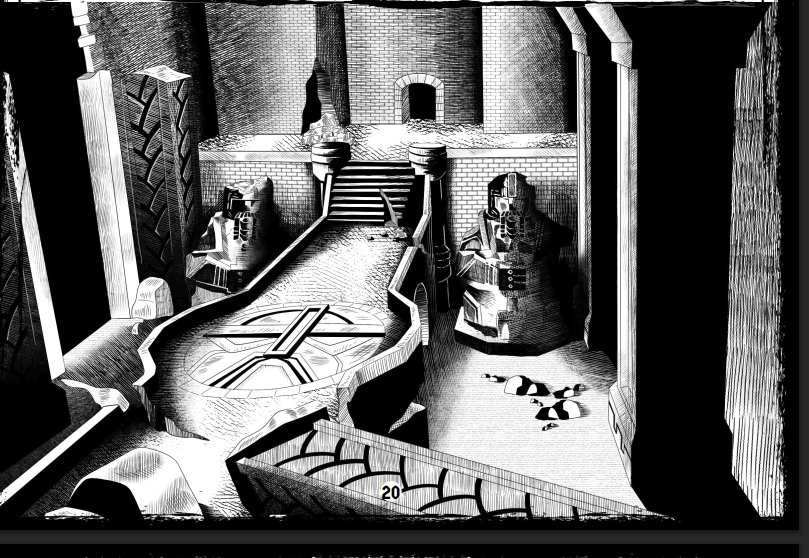
I’ve mentioned that the map levels are rather small. Five rooms on a level, six rooms on a level. One has like thirteen rooms, an anomaly. They are done in a faux-art style so you’ve got cracks in the stonework and so on. The end result is that it’s hard to make out doorways and other features that you need to run the adventure. What’s a portcullis? What’s a door? What’s an open doorway? Good luck to you. Level entry/exits are not the clearest, from the maps, but there is an “overview” map in the back that has all of the levels on it and has some lines showing stairs from one location going to entry on another floor, so, that helps. But, also, putting it on the single page maps would have been better. The text says things like “ Room 2 is locked behind a closed portcullis and only accessible through Room 1.” Uh … no? Yes? Technically? The adventure seems to do this a lot. In another place we’re told “To continue delving into the dungeon, the adventurers will have to open the titanium gates that block the way to the Great Stairs.” Uh. I’m level nine? So, I guess the meaning of the text is that ONE of the room two entries has a portcullis in front of it and the other entrance is just open, the one from room one. It’s a strange way of writing it though. I’m sure there are EASL issues here, which I generally give a wide allowance for, but I think in this case it’s something else. It’s something like a lack of acknowledgement that you can go through the portcullis? Or the gates to the stairs to level two? There are no additional details, like bend bars/lift gates, or spells or anything. Which I guess you don’t need, it’s just a weird phrasing. Over and over again. Anyway, we’re gonna forget about all of that and look at the rest of the adventure.
Looking at the enemies we’ve got a two hit die ooze. And a one hit die giant rat. ONE one hit die rat and ONE two hit die ooze. Eventually you get to fight like FIVE two hit die creatures. There’s a 4 hit die ghost. What’s the turning rules again? TWO three hit die orbs? There’s a gold golem. I guess he’s seven hit die. The boss is a twelver. I understand that we normally look at dungeon encounters that are tough, and give the “it’s OSR, run away” answer, but I’m not sure what we do in the opposite direction? There is the usual “doors slam shut’ stuff. Anyway, we’re gonna forget about all of that and look at the rest of the adventure.
Writing is dull. The usual padding. “This room has several armored corpses, which in the past were dwarven guards.” THIS ROOM HAS is all padding. And then we run in to the usual historical survey of what the room was. It’s dull, long, multi paragraph with little in the way of formatting to help scan and run the adventure. Interactivity is generally stabbing something or a trap or “pull the two levels on the level to unlock the door to the next level.” I mentioned a gold golem earlier. Here is the entirety of that room: “This room is filled with gold and valuables, as if the noble dwarves had put their riches here to protect them in desperation. If someone takes a coin, several of them take on a humanoid form and will turn into a gold golem that protects this treasure.. Upon death, the golem becomes 355 gold coins.” That’s it. Nothing more. What do you think filled with gold and valuables means? 355 gold coins? Does it seem weird to mention the 355? Everything is like this. Missing information. Dull writing. Lengthy writing that leads to nothing. Anyway, we’re gonna forget about all of that and look at the rest of the adventure.
And then the tone changes, in one place. “This room is full of bags and suitcases, all arranged in a pile. Inside the suitcases there are souvenirs, family portraits, letters, and books. Everything is mundane, but each object represents someone who died in this place.” Uh …. The next room has a bunch of people in it, skeletons, bodies. Children sitting on mothers laps. People huddled. With the marks of slit wrists where they all killed themselves. Jesus man! So, yeah, there’s an emotional impact there. The antechamber, with the luggage, clearly is culturally overloaded. A mass suicide scene would not have as much impact as a mass suicide scene with some hints beforehand to really foreshadow and bring home the horror. “And we looted it?!” It’s the Lareth principal, done right. But, also, Jesus man! Here I was just killing rats and oozes and stabbing shit and pulling levers and you dump this on the players? But, whatever, it was good design even if tonally it is out of place.
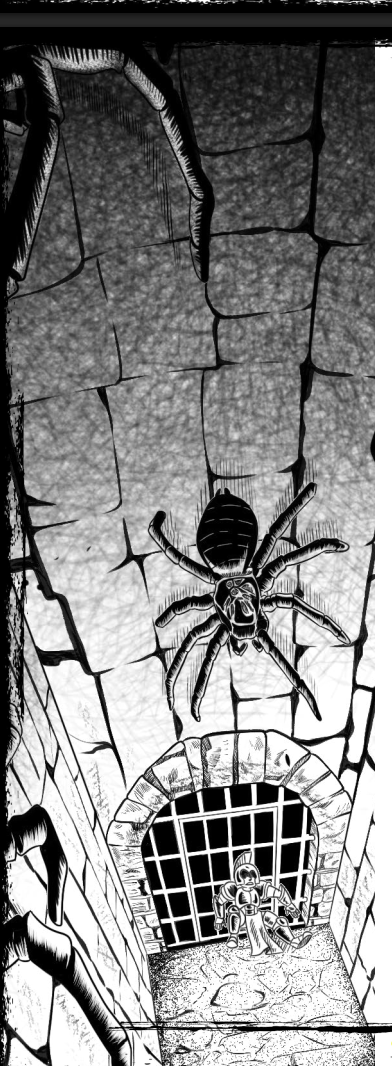
There are also a few decent art pieces in this. Good art, in an adventure,helps the DM run the adventure. It helps clarify a room, or sets the mood for them, helping them riff on it. It’s evocative. David Arcila and Diana Rex are credited. I don’t know which one it is but I like them for the purpose of inspiring the adventure. A nice barrier peaks vibe to it, that pulls you in. It’s not all the art, maybe four pieces or so, but those are good.
So, just kind of generic adventure for the most part. Nothing very stand out in the writing or the room interactivity, with a notable exception. I’m not overly upset by it, but it’s just another of the large number of marginally poor adventures that flood the market.
This is $5 at DriveThru. There’s no preview, but you do get to see some page layout on the product marketing page. It needs a real preview, that shows real rooms, so potential buyers can get a read on if they want to purchase it or not.
By Jesse Winter
Slime Mind Studio
BECMI/Shadowdark
Levels 1-3
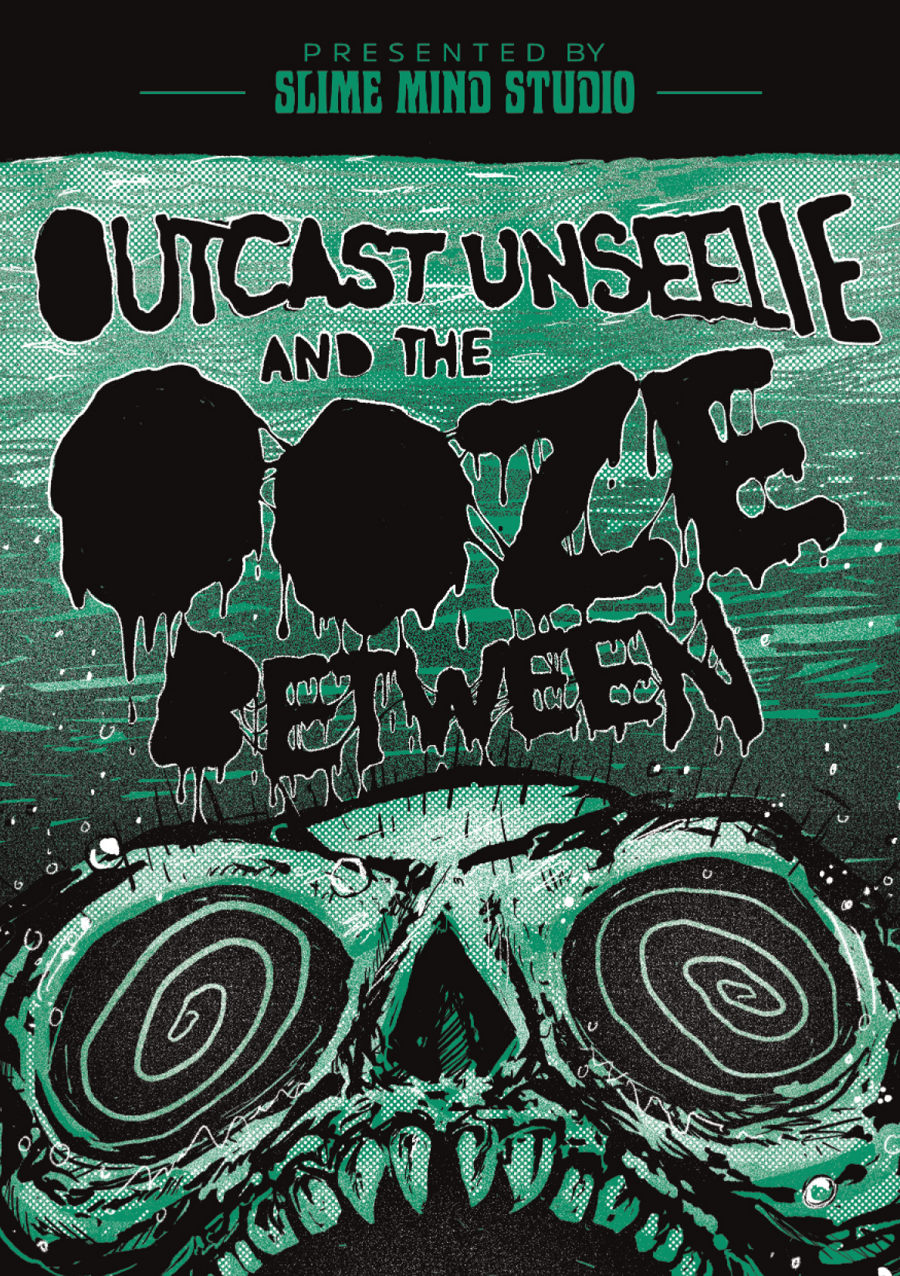
The mountain bled. Now powers from beyond slake their thirst. Bordering the long-abandoned Brackenhoorg mines, a lone gatehouse suffers both from the churn of a mysterious ooze and the encroaching domain of a fey lord. Test your mettle against a dungeon swamped by a potent arcane ooze and conniving fey vying for power. Will your players learn the secrets of the ooze—or need enough treasure to afford a priest?
This forty page adventures uses about 25 pages to describe about fifty rooms in a two level dungeon features slime, fey, and insects. And dwarves? It’s full of fantastic elements and does a good job with formatting even though I think the overall attempt at a “Timeline of events” doesn’t work very well. A good journeyman adventure.
I think this adventure is fascinating. First off, it’s an ok adventure. Which means I guess it’s great? In the sea of filth I usually see it’s not one of those. It’s doing almost everything right. I don’t think I’m excited to run it. And I think that sucks because it IS doing almost everything right and when you compare it to the absolute dreck that people publish it is light years beyond that shit. I mean, the designer deserves some admiration for that. If this was plopped down in front of me at a table and I was told to run it then I would and it would go great and I’d have a great time. I just don’t think I’d ever reach for this of my own free will. Maybe it’s something like marketing. I’m not saying it is marketing, but I’m drawing an analogy. Nothing made me excited by this. Except for the meta-discussion that it doesn’t suck. I’m super excited by that. Seriously. If every adventure in the world were as good as this one then I wouldn’t have the tenfootpole blog. Technically, it’s great. It just lacks a certain joie de vivre. That sucks. It’s like working for one of those shit ass companies in which being competent isn’t good enough. You have to suck off the boss verbally and engage in the kabuki of mouthpiecing the the mission, blah blah blah even though you’re really only there because hookers and blow cost money and you need money. That seems unfair?
The formatting here is nigh perfect. “Oh, Bryce cares too much about formatting!” No, dipshit, I do not. But I do seem to understand, which many of you do not, that formatting IS the great downfall of many adventures. My standards are quite low. Can I run the adventure? Ok, you get to squeak by. You can write the worlds best adventure and have shitty formatting and I’m still gonna call it the worlds the best adventure and grumble and recommend it. But, if you write a mediocre adventure and do a shit job at helping me run it then you can burn. The entries are clear and easy to scan. A little summary/read-aloud with some words blended that are then called out with more detail in the bulleted sections below. Just a few sentences each. It’s also using a ? ? layout, so ? of the page, the left “column” is used for the keys while the right ? “column” is used for notes and other called out detail, like monster stats and so on. I think the format here is perfect. Easy to scan. It’s clear. It’s easy to find things, and to follow up on information. No notes. Well, ok. You can have your preferences with formats. You can prefer a paragraph style over say an OSE style. Both a paragraph style and an OSE style can be implemented poorly. But, ultimately, many formats styles can be used, anything, really, as long as they succeed in their purpose and this one does. It could, perhaps, be terser in paragraph form. Less whitespace and all of that. But it’s not overly long the way it is and it’s dumping three or four rooms to a digest page in this format, while maintaining an easy to read font size. It’s fucking good. Formatting.
And the map is decent also. Dyson is credited. I’m not sure if these are his free maps or this was a commission. They look a little more involved than I’ve seen many of his free maps. A little more complex, a little more involved. Same level stairs, tunnels present, and they even run above and below other passages. A kind of rubble-vibe to them. Monsters are noted on the map, as well as entry/exit locations. (The level one map has six, I think, exist/entrances on it, out of 22 rooms total. That’s some decent map interconnectivity!) Monsters and traps are also noted on the map, and the lettering is generally clear with the keys, proper, being very clear. And the wandering table is ON the map also. This thing is close to being platonic! Maybe just tending a little bit to be busy, but, I’d take a look at the adventure just to see the maps in it and how they are done. Little minimaps are included on each page to orient you toward the room and exits.
Descriptions are pretty decent, above average for sure. Terse, but evocative enough. “An emerald waterfall, frozen in time, suspends loose rock and a charred body. Green, soot-stained metal encrusts the floor and walls.” or “Green liquid oozes from a cracked stone wall and marble bricks ju??ing from the ceiling. It pools around a toppled stone statue “ These aren’t bad. Like, not rock star but certainly pretty good as a short description goes. The bricks jut and the liquid oozes. Dislodging a brick “spews warm verdigrint.” Spew. And warm. Ewwww!
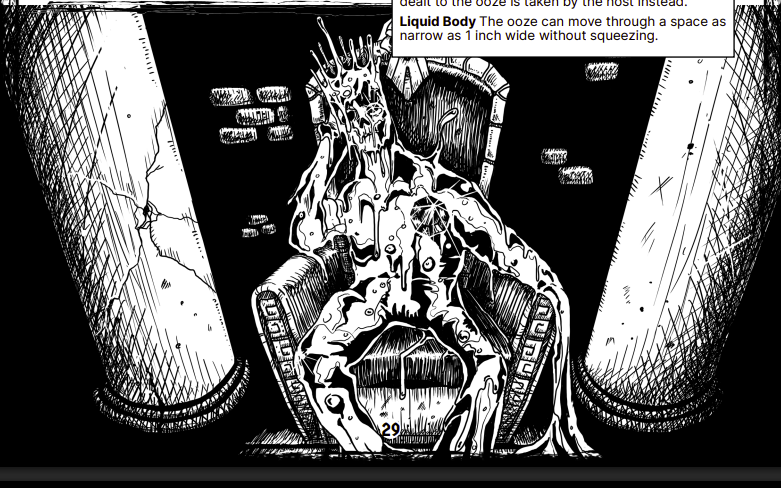
The rooms get noise and light pointers to rooms nearby, so you can hear things from the right or to the east or some such. Love it. Same with monsters reacting in certain situations. Attention is paid to the dungeon as a whole rather than a more room by room orientation. (Which, I suppose, is also mirrored in the entry/exits, both in quantity and in noting them on the map.) There’s also this thing the adventure does with blocking exits. Normally we’d see a door. But in this there is a frozen emerald waterfall, as noted in the quote above. It blocks an exit if you hack it loose or unfreeze it. In another place there’s this kind of giant mass of flowers in a corridor … which it turns out is blocking a kind of Y intersection, growing in all directions. These particular flowers regrow FAST when fed blood and there just happens to be a dead body in the intersection that it can suck blood from. An interesting problem, yes? (Also, I really liked the art piece that went along with this. A kind of grayscale/monochrome image of a ruined hallway with a mass of giant flower in it, with the petals done in a kind of muted red. It very much delivers the kind of striking impression that I think this encounter was going for.) There’s decent interactivity here.
Randomly, the page count is misleading, there is almost NO padding in this at all. Excess pages are NPC descriptions for the dungeon. These are little paragraphs with wants, fears and secrets called out and some keywords to help the DM quickly. “MYREROSE – SPITEFUL QUEEN. CALMLY SADISTIC. Master alchemist. Retains her fairy form by bathing in Blood Honey (made from perish lily pollen). The Gardener is her pawn: She gives him Blood Honey, lying that it will restore his True Name. Suspects Shiv, not Slaveral, created this mess. She rules from Bleedspire (V1) “
And those NPC’s are, I think, the downfall of the adventure, if it can be said to have one. Yeah, sure, the designer didn’t put the fucking level range in the marketing page or on the cover. Yeah, the hooks are fucking lameo hiring shit and the framing of the adventure could have had a little more thought. But, the NPC’s are the only thing here that I think doesn’t work well.
The idea is that we’ve got this old mine/complex that hit an ooze vein and was abandoned. And then some shit went down in Fey land a group/manor of them got cursed in to bug-like creatures (again, good art!) and somehow their manor is now level two of this place. There is supposed to be intrigue among the fey, hence the wants/needs/secrets and expanded NPC sections for them. There’s even a timeline of events. But I don’t think ANY of it works AT ALL. Some individual encounters work out ok, like a room with covered mirrors and a dude can/will reach through an uncovered one to pull someone in if they can. But the lager intrigue thing just doesn’t come together. And the timeline doesn’t really impact the dungeon environs or the party in such a way as to impact play/the party to care about. “Meck accidentally blows up Lalizar. The cultists disband. Slaveral and Meck fly away to find Meck’s mother “ Sure thing. I guess fewer things to stab then? I mean, whats the impact in intrigue and, ultimately, the party interaction?
There is also an overall … I don’t know, lack of … intent? Recall the dungeons exits and blocking exits and sounds/reactions, etc, all of which kind of give the dungeon a more wholistic feel. But, also, that wholistic feel is lacking in the way the dungeon rooms work together. The theming, of the fey anyway, doesn’t come through very well. The entire place, as a whole, isn’t left with an overall feeling. Yeah yeah, that a shit explanation. But, also, I wonder if thats not why I’m saying that the pace lacks a certain amount of joy and/or glee in it? My lack of enthusiasm for the place?
This is doing almost everything right. It’s a good adventure. I’m going to dump this in to two categories until I can decide what I actually think about it. I’m happy to run this. I’m just not sure I’d go out of my way to run this. I think it is absolutely worth checking out.
This is $9 at DriveThru. The preview is thirteen pages, the first thirteen. You get to see the map, the NPC’s, the timeline, and three rooms. That’s a decent enough preview.
By Jon Brackin
Brackin Adventuring Company
BECMI
Levels 3-5
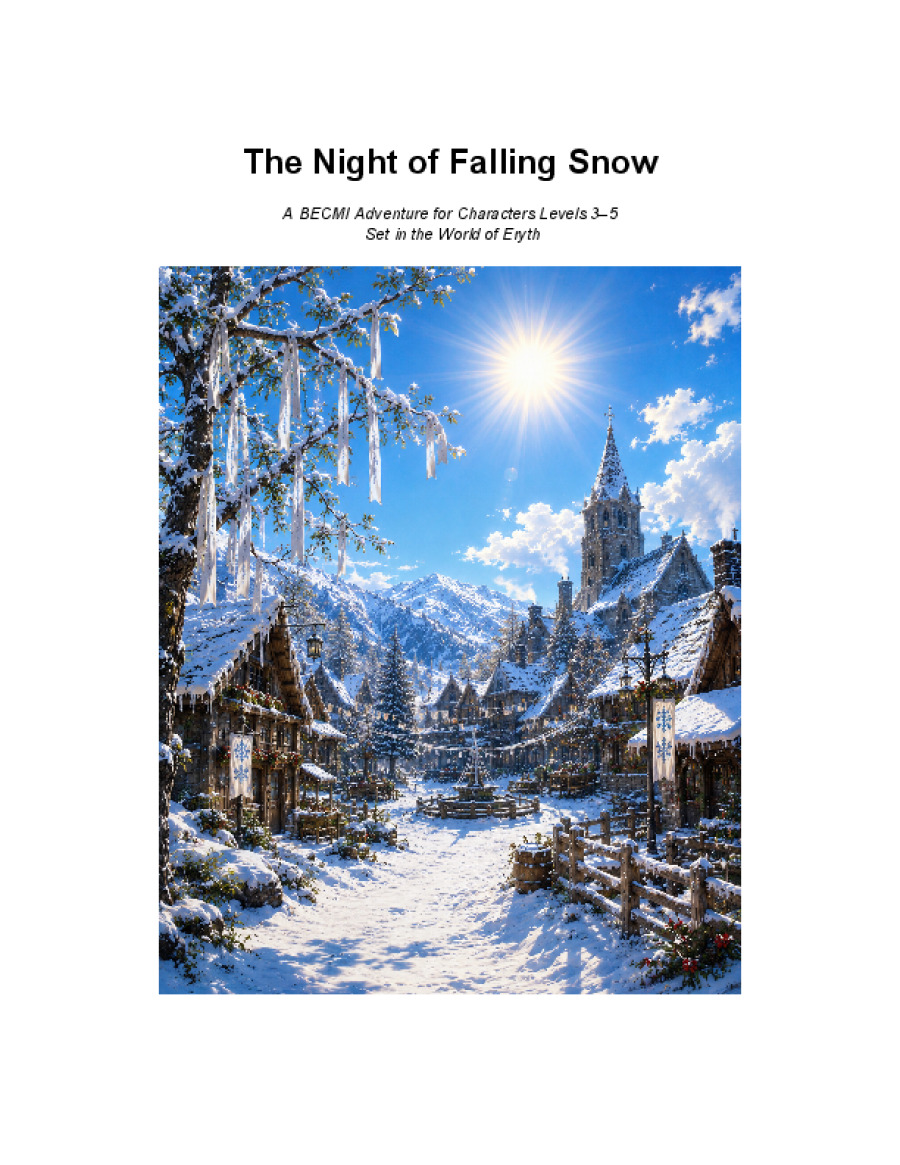
On the hottest night of summer… it begins to snow. For as long as anyone can remember, the quiet village of Frosthollow has celebrated The Night of Falling Snow, an ancient midsummer festival unlike any other. White ribbons flutter from old trees. Candles burn in every window. Gifts are exchanged beneath a blazing summer sun while soft snow falls from a cloudless sky. The villagers call it a miracle. They have forgotten that it is a warning. This year, the snow arrives early… and it does not stop. As impossible winter spreads across the countryside, travelers find themselves drawn into a mystery buried beneath centuries of tradition. Forgotten journals, hidden chambers, and an ancient ritual reveal a terrifying truth: the festival was never meant to celebrate the snowfall. It was created to keep something from crossing the threshold into the world. And at the center of it all waits a smiling traveler known only as The Pale Guest. Will the heroes uncover the truth before midnight, restore a ritual no one remembers, or unknowingly open the door to an ancient horror?
This seventeen page adventure uses about eleven pages to describe about ten areas in a village about to reawaken an ancient entity. It’s sparse, with little specificity. There is an outline of an adventure but little to ground the characters actions or the DMs responses.
I am continually mystified at the lack of adventure that passes for adventures. The barest outline of an adventure is somehow expanded to twenty pages and then a few dollar price tag slapped on it. We get little more than DM notes, time and again, the kind scribbled on my party tracker page ten minutes beforehand to run tonight’s game. What ends up being published is just anything that anyone could come up, with all of the specificity and adventure just not present, the stuff the designer SHOULD be working on to help the DM bring the game alive. Yes, the DM needs to do work, but the designer is there to inspire them to greatness and provide the tools to do so.
There’s this village where it snows on a day in the summer every year. The villagers hold this festival with a couple of traditions attached to it. Well, wouldn’t you know it, the snow doesn’t stop this year and gets VERY heavy. The party is there for [the usual lame reasons.] Oh no, people are missing! Poking about you find the basement of the inn has some old records, and the traditions are bastardized versions of a yearly ritual that has to be done to keep THE VISITOR away. The party must convince everyone in the village does a Whoville song and dance number and the entity will sleep for another year. Or, just stab the 12HD dude till it dies.
The most specific thing in the adventure is, what a coincidence, also the most interesting. The villagers hang ribbons from a tree in the village with their names on it. (And, the missing villagers have ribbons there also, with their names faded away. I’m not sure how you know that given that the names are no longer there, but the concept is decent.) This is great. It’s like a line of text. It’s specific. It grounds the DM and gives them something to build on. This is by far the most interesting thing in the adventure.
The actual locations are given this description style that is … poetic? An attempt to be poetic? Let’s look at “Chamber Two: The Ice Archive”
A chamber sealed within magical frost.

Contains stone tablets.

These preserve the complete ritual.
Uh. Ok. How about another room, for comparison? The Hall of Forgotten Names:
Thousands of names carved into walls.

Reading them aloud causes spectral figures to appear.

Most are harmless.

Three become Snow Wraiths.
Meh. This borders on pretension. It’s the fucking idea for a room being sold as a room. Put in a fucking description. Look, I’m supportive of new ideas but also you gotta recognize when they don’t work and this don’t work. There’s nothing there! At some point we’re told “Eventually clues point toward old records beneath the inn.” What are these clues? Not present. Nothing. The DM gets to make them up. This is just some notes on a napkin about some major beats in a potential adventure. How about monsters? Here’s notes about an attack by Candle Guardians. Or,, maybe, Frostbound Remnants, both phrases are used: “Four Frostbound Remnants attack as soon as the door closes behind any person entering. “ What the fuck is a Candle Guardian?
This is a ridiculously low effort adventure. I’m sure some work was put in to it, but its like the designer has somehow never seen what an actual adventure is and what one needs to run an adventure. Like what the fuck a monster is.
This is Pay What You Want at DriveThru with a suggested price of $2. There is no preview. You gotta put in a preview man, so we can make an informed decision to purchase or not.
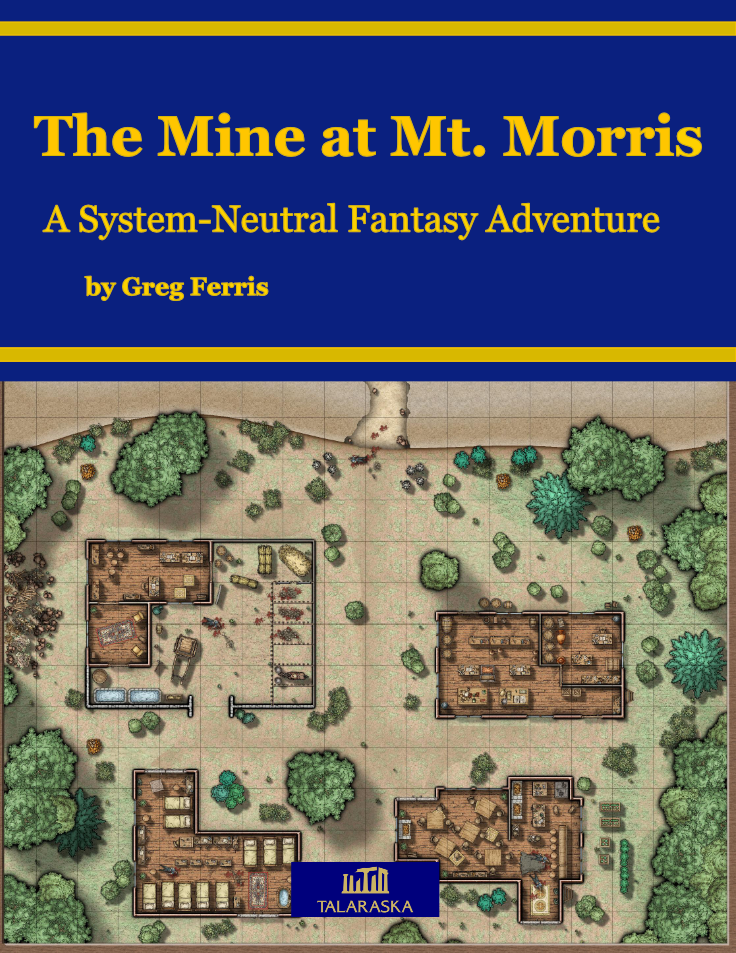
By Greg Ferris
Talaraska
Generic/Universal
Level ... 3?
The hills making up the Archian border with Caledos are pocked with dozens of abandoned mines. These leave a lasting reminder of the rush for silver in the years prior to the rise of the Graun Empire. Without drawing much attention from local officials, a nebulous consortium of investors has been purchasing old dig sites throughout the region. The mine at Mt. Morris was one such purchase. About 12 months ago, a group of ten men reopened the dig, which locals were sure was folly. After spending a couple of weeks repairing the base camp, the team resumed the dig. None but the foreman had any previous mining experience. Most of the “miners” were farmhands or former members of the stevedores’ guild. None were strangers to hard work, but they were a motley crew to be certain. However, the strangers who came and offered them the job assured them that they would be paid handsomely. The past year had been difficult. The team had failed to find any substantial amount of ore and they often assumed that their work would soon come to an end. Despite this, the paymaster and his retinue of guards would appear every month and the dig continued.
This nine page adventure presents eleven rooms in an old mining camp & camp that has been “overrun” with undead. It’s pretty basic, with not much going on.
I’m not super sure how this made it on my list. It must have either been in the OSR section on DriveThru or a request? I don’t think I see a request, so it must have been in the OSR section at DriveThru at one time, even though it’s labeled Generic/Universal. The marketing blurb advertises it as a flesh out adventure hook, but the adventure, proper, lists itself as an adventure. I don’t know, some way of framing it not having stats? I don’t think that matters. In any event, it has more life to it than the vast majority of adventures and even manages to present more rooms than the number of pages in the adventure. How far have we fallen to have that be some standard of success? What’s a spud to do? Anyway, ignoring most of the intro there’s a small adventure hidden in here that is relatively inoffensive. There’s not much interesting about it either, but, hey, it’s 2026 and I’m in a morose mood because somehow an uninteresting adventure with eleven rooms in nine pages somehow is better than most if the garbage I review. So, no stats and no treasure, just some “place treasure appropriate to your system” notes here and there.
There are some pretext reasons here for exploring, nothing very interesting. Hired to do blah blah blah, or local priest has visions blah blah blah. Getting to the site you find four outbuildings and then seven rooms in the mine. There are bodies about, partially eaten. A stable has horse bodies, and one stall padlocked with a living horse in it and extra water that has run out. One of the buildings has a survivor barricaded inside of it with a confusing story that doesn’t make sense. The idea is that the party will use the stable clue, as well as another clue in the bunkhouse, to understand that the dude knows more than he is saying and that they’ll press him for details. The details are not altogether interesting given the small size and stand along nature of the adventure combined with the generic/unival vibe. He was hired to run a mining crew, looking for a diary in a buried complex. He did some research on his own and found out that the dude was a necromancer and used animated bodies as guards. When the miners found a wall he gave his horse some water and locked himself in, fearing the worst. The miners break in, undead get out, the worst happens, everyone dies but him and his horse. It’s an interesting way to present a clue, without having to resort to a diary or monologue. And by interesting” I mean “correct.” We get to see the results of actions taken in the past that help explain the now, rather than listen to a droning monologue. The players gets to use their brains to put things together. Or not.
The rooms inside the mine are uneventful. Generic alter room. Generic crypt. “There are 8 sarcophagi in this room. Four of these are open and empty. The remaining four are closed and hold inanimate skeletons. There is a small stone altar along the western wall. Beside it rests an open chest filled with gold and any treasures that would be appropriate for your game. “ Nothing really evocative about them, inside the mine or out. Nothing really stands out. A few ghouls/ghasts. Entries are padded out with things like “As the party moves in this direction, they are assailed by [an odor.]” There’s like five pages of intro to go with the four pages of room keys. There’s just nothing to this. “First, do no harm”, the slogan goes. And, for the most part, that was accomplished here. Sure, some padding, a decent amount of it. But, also, the rooms are still relatively terse and easy to scan. There’s still no way I would run this, there’s just nothing to it, but it IS still better than most adventures because it IS doing no harm.
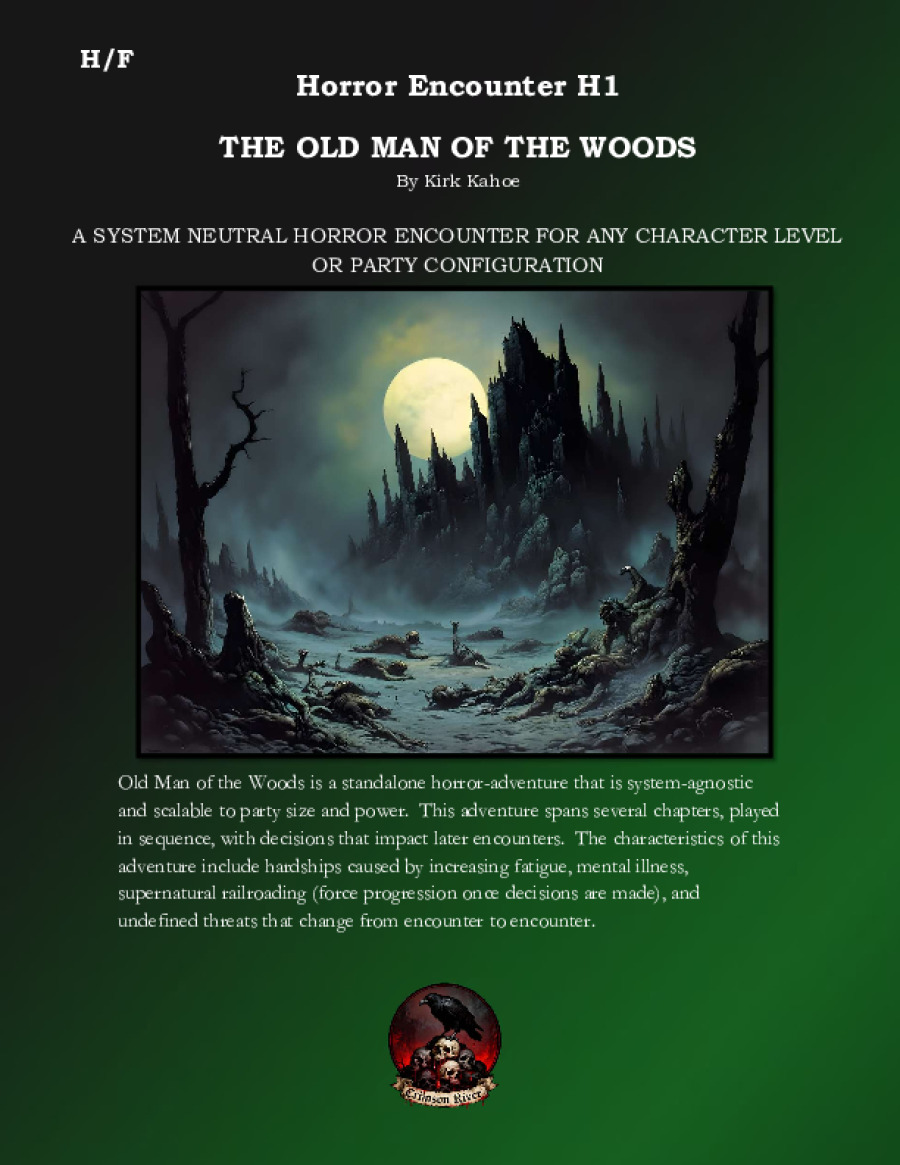
By Kirk Kahoe
Crimson River Games LLC
Generic/Universal
Levels: Any
Warning! This is as close as you can get to being a Heartbreaker without actua;;y being a Heartbreaker.
An eternal horror haunts the woods, reaping an endless harvest of woe from those foolish or desperate enough to travel through them. Tired and injured, the party will have to not only face an endless onslaught from the horror but fatigue and madness as well, for there is no sleep in the Old Man’s realm other than the sleep of death.
This 169 page adventure is an overwritten railroad in which the best solution is leaving the table to have explosive bloody diarrhea in your hosts bathroom and then going home. Ok, that was mean. It’s a 169 pages of railroaded atmosphere in which you have no choices to make as a player and the DM must wade through an excruciating amount of text to run even the simplest encounters.
Page twenty of the intro text tells the DM that they should Describe, not define and then follows this statement up with “A shambling and decaying humanoid creature that stinks of ammonia is scary. Labeling this creature “Zombie” and adding specific statistics is a game mechanism. It is thus no longer a scary monster but a set of numbers to crunch and probabilities to consider.” This is 100% correct. Not only does it follow the show and don’t tell mantra, but it adds that air of mystery that RPGs thrive on. I’m a big big fan of this attitude and it bolstered my spirits seeing it.
Oh! Oh! I forgot! You can get Hep! That’s right! Hep! That’s BAD AZZ! “So, what did I get? Another plague? Yellow squirting zombie fever or something?” “No, you got Hep.” Fucking christ ma! That’s great! I love it! Next time you roll through a village you find out 15% of them are dead from cholera. That’s nicely visceral and I do love a reaction from the players. Which, I might note, is exactly what the adventure is trying to do with its horror.
Great, I’ve said something nice, even if I did include the backhanded “page twenty” reference.
There’s a dude who is the only worshipper of a god and he’s constructed this obtuse parallel reality death trap in a forest to select sacrifices worthy of his god. As the adventure tells us “Due to the depth of role-playing required to deliver the Old Man and the complexity of fatigue’s impact on gameplay …” It’s a test/challenge dungeon. That’s it. 169 pages of test/challenge dungeon. You know how those things work. It’s an alternate reality blah blah blah, you can’t leave, blah blah blah, he controls everything blah blah blah. “In the event (which happens often) that the Old Man (or his copies) are somehow killed in any of the encounters before the final encounter at his hovel, he is instead fully healed and moved to the subsequent encounter.” Cause hes wearing this fucking ring that brings him back. Worry not, DM afraid the railroad will stop, “In all cases, the presence of the ring should not be noted due to the grime and darkness until the last encounter.” Ain’t nothing like having no choices that really brings home the immersion. Time and again we see this. This reliance on a test/challenge environment as a pretext for all of the setup the baddie has done. Time and again we see these mechanical contrivances, like the ring, used as an excuse to justify an effect. Time and again we see these railroads as an attempt to tell a story and get an effect. You can’t fucking do it that way. One of the keys to a roleplaying game is the ability to make choices. Once you take that away you might as well be watching a movie with a predetermined outcome. Sure, I can roll a die. Will the DM let me die or force me to suffer through the entirety of their story? Players check out when they can’t do anything. When they can’t make a decision. Sure, there’s a time and a place for “the RPG adventure as an Activity” instead of “the RPG adventure as a Game”, but, Baron Munchhausen did this a long long time ago.
In spite of the adventures words implying it’s a show don’t tell piece, it relies on mechanics and read-aloud to bring the horror, telling instead of showing. A fatigue mechanic. Mountains and mountains and mountains of read-aloud. No one wants to listen to your half page read-aloud man. You don’t set a mood by using a lot of read-aloud. Yes, the writing should be evocative, but it should not be lengthy. You get a few sentences, three or four, and that’s it. You need to really work those sentences to bring the effect, the impact you are going for. Yes, it is not easy. It is, I think, the hardest part of adventure writing. More is not better. Player attention drifts. You make it harder on the DM to focus. You can’t use mechanics to fill in either. Sanity, in CoC, is just another pull of hit points, campaign hit points, as to say. It is up to the designer to put something together that FEELS like fatigue without relying on mechanics to accomplish that.
So, yeah, railroad. The adventure starts at a little trade town. Caravans leaving, to go over the pass. Wanna join? SURE you don’t want to join? Ok, so, no, you decide to wait at the trade town over the winter? Ok, then bandits keep attacking. Eventually you see over a 100 bandits about to attack and the entire town, whats left, flee in to the hill. Along the caravan route. Heh. So, yeah, you’re going on the adventure. Then you’re in the alternate reality shit where the dude controls everything and you’ve got exactly one path to go on. Just follow it and make skill check after skill check as: there’s a rock fall. There’s a bridge collapse. The wagon is stuck. Blah blah blah. I don’t know, there’s about fifty locations, between the overland and like a manor and such.
There is an EXTENSIVE amount of information presented for each area. There’s a section for environment, then a section for topography. Then a boxed text section for the read-aloud, then a section for monsters/traps, then a section for encounter mechanics, then a section for notes, and a section for treasure, and a section for game master notes. There is EXTENSIVE repetition, which is great because with so much information, a long paragraph or more for each section, the area is then spread across multiple pages. There is NO WAY a DM can keep this shit together for a meaningful encounter. And this stuff is present for almost every area. Time and again, DO NOT use such a rigid format. Leave shit out if you don’t need it. Do NOT do shit like tell us the door, walls, light, smell, taste for each and every room. The purpose of formatting is to help bring clarity and help a DM when they scan the adventure looking for pertinent information. Used in mechanical fashion though, as it is here, is instead obfuscates and works against the goals it is trying to achieve.
It’s just weird, the way things come together in this. In one read-aloud section it says “They have knowledge of the mountains and what supplies are needed, and they can provide basic information about the mountain road. This sound slike DM notes, not read-aloud. And that’s not an isolated example, I’m not cherry picking. In another section there is a Treasure heading that reads “Treasure – Supplies from the abandoned wagons (See Treasure section).” Isn’t THIS the treasure section? (Turns out, no. It’s _A_ treasure section. FLipping to an appendix we can find a Treasure appendix with a listing for “Wagon Contents” which is full of mundane supplies.)
It’s just crammed with so much extraneous and repetitive information. And then the encounters are so humdrum. Oh, make a skill check! Ok, get a fatigue. Yawn. The final battle with th dude is anticlimactic as fuck. He attacks, eventually you drive him off. You find him in his hut and kill him there. End. Given this is 170 pages long and like almost fifty railroad encounters I would have expected just a little more in the way of flavour than a couple of sentences saying “he attacks you.” The horror element here just doesn’t work, hardly anywhere in the adventure. Mechanics and read-aloud doesn’t do it. The Hep C cant save an overwritten adventure in which the horror element is reduced to mechanics.
This is $5 at DriveThru. The preview is the first seventeen pages. Which doesn’t show any of the encounters because there’s a LONG intro and background info and so on and so on and so on. A preview needs to show some of the encounters so a buyer can make an informed decision about the purchase. That’s the purpose of the preview.
The Delta has long been a dangerous place. Most citizens tend not to stray too far from the port city of Mirkell. When times were not so tough, barges, caravans and other travelers braving the wilds of the province would be well staffed with armed guards. However, as coin purses lightened, the extra expense couldn’t always be justified. Opportunists, both men and monsters, take every chance for an easy payday, or an easy meal.
This 120 page adventure presents a small region with about ten adventuring sites (taking about forty pages), a couple of towns, and a few other locations. I love the premise and setup of the region but the core dungeon locations are beset with clumsy writing and lacks a certain life to the encounters.
Ok, look, I’ll get to the review, but I need a moment to diatribe first. In this we’ve got a new king, a Good Guy” “He established a parliament, limiting his own powers, and fully recognized the citizens of the Delta as members of the kingdom.” Kings don’t do this. Well, they do, but only when their barons have quite strong armies and are not pleased with the king. That’s just not what the job of king entails, giving away your absolute rights derived from god. But, then, also “Recently talks of secession have been heard in the Delta. King Nicolai will not abide such murmurings.” Well king dipshit, what the fuck does your parliment have to say about that? After all, you ceded rights to them. We’re gonna ignore this little bit of contradictory realpolitik for the rest of the review; it’s really the only truly dumb ass thing the adventure says. Not being internally consistent breaks immersion. Pick a direction and go, for real reasons that are relatable, not this scattershot shit. But, again, not a big deal, which is why I’m leading off with it and ranting about it ?
The really strong point to this adventure is the factions and their timelines. You’ve got loyalists and successionists, anti-humans, researchers, nihilist death cult, and the Old Guard Rich & Powerful. Oh, look, the Teamsters (The Delta works best when we say Union Yes!) want more money and better conditions. Oh, look, the old boys club isn’t happy about changes to the status quo. Oh, and some agtators who think the Delta would be better without a remote king. And the kings men who disagree. Oh, and now there’s a death cult type thing mixing in with crowds and throwing firebombs, literally and metaphorically. This amps up feelings on all sides. And mixed in to this we’ve got some rc town assholes and dedicated researchers and the usual array of bandits. There’s a rough timeline of events that can kind of help set the tone during the game, such as “A police force, only answering to the Noble Stewards, is established in Mirkell. The Secessionists have a protest outside of Town Hall in Mirkell. The Cult of Saint Hideo will begin attacking and burning barges on the river. The Segregationists will begin importing mass amounts of arms and armor.” This isn’t a set of specific events but it does outline the general situation and the vibe. I SUSPECT thats enough. Just reading that I can think of a lot of things I can drop in to a game as little side things, and that’s generally what I’m looking for from a designer: enough to get ME going to create and drop in things. We can see crackdowns, brutality both accidental and intentional, accidents that are real and imagined. What do you do when a crate of bows spills out of a wagon? “Uh, it’s for fishing” says the fisherman hailing it. It’s a great little set up thing and a good way to use a death cult. “Yeah, there were death cult agitators in the crowd.” “Yeah, that’s what you WOULD say! Death cult! As if!” I love it when the party explores “Big Als Fireworks & Open Barrel of Gasoline Emporium.”
There are other tidbits here and there that are great as well. There’s a rival adventuring party that shows up form time to time in the wanderers table and in other places. “They are always kind and helpful unless given reason not to be. They travel with their mule, Bee,and little treasure (hoard type D).” Their mule, Bee. That’s a nice touch. Good grounding. And good job sprinkling them in to places to give the world that lived in feel. Good design. And, here’s a magic item “The Golden Eel Mouthpiece An exquisite, hollow golden eel. When held in the mouth, the wielder can breath underwater and swim twice as fast as usual. However, these effects only work in saltwater.” That feels real, yeah? The description, proper, is quite short but great, and while it mentions an effect it doesn’t belabour mechanics. Great magic item!
There are a few things that seem out of place, before I get to my major issue.
There are these graves of saints scattered around. Maybe twenty of them? Basically if you show up and do something for them then you get a magic item or boon or something. It feels a little … I don’t know, video-gamey? In that they are all basically the same mechanic? Or slight variations on the same mechanic? It’s like you’re touching all the totems on the map in Far Cry 19. And, then, one of them has a very specific morality test they ask you. “A poor beggar child is caught stealing bread. He is arrested by the town guard and hung for his crimes. Who committed wrong here? The child? The guard? The hangman?” Bonus test: this is a saint of the god Zakon, who believes that “cultural tradition and legal authority are inherently holy.” Make a guess. Did you guess? I SAID FUCKING GUESS! The child and guard are wrong but the hangman acted justly. I guess there’s room for interpretation in the holy tenets, even among the sainted of Zakon.
All of the intro and supporting information (and there is a lot of it, given that only about forty pages are dungeon) in this is either easily ignored or pretty decent. I wish, perhaps, it were trimmed back. A LOT. But, it is what it is and it’s generally inoffensive when its not great.
The dungeons, though, are something else. Maybe, I don’t know, about twenty rooms in each of the ten dungeon locations? There’s something weird going on with the entries, but, also, it’s hard to point to what exactly. Here’s an example “Bloody Hall The scrabble on the floor here
makes quiet movement nearly impossible. The stalactites here are smaller and are not dripping.
There is a bloody Drag mark here, leading to Room 4. There is also a Pile of stones along the northern wall.” (Bold has more information) So, this should be pretty chill. Bloody drag marks. The text above is the “at a glance’ information, so, not exactly read-aloud. It’s just … blah. “There is a …” repeated multiple times. The tites are smaller and not dripping. “Here makes quiet movement …” I don’t know. Here is a blah Here is a blah Here is a blah. Here is not a blah. The core here, though, I think you can recognize from what I’ve pasted in, is not bad. Hard to be quite, tites, and bloody tracks. Somehow, though, the language, and the follow up language, diminishes the interactivity in te room. Or the evocative nature? It’s weird. I’m not sure I see this too often.” It’s like having a decent idea and putting it down on paper in the most uninspiring manner possible while the concept still comes through. It’s not padded out in a meaningless way, maybe just in an … ignorant way? As in the designer didn’t know a better way to phrase what the room looked like in a more dynamic manner? And room after room is like this. The neato things going on are just so … BLEH. The follow on, for the bolded words, are fine, and the formatting is fine. It’s just all so, I don’t know, both padded out with pad phrasing and then, uninspiring? The formatting is fine. The interactivity is varied. I just have NO desire.
The dungeons, and the adventure might be fine but I’d rather run something else. It’s all just cumbersome. The NPC’s are listed in the back of the book, and are relatively terse, but there’s no way I’m flipping back there to run them. The dungeon are ok, but lack enthusiasm. Even something like the stricture of the regions and adventures. There are hooks for the ten adventures, or, perhaps, ways to get involved. I’d just list them all up front, rather than right in front of the adventure, as shit going non in town or the village or something. Everything all at once, or tied to the timeline. Cut a shit load of text and instead focus on putting the NPC’s together with the timeline together with the hooks, to make the entire regional flow together better as a cohesive flow.
This is, I think, the designers first real adventure/publication. And, given that, it shows. The rooms are not overly written, while the regions is perhaps a little excessively written. The rooms ARE padded out with simple language padding while the regional data has some decent specificity here and there. A strong focus on specificity in the region, trimming a lot of the boilerplate fantasy stuff, and reworking the rooms in the dungeons to eliminate padded out phrasing and bring in more adjective and specificity would make this pretty decent.
This is Pay What You Want at DriveThru with a suggested price of $7.77. The preview is 25 pages and mostly fluff. Page 19/14 has the factions and their timeline, which is the best of the more interesting possibilities with this. It should really have had a few dungeon pages as well.
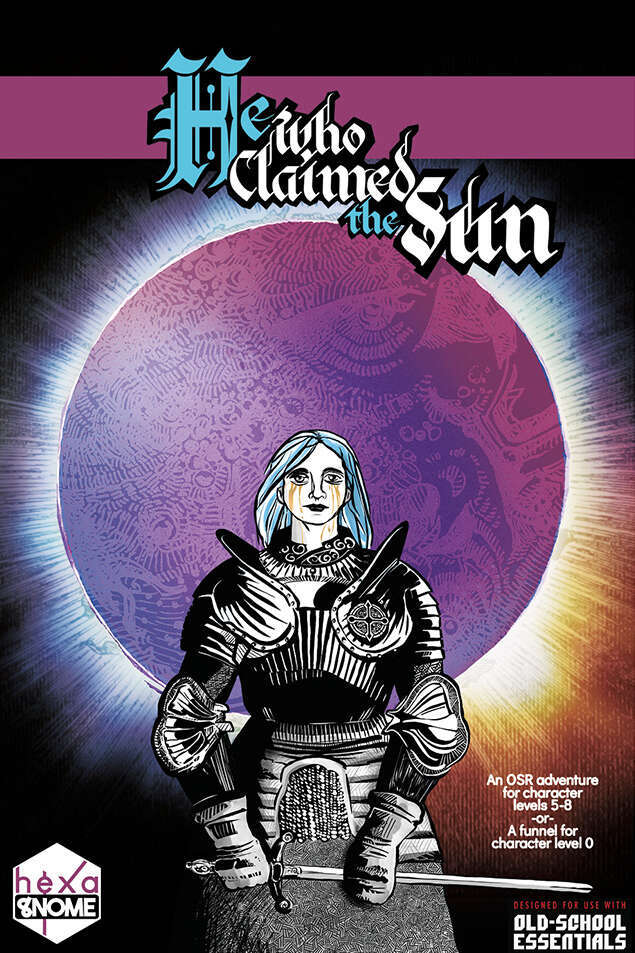
When the One God’s faith washed over the world, the Old Gods of the forest fought back. They fought back with fire, with blood and with ice, and with every season. And they lost. Last night, the cathedral built on the site of their defeat burned, unearthing forgotten stairs… A journey begins, from that unholy crypt through a hellish fairy realm, to the deadly, blasphemous truth.
This 80 page adventure presents a recurring abbey location for your game world that turns in to a complex dungeoncrawl with campaign ramifications. It is deep, full of interactivity, and maddening in its presentation. This will require study and is worth it.
SPOILERS. Have I ever done that before? If you think you might play in this then maybe bail out now and try and get your DM to use this. I don’t think that’s my audience, but, hey.
To give you an overall vibe here, there’s a little designers note at the beginning that finishes up with “This was done for three reasons: its obvious, hegemonic role in sanctioned and unsanctioned syncresis; the fact that it is also a formidable folklore machine; and because it is, as a white-label concept, familiar enough (at least through parody) that most referees can adapt it. Other themes include how beliefs inform communities and societies, how crises of faith impact these groups, and how individual interests impact beliefs.” And then it goes on to actually finish up with “Above all else, this adventure is about solving problems, casting spells, talking to and bashing the skulls of freaky little guys of all sizes, genders, and numinosity.” Fuck yeah man! A designer that knows what D&D is. Let’s raid that keep on the borderlands! And it accomplishes that first goal, the complexities of the themes, while still keeping true to stabbin and lootin. Further, the adventure is noted as being suitable for your level eight party OR a level zero funnel. I’m not so sure completely about the funnel concept, given a few of the encounters and the wanderers/events table, but I think that also gives you an indication of the vibe here. You can explore and accomplish things without necessarily having to turn to high level magics or stabbing everything in sight. Maybe. 1d6 boars that can spit firewalls from both ends is a rough encounter for wanderers. But the overall exploration vibe is there, as well as, perhaps, a real world vibe. In our day to day lives you don’t get randomly attacked on the way to the grocery and maybe make polite conversation along the way.
The first twenty pages of this presents a small abbey. The intent here is that the abbey be a part of your game world and exist until the party reaches a level in which you want to run the core of the adventure. It’s a rural site, the home base of the highest honored paladins of the main religion, The One God. That’s unusual, and people acknowledge it, including the other holy orders who are not always pleased that they play second fiddle to this little abbey in the role of the honored. And yet the abbey is grounded and down to earth, a rural place, not teeming with super-powered clerics and paladins. Grab a heal, a cure disease, maybe a raise dead for the recently departed. It’s a resource for the party to take advantage of. When you’re ready, the church burns one night, which kicks off the adventure/dungeon portion of this thing. Again, as notes by the designer, this is targeted right at the beginning of domain play, with the events then transpiring kicking the world, almost certainly in to a kind of religious schism for which to spice up the domain play elements the party should just be getting in to. Broodmother Skyfortress indeed! Excellent use of the right kind of thing at the right kind of time in a campaign to leverage.
Here’s your spoiler. The One God is a foreign god, who showed up long ago to become the dominant religion. At some point the religion reaches this neck of the woods and comes in to conflict with the two primary deities here, the autumn/spring equinox gods. They did the Persophne thing a while ago and did a merge/dual citizenships thing. They lay a trap, which involves perpetual suffering for one of them, and depose the one god, with the remaining solstice god taking his place, imitating him and stealing his worshipers faith/power. And that was done at the site of this little abbey, and no one remembers it except as the site of a battle where the One God defeated the solstice gods/fey (who had a strong fey/pagan/old world influence.) The discovery that the one god is the solstice god, and perhaps the freeing of the original one god, is going to cause the religious schism of the primary religion in the game world and a whole thirty years war thing with people splitting in their allegiances. The adventure isn’t taking sides, and the One God thing, and rites, play on the complexity of catholicism and its rites and rituals, but it’s not rooted in any real world religion beyond that comparison. Once the church burns down you get access to the first dungeon, which leads to the second. The first is the place where the two solstice gods transferred power back and forth twice a year, with some rituals involved. This has some stronger State Church theming with the rituals clearly being all Wicker Man and their obviousness to more pagan religions in a dungeon with the trappings of an established church with hierarchy. The second dungeon is in the fey realm of the suffering god, a kind of fiery portion of the fey realm, with the theming being more fey-like.
The first twenty pages support the abbey as a location in your lower level campaign world. A brief overview of the immediate environs around the place, some description of the abbey compound buildings and church (Loot!) and more importantly the people there. The monks, the paladins, some lay people who work there and eventually some stone mason who show up a few months before the fire. These NPC’s are relatively terse written with some little details that help them fit in to a game. Emphasis on fit in to the game. Trivia is avoided and instead the emphasis is on detail that could help add color to the game. One chick, who has emotional blowup, has this “This time, her father got engaged to her childhood friend, two months after her mother’s passing” or “She’s likely to fall in love with the next stranger who shows her kindness.” Or, for one of the principal monks, in full “Father Batty- Second in the Order, the prevost is formally in charge of the cathedral, as the bishop’s proxy. Hawk-like features and slick platinum hair, he moves quickly and wastes no words. He plans to become a bishop, and will do whatever is needed to nip any budding scandal.” I think we can see how his little details would play in to both the lower-level interactions before the fire and then, once the fire happens, the ensuing potential for schism. The church descriptions might be a little long, but their heart is in the right place and the NPC’s descriptions are all quite solid. The events table, along with some rumor tables, are nice little petty dramas and things that help the abbey come alive. A wedding! Or “ Frau Gavarn may be seen, sneaking a bowl of hot soup to Brother Lefftish. “ Someones drunken brother shows up and may punch someone. IThey are great!
One night the main church burns down in a mystical/weird way, revealing a set of stairs uncovered leading down. The head abbot organizes an expedition down. The Paladins, inexperienced, will investigate, says the abbot. They let the party take charge, recognizing their greater experience, and a few stonemasons and monks join. And maybe some ley/etc based on past events with the party. The lovestruck and wannabe adventurers impressed by the party sort of thing, sneaking in.
The first dungeon is thirteen complex rooms. This is the site where two gods performed a ritual to swap power twice a year. In addition to that you’ve got some stuff mixed in, the consequences of the plan that deposed the One God. Once you’re in then you’re in, a stone mason forgets his tools and tries to exit only to be burned to ash when crossing that weird symbol on the threshold. There’s a ritual to perform. One of the room has a depression in the earth floor, which is itself unusual here, this is a stone place. There’s a cold iron dagger. A humanoid has to lay in the shape and spill blood from the dagger. Then hundreds of stems sprout from their body, growing in to daffodils and their body vanishes. Fat angry flies swam out and then swarm down the mouth of an effigy also in the room. The effigy then gives silent birth to the reincarnated person. This is, of course, the Vernal Equinox room. How’s that for a themed ritual? Recall, these rituals are being performed by gods, and fit in quite niocely to that fucked up kind of immortal power thing.. One of the rooms has The Night Sky (literally) trapped in it which can, in its own fucked up way, provide some assistance by answering questions. Another strong impression was made by the Autumnal Equinox room, where a loved one (“They look like deceased loved ones: lost PCs, beloved NPCs, parents, lovers, friends, pets… “) rises from a sacrilegious to embrace a party member lovingly and then vanish. “4 kind specters”, notes the stat block. The embrace causes an energy drain. And gives a boon. There are a few real traps here, like a save or get turned in to wood trap, that careful play could avoid, and this also hints at the higher level/experience play required in some places. Utility spells, auguries and the like are gonna come in handier than lightning bolts. Or a funnel of level zeros. 🙂 There are also some “well what did you think was gonna happen dumbass?” things. Walk through a wall of fire and get burnt. Walk through the other direction, the right way, and don’t get burnt. This is a puzzle dungeon.
You will eventually make it to a fey portal, the realm of the Huntsman. We transition then from mostly puzzles to mostly NPC”s in fucked up situations and a complex web of hatreds and goals to be negotiated amongst the ten locations, mixed in with a little fey absurdity. (There’s a Castle Amber like “you can also go visit the rest of this realm” type thing going on also, a page of locations and some notes for running them, for a party who insists on coloring outside the lines.) Encounters here, particularly the potential for wanderers, are going to involve more combat, potentially, and this is where my skepticism of a funnel come in. “Red hands, hanging from a tree, 1d4 drop on those approaching, stats as wraith” or “1d2 Torchbears, flaming, ignivorous bears (stats as owl bear).” Noice! Good retheming to whole fire motif of this area. While the first dungeon may contain some implications of uncomfortable truths, when thought about, this second dungeon is where we can free things will results in godly manifestations in the real world. It’s one thing to kind of guess your religion is a lie, it’s another to then have several new/old gods reborn/freed and KNOW things were a lie.
Theming throughout is spot the fuck on. From the mundanity of the abbey and its petty dramas, organized towards actual play, to the first more Organized Religion dungeon to the second more Fey World/horrors of paganism dungeon, it hits over and over again. Both in the overall theming and in the little things going on. “Now and then, a rumble: bits of high masonry falling” Yup, that’s what happens after a cathedral burns down. Blind Satyrs, drinking, hiding from an avatar, with a 10,000 step stairway leading down to the base and the rest of this corner of the fey realm, if you want to.
Descriptions rock. “A lumped corpse, mummified inside a hoarfrost-coated armour; angry flames erupt from her chest cavity, pierced by a blackened spear “ That’s Saint Larme. There’s a sword, frostburnt black at its feet. Cursed, but, the Witch can turn back in a holy avenger. The witch is a mega-cunt, though, in the worst possible ways. Classic “friendly” hag. The entirety of the dungeons are sprinkled with little sayings that the Paladins might drop in. “We CANNOT leave her thus! We must carry her hallowed remains back, and Any give her an honourable grave! “ Uh huh. Immersion here is VERY strong. We’ve got a drider type thing in place with this “A pair of eyes that shine with hunger, above mandible-arrayed lips. Four more eyes that betray pain: she’s been pregnant for decades. Things crawl inside her gravid belly; it swells; bulbous— it rivals her arachnean abdomen in size. “Ey can feel dem, yoo kno? Mey tsildren, hatsing. Devooring eats other. Breeding. Starteen, all over egein.” “ Ewwww! Cool as fuck.
Treasure is strong, both in the mundane quantity and descriptions and in the relics/magical. Overall value is applicable to the adventure if you can loot bulky things. There are boons in places like “Deliver a Truth: let the player read a random page of this book for a number of seconds equal to half their WIS score.”
The adventure is rewarding, figuratively and literally, and complex. And therein lies my primary grievance.
The meme of “running it without reading it first” is just that, a meme. The goal is something easy to run and the designers work to make that so. This adventure, while it’s going to get a Best, is complex to the point that it is going to take some study and thought. And by “some” I mean “a lot.”
You have the personalities of the hangers on. This is NOT an escort mission, in any way, but those folks are there and have some reactions to things, yes? The first dungeon has a non-trivial ritual and The Consequences of the Depose and a lot of effects, including holy days, urns, effigies, and runes on the floor, all to understand, as a DM, and navigate for the players who are going to try and do player shit. There is a complex set of relationships in the fey realm, none of which are going to be really straight forward in their solutions and/or navigation. I’m not really bitching about this. The environment is deep and complex and I wouldn’t have it any other way. That’s what gives it the soul it has and makes it rewarding. It’s just not presented in the most comprehensible manner. Or, maybe, in a manner that lends itself to easy comprehension to the degree needed to it easily.
There are summaries, but I found them a lacking and not really covering the overall situation. After three read-throughs I’m sure I don’t fully understand the first dungeon, it’s relationship to the second, and how to navigate the entire thing. There are sub-systems here, like the NPC’s and the floor wards and a tangled flaming wood path, that you need to keep in mind that are critical to the adventure. Maybe there’s a little too much exposition on these topics, or an emphasis on the mechanics? I’m not sure. The Hexagrams of Anniliation, the floor wards, take up a column and while I get the gist “wrong way bad, right way good”, there’s a lot going on here. As with some immovable rod locked doors and the 8 spectral votive bowls, attuned to holy days, which control a Planar Shield which gimps the usual spells but you can maybe do something about?
This is not helped by the chosen format, especially in the first dungeon. A mini-map, taking center stage, with little arrows pointing towards things that leads to explanatory paragraphs comprise the descriptive/layout style. There’s a hyperlink thing going on that mixes in a blue font that will take to that detail, but I think maybe that distracts and I suspect isn’t needed most of the time. I found myself wishing for a traditional layout, or, perhaps, wonder if a more traditional layout wouldn’t have made comprehension easier.
Still, absolutely richly rewarding. Excellent job on theming and in creating an environment to explore and overcome through intelligence, wits, roleplaying, and dumping in a fucking fireball on those fucking blue babboons. (The witch ain’t gonna like that! And she’s a central figure …) Great tie in to domain play. No right or wrong or morally grey, just a place, with consequences, depending on actions you take. It rewards a thoughtful party both in avoiding death and in gaining great loot/relics. And you are gonna have to study it to get there.
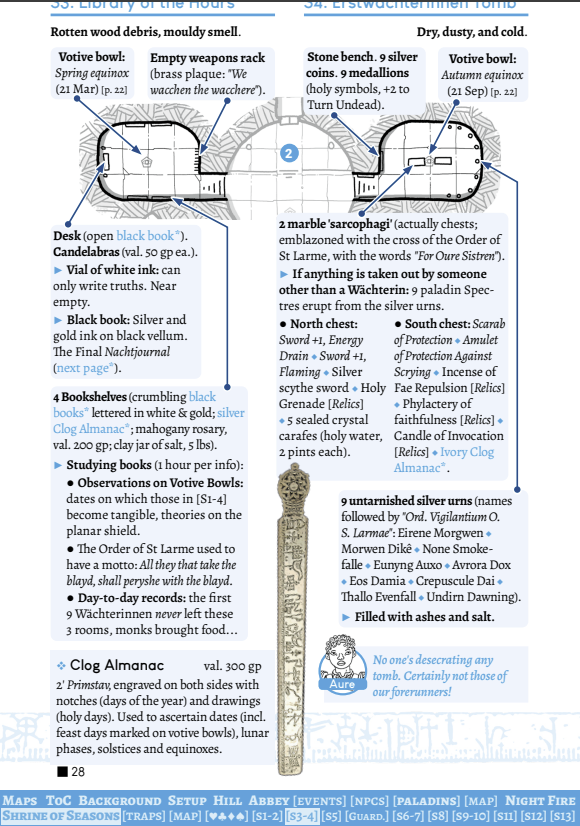
This is $10 at DriveThru. Fucking thing is a steal at $10. There’s a preview, which is currently broken. (Seems like it might be a DriveThru thing, I’m getting XML back.) And there are some thumbnail pages on the blurb page. There’s also a fourteen page “toolkit” included with time trackers, npc’s, and other shit on it to help you run it. I’ll dump in a page from the first dungeon to help you understand the layout issue I’m having trouble with.
Hexagnome is running three for three. I’m going on vacation soon so I’m written out until Mid-August and rescheduled things so this review is dumping sooner than that.
In the delta city of Portic, the heralds walk the bridges and call for the brave to save the settlement from the pernicious Thieve’s Guild. Papyri offering rewards in the thousands of gold pieces are handed out to the armed, the weaselly, and the wise. Advertising had its effect and dozens of applicants turned up at the Lighthouse. Even after describing the undead infested island, and the underground trap maze expected to confront them, four groups of adventurers drew lots to select which night they enter. The party is assembled, with retainers in tow, as the sun sinks west on the third day. No one has yet emerged from the Odd’s Sink (the Island of the Death). Straps are tightened, supplies checked, and holy symbols kissed as the guards move the barricade on the pontoon bridge.
This 26 page adventure uses about sixteen pages to present forty rooms in two tomb/undead themed dungeons. It is … obscure? In a good way. Full of tomb encounters that are familiar and yet not boring old vanilla tomb encounters. This feels like a lived-in world. That needs an editor in charge of formatting and layout.
You’ve read the marketing blurb, above, and it sounds a little early days to me. Like, 1972 early days. But, let’s back up a minutes and cover what has lead to that marketing blurb, above. We’ve got an old city. The nobility want to revolt cause they don’t like the current .gov. Revolts cost money. They get a loan from the local Guild Bank. This is a legitimate front for the thieves guild, which the current .gov kind of telerates. Revolution successful, there’s a new .gov in charge. Oh, the nobles have a VERY large sum to pay back to the Guild bank. And don’t want to. And the new .gov HATES thieves. Thus starts a pogrom against the thieves and the guild bank, which has an air of neighborhood watch death squads to it, an/or citizen checkpoints/militias. The last of the guild has been tracked to the Isle of the Dead, a funerary isle for the city. Chill during the day for burials, at night the undead walk about and giant beam of blue light shoots up into the sky. And the last of the guild was seen descending in to a tomb tha the light shoots up from. NOW you can go to the lighthouse and apply to root out the last of the guild … and you’re third in line to do so after drawing lots. Needless to say, your turns pops.
There are two dungeons to explore, each with about twenty or so rooms with a “tomb” or catacombs theme to both of them. Supplementing this is a small handful of other encounters nearby. A ship anchored offshore that could be aligned with the guild. Another, with a letter of marque, bringing in smugglers and pirates. Not exactly an adventure locale but more support for play AFTER the tombs are entered and the party returns out again, either successful or taking a break before they reenter. IE: things to support downtime, and such. This is further supplemented by eight or so “events.” Each takes up about a quarter of a page and details some things that could happen to complicate things. If the party returns out of the dungeon then maybe they get approached by someone and a conversation is had and an alternative entrance is offered, or bribes, or so on.
I’m hoping, from all of that, you take away of a kind of context tha the designer has provided for the adventure. A context that all directly relates to things going in the adventure that a DM can use to add interesting things going on in the real world, to riff on and further enhance play. Specifics. It gives the world a kind of lived-in feel. The dungeon encounters, also, have a kind of lived-in feel to them, but its done in a different way. One room is kind of partially flooded. Below the water, is a grate that shifts if any step on it. (That, alone, is pretty nifty room feature. The use of a shifting grate implies things that a static grate does not.) “The Red Tree brigade, who entered the vaults first, are still here. They move through the water, their mail and robes torn, the wizened and twisted shapes no longer alive. They thrash through the water toward the warm meat of the party. – Red Tree Brigade Ghoul (3) “ The flooded room. The grate in the floor. The SHIFTING grate, and then the former party. It’s layered, and feels real to me. And the adventure does this over and over again. I think tomb dungeons can usually feel boring. But this has more of an undercity vibe, with tombs, vibe thing going on. Not completely, but there’s enough that it does bring a freshness to it. Ye Olde Slamming Locke Door is present as a trap room in this, but the room fills with smoke, a real life hazard that is quite seldom used. And this in spite of the twenty-ish room size of each of the dungeons.
And this thing is a PAIN. I mentioned “obscure”, yes?
It’s like, all over the place. Sometimes we get a “you” in the descriptions. “A set of creatures clunks toward you, heavily decayed, skull domes showing. …” Sometimes there’s a random monster stats in a room that IN NO WAY mentions a creature. The rooms are inconsistently written, not clear in many places, or similar features described different ways, in the same room, making you wonder if you’re missing something. The text is … obdurate. Lengthy, maybe with a touch of self-indulgence, but not falling in to any clearly recognizable sin, like backstory, trap and door porn, or explaining why. Maybe a little of the if/then style. It’s just hard to dig through it all. Hard, but not unrewarding.
I am waffling, back and forth, on the Tarichan adventures. Best. No Regerts. I’m going to Best this one, I think. But, also, you know what I really wish? That Daley keep writing. Keep working on his products. And every day go back and edit the manuscript to this adventure for ten minutes or so. Every day. Not with the intent to publish it again but just to rework it and try to clean it up. Call it a daley trip to the adventure formatting and writing gym. Just to kind of get in the practice of seeing what’s possible, without any pressure to produce.
Anyway, good little necropolis adventure. and, frankly, I think Daley is about at the point in which he’s on an auto-buy list.
This is $3.50 at DriveThru. The preview is fourteen pages, more than enough to get a sense of the piece.
By B. Wraven Wright
2Die10 Games
Dolmenwood
Levels 4-5
Four months ago, Father Wolfgang and several other members of the Church of St Pastery’ clergy were having strange dreams that all had one thing in common: a call of pilgrimage from The One True God. Father Dobey, Vicar of Lankshorn, initially had these strange dreams also but they faded in frequency and severity for him while the opposite was happening to Father Wolfgang and the others. Having been compelled into blind pilgrimage towards the direction of Hags Addle, Father Wolfgang and those afflicted with these dreams were confronted by Father Dobey, who declared these dreams as heresy. In doing so, the pilgrims openly questioned his piousness as well as his status of Vicar of Lankshorn. Father Dobey, eager to avoid conflict, decided to let the pilgrims go on the condition that they return in one month’s time. The pilgrims agreed and took their leave with the vicar’s blessing. One month has come and gone, with Father Dobey wanting to know what happened to the pilgrims for a host of reasons…
This seventeen page adventure uses about five pages to describe 27 rooms in a small dungeon. Hack till you drop and do little else as you explore the monotony of uninspiring rooms.
I was quite disappointed with this one. Dolmenwood has been hitting at a decent rate, but, I guess, as a sign of its success, “more is coming out now.” I would hope you can understand the euphemism. The map, also, looks promising. It’s a larger Dyson affair with forty or so rooms on it, only about thirty of which are keyed in the his adventure. Some columns, stairs, curtains, an overhead passage and murder holes. Almost none of which is taken advantage of in te text. ?
The local clergy been having God dreams. The vicars gives them permission to go on a pilgrimage to their dreamed of site. They don’t come back so in you go to find them.
“The One True God who weeps in the temple underneath the dolmen” is pretty strong flavour. There is no preamble to the adventure, no investigation, so there’s no build up to this before you get to the dungeon. Once in the dungeon the theming, of The One True God, and the weeping, is essentially not present either. You will find a weeping statue face (with decent art piece to accompany it) but that’s it. What you WILL find are a bunch of clergy/clerics. They are all scaly bipedal wolfmen.
Why are they scaly wolfmen? No clue. You just show up and there are these empty, or mostly empty rooms and more than a few of them have these scaly wolf men in them that are doing clericy shit. And they attack you. In fact, everything and everyone attacks you in this. Monsters attack you and in a couple of rooms there’s a false floor that breaks away in to pit things. That’s it. That’s your interactivity.
I cannot emphasize that enough. “You see 4 beings standing, frantically “reading” scrolls out loud in a hissing, barking language.” Thats your room. Oh, also, in the description for BEINGS, “Four LUPINE CLERGY stop praying and attack on sight.” Mystery. Wonder. Exploration. Not present. Just stabbing things that attack, which are the scaly wolfmen clergy and some black blobs that are in a few rooms. More than a little one-note. Oh, and the “break through the false floor” pits, Order of battle, for our clergy? Nope. They just sit in their rooms and get stabbed. Stab stab stab. Stab stab stab. Stab stab for the fun of it, stab stab for the fun of it, stab atb for the fun of it stab stab for the fun of it!
There’s little to no treasure present. The last room of the dungeon has Lareth in it. There is not hint, anywhere, that Lareth is about. “As you get close enough to the tapestry to make out the material it’s made of, you see that the ground starting in front of you winding all the way around the room to the pillars on the other side, is freshly turned earth that has a strong sickly-sweet smell of vinegar.” That’s Lareth for you, all vinegar-smelling! So, an earth wyrm pops out of the dirt and then attacks. LARETH WAS BEHIND EVERYTHING THE ENTIRE TIME!!! Oh, Lareth, such a card. No hint. No build up. Nothing that means anything. Just stab some scaly bipedal wolf clerics and then in the last room a wyrm pops up from the ground and you kill it.
Formatting is ok. Headers, color changing, underlines, bolding. You can find things well enough. It also notes the door, light conditions, and exits in the rooms. I am not amused by anything done by rote. I think, that, unless told otherwise, we can assume darkness, or light, depending on the mood of the individual dungeon. Note what’s different,
I don’t know, man. It’s just a VERY basic and simplistic dungeon. It;s padded out, with doors, and light and exits. It’s got some formatting to make it scan nicer. But the core of what’s going on it is quite simplistic. The One True God is not played up. The wolf dudes get nothing. The Lareth behind the curtain is not hinted at. There’s no build up. There’s no really e octave room descriptions, just a bunch of They Attack!s. There’s no insidious presence in town. There’s nothing really to EXPLORE ot interact with in the dungeon, proper. Even the scaly wolf dudes just sit around waiting to die with no order of battle.
This is different than, say, a raid. In that case you know what you are doing and the various encounters and environments are engineered by the designer to support the raid. This is just … basic and static?
This is $1 at DriveThru. There is no preview. Sucker.
The link to the product in this review is probably an affiliate link. If you follow the link and buy the product, I make some money. Just thought you should know.