
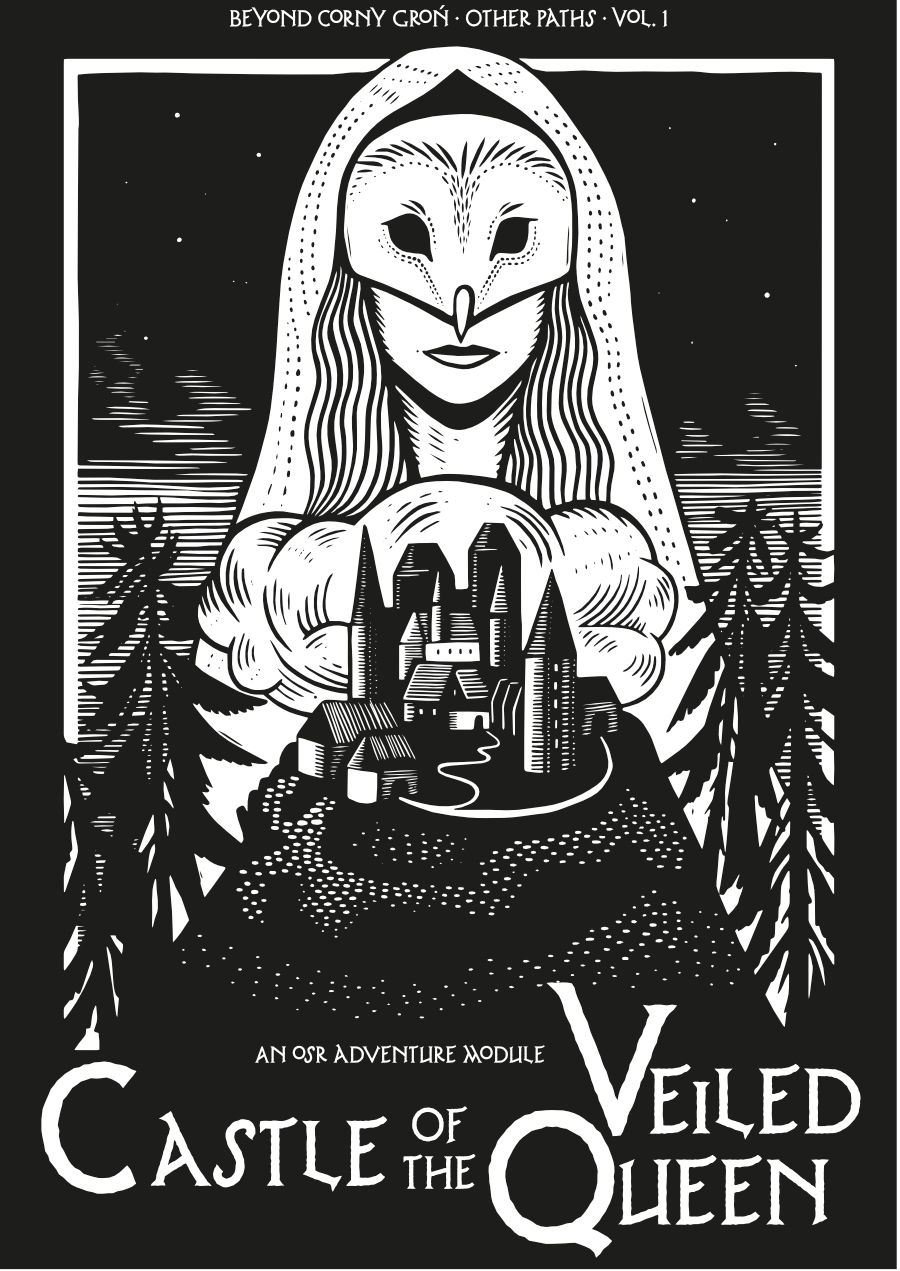
By Kuba Skurzy?ski
Nerd Sirens
OSR
Levels: Low to Mind
[…] To protect St. Honegund’s holy site, stone wall and tower were built. Tower became inhabited by owls over one, full-moon night. From that date onward, the full moon was a special moment for the inhabitants of the fortress, as during these nights the foundations of the so-called Moon Tower would light up with a blue glow, as a sign of the divine providence over the castle. Imperial guards still repeat a frightful prophecy to each other, that when no more owls will be nesting here, the whole Karpaki shall be flooded by the infernal heat of the Eastern Sun. So far, legend has never been verified, as despite many sieges of the castle, the Moon Tower has not fallen to ruin, and owls have always been around.
This 44 page thing is not a adventure. Maybe a setting? A castle description? It’s Wall of Text, that’s for sure, with many issues that stem, perhaps, fro a lack of understanding of what the thing they were writing IS and thus how to write for it.
It’s a castle in some pseudo-historical-like central european setting. Gunpowder, Kaiser-moustauches and so on, mixed in with fairies and medieval markets. But, it’s not really an adventure. It’s like you included the Keep portion of Keep on the Borderlands but not the Chaos Caves, but then padded out to many more pages the keep. There are castle rumors. “The tower will fall when the owls leave the roosting!” Hmm, sounds familiar. Anyway, shit like that. Some rumors about the castle, some rumors from servants in the castle, a random guard generator as well as a random prisoner generator. And, a nice little section on the guards. Their hour, rotations, how they respond, and a note that they can also be lazy, corrupt, and don’t necessarily dislike the prisoners so they can be lax and give special favours at times. That’s a nice bit of realism and a nice little appeal to the party interacting with both groups, both to exploit or make friends with. There’s also a decent little wandering table, with things like a soldier or servent trying to witness something suspicious/illegal and wanting to report it to their patron. Decent. A situation, which is what things in adventures should be. Something for the party to exploit and a nice appeal to richer interactivity inside the castle.
I’m assuming that this is an EASL adventure and it shows through in a place or two in some awkwardness in the language. “The old well was drilled for sieges – on a daily basis it’s secured by brass plate and the castle crew does not draw water from it.” I’m not quite sure what is being communicated here. It IS or IS NOT ever unlocked? The phrases seem to contradict itself. These DO tend to be the things I care more for, I’m chill with some awkwardness but when I can’t figure out what’s going on in it then problems arise. And there were a lot of people associated with this in production. Weird
But, really, the core issue with this “adventure” is that it lacks a purpose. And that the way the adventure is formatted/laid out/described can’t then match the purpose/objective of that part of the booklet/adventure/whatever. We know, for example, that a map/key format is great for a kind of exploratory dungeon. And that other types of adventures, like investigations, or social adventures have other formats that work better for them. But this booklet doesn’t really know what it is so it can’t really match its formatting to it.
It is supposed to be, I think, a castle setting? This is the local major castle in the area. These are the people who live there. These are various general parts of the castle. And, then, for each part of the castle, these are some Things Going On. So, bandits hiding in one area, caves underneath with more. The blacksmith and carpentry shop.
There’s no real thrust to any of this. In this way it is very similar to the Keep. You could, if you were so inclined, do something with the various parts. If the part is visiting then you could drop in part of it, or, rather, use some part of it to spice up their visit. But there are a couple of issues. Unlike The Keep, there’s no real reason to visit. In B2 it’s natural to visit the Keep as a home base, and, even, some of the rulers and such have a reason to eventually interact with the party. That larger framing is absent here, so it really is just a place for you tp drop in and use. But, also, it’s not on the borderlands; it’s a fairly major place. So we’re looking more at civilized play/intrigue. And then the various areas inside are not really set up for intrigue. Theres prisoners, in the jail underneath, but no one and nothing to hook you in as a small todo or such. IF you wanted to include a prisoner for your own game then you could insert them and create some play from it, but this is all just a general framing. Do you want to explore the included Moon Tower part of the keep? Why? Well, there’s not much here. Yo uCOuLD place the McGuffin there, or give the party some need to go there and thus do it. Or create your own intrigues in the political realm and thus give the party a reason to hobnob. But, again, with little purpose to it from the product proper.
So, we get the various parts of the castle explained in a very general way. There’s specificity here but no interactivity to speak of. Its missing things to get something going, but provides a setting if you want to add your own. And, thusly, not an adventure but rather a setting. And, given the lack of interactivity in the product, a kind of weaker one at that.

And, given this focus, or lack thereof, the formatting it off. General descriptions, with some specificity. Lots of overviews and bullets, to the point that I think it becomes kind of a wall of text in places. They are used as paragraph break rather than calling attention to important things and summaries of them.
The closest I can get here, I think, in comparison is the fortress supplements from MERP. Here’s a place. You could do something here but we’re not really going to provide an incitement to do so.
This is $10.50 at DriveThru. There’s no preview. Sucker.
https://www.drivethrurpg.com/en/product/532586/castle-of-the-veiled-queen?1892600
Apparently, this is not AI. Rather, there was a kickstarter to expand on a PWYW adventure (that might have gone off the rails at some point?)
Thanks, detective! I love reading about AI in every single review comment section, even for adventures that don’t use it!
Yeah the best thing about this site is that it is no longer about adventures- but about hysterical accusations and sober reflections on AI in every. single. fucking. adventure.
Bryce, make a decision one way or the other to either just filter that shit out in whatever way you feel appropriate (several have been suggested).
Or this place becomes a fascinating study into human paranoia of r3plicants taking over our creative spaces. Like tears in rain. Or cesareans firing off the coats of Ohio. Lost, all of it lost like rears on the train.
Sorry… My non “localisation” is showing.
What does “Or cesareans firing off the coats of Ohio” mean?
At least I’ll expand my vocabulary while dredging the forums 😉
It’s from the monologue at the end of blade runner. None of it is explained, it’s just glimpses into the wider universe of that world.
“Attack ships on fire off the shoulder of Orion.”
It’s from the movie, Blade Runner, replicant Roy Batty’s (Rutger Hauer), final soliloquy:
“I’ve seen things you people wouldn’t believe. Attack ships on fire off the shoulder of Orion. I watched C-beams glitter in the dark near the Tannhäuser Gate. All those moments will be lost in time, like tears in rain. Time to die.”
Yeah, because it really fucking matters if we mislabel a shitty human created adventure as AI slop.
“We know, for example, that a map/key format is great for a kind of exploratory dungeon. And that other types of adventures, like investigations, or social adventures have other formats that work better for them.”
Like what? What is a format that works for investigations? Genuine question, since this adventure is extremely similar to one I am writing right now (castle investigation). I am keying the rooms right now and it feels off. Because it’s not really a dungeon. One doesn’t expect the players to go room by room to investigate, right? So what format could work for such an adventure?
Seconding this – I’ve just released a very similar adventure and I ended up using some pretty ‘hacky’ workarounds to make it feel less like a procession of rooms (random events, a crude day/night cycle, NPC schedules), but ultimately it does feel like a constraint of the format.
Ditto with the ‘Here’s a place. You could do something here’ problem – that’s fine for a dungeon full of treasure, less fine for somewhere with more complex/’story-driven’ goals, like an investigation.
Very curious if Bryce/others have any ideas for best practice here.
At the moment I have both. The schedules, events and so on… on top of the keyed rooms. It just feels like the keys will be redundant? Like, even if the PCs hear a rumor that X is happening in Y room and go there to investigate, sure, they’ll play out the room, but i dont think there is the incentive to continue opening doors after they are done, like the’d do in a dungeon. In any case, I’m about to playtest a preliminary version tonight and see how it goes.
That sounds like the right balance. The room key should be very bare bones, so as not to obscure what the adventure is actually about. I seem to remember this was done well in “Kidnap the Archpriest”; not so well in the Cthulhu Medieval adventure “The Lord of Nombrecht”.
Terror at Trollmarsh White Dwarf 74 for AD&D is a good one.
Thanks a lot for the suggestions! Will try to find then and take a look.
Sounds like a good discussion piece for the forums.
I have a good example of a mystery adventure *not* to emulate, “Huddle Farm” from Dungeon #12. All the information is buried in the map/key format. When I ran it I had to practically rewrite it.
I think for mystery style adventures, you’ll want an NPC list, with everyone they know, everything they expect, etc. You’ll also want an event schedule, if that’s important. Finally, even though the room keys are minimal, you may want to highlight clues that are available in each room. Better yet, maybe in the NPC section you might include a blurb on how so-and-so will react if confronted with “clue #1 in room 6”. And maybe an ‘order of battle’ for the villain(s) when the jig is up.
The Heretic
I’m thinking of running “Huddle Farm” myself in the near future, and I agree: as an investigation it is *far* from user-friendly.
The Alexandrian has two series of articles related to this.
The Three Clue Rule: https://thealexandrian.net/wordpress/tag/three-clue-rule
Node Based Scenario Design: https://thealexandrian.net/wordpress/tag/node-based-scenario-design
Take a look at the Three Clue Rule (https://thealexandrian.net/wordpress/1118/roleplaying-games/three-clue-rule) and the links at the ‘Further Reading’ section at that link (in particular, the stuff about node-based scenario design).
And I see I should have read further than the comment I was replying to!
RULE #1:
AT ALL TIMES- Avoid Red Herrings!!!
RULE #2:
AT ALL TIMES- Avoid Red Herrings!!!
False clues are time wasters and actively work against you at the table. Think about it- you have more than enough trouble anticipating your player’s actions. Why would you include anything to purposely derail your Game’s progress?
RULE #3:
Be adaptable. Meaning when your players are derailed and following a wrong line of investigation-listen to their reasoning-just maybe you can make their incorrect theories work out better than the plot line you came up with. Yeah I know all about the Quantum Ogre, running a railroad, and Schrödinger’s Cat. But if the player’s reasoning provides a better group experience-why not? You’re not forcing a predetermined encounter or result you are modifying your story to fit the group dynamic.
Tough call. Red herrings are a bit essential to a mystery, otherwise the players are just following a path of obvious evidence to an inevitable conclusion (i.e. a railroad, no “mystery” at all). Some of the more famed mystery modules are absolutely loaded with red herrings; L2 Assassin’s Knot comes to mind immediately, since it starts the players with with three false leads and no actual evidence trail to follow.
Yeah, herrings will send your party down dead ends and waste peoples’ time… but I mean, isn’t that kind of the whole point of a mystery? Isn’t that where the actual challenge derives – sorting the pertinent from the non-pertinent?
There’s a problem though, you can create red herrings without even meaning to. What might seem like a throwaway line of description to you might be the biggest clue in the world to the players. This happened to me while playing D20 CoC back in the day at a con. The GM said that there were strange looking fish fossils at the dig (makes sense, prehistoric fish are heavily armored) and we fixated on this for over half an hour.
Red herrings are okay, but you need to provide additional clues that confirm to the players that what they had was a red herring.
The Heretic
“The GM said that there were strange looking fish fossils at the dig (makes sense, prehistoric fish are heavily armored) and we fixated on this for over half an hour.”
lol, your red herring was literally fish. That’s hilarious.
The Heretic raised the point I was trying to make. You are not writing a novel. You are not running a railroad. You don’t control what lines of information your pc’s WILL get sidetracked on. Don’t add to the chaos by adding deliberately false lines of investigation. Especially in short one shot adventures.
That being said -this dnd story (currently on Reddit) has stayed with me for a long time.
r/DnD icon
Go to DnD
r/DnD
3y ago
bytor_2112
The Scarlet Hairband: How to intentionally plant a false lead AND make your players groan
People I know have really enjoyed this story from a homebrew session (5e) a few weeks back, so I thought I’d share it with the community — maybe it can spark some creativity.
Session 1 (maybe November?): On the side of the road just after setting off to find the cause of missing trade caravans, one party member (Gnome, Spore Druid) scans the ground for any clues. On a whim (and thanks to a great roll), I tell him he’s found something — a sort of hair adornment or accessory, round like a ring, scarlet in color, with a faded but unique insignia on it. I draw a symbol off the cuff and the players take some notes.
What I have done here, by doing that, is trying out something that has been wildly successful that I never really tried before as a DM: laying down some tracks before even I know where exactly they go. I have the ingredients and some framework, but with this, I was only armed with a glimmer of an idea, and had no sense of just how flawlessly this would eventually play out.
It’s session twenty-something by now, in early summer, and the same player has become personally invested in discovering what this thing might mean, and takes every opportunity to search new areas for this sigil or anything similar. (This was helped greatly by the character’s conspiracy-theorist mindset. He tells anyone who will listen about Flat Plane theory.) But as the story developed, I finally found my chance to cash in on almost a full year of questions.
The team is smuggled with the cargo of a merchant ship to avoid some well-connected enemies. In the cargo hold, I tell the player that finally it’s right in front of him: the mysterious symbol, on the side of a barrel in the cargo hold. Overwhelmed with excitement, the party watches as the gnome procures the tools to pry open the container.
When it’s finally opened, the party is hit with a horrific stench. The barrel is loaded up with pickled fish.
As my players try to understand this turn of events, one asks for details. I tell them that to the best of their knowledge, this fish species is red herring.
What followed will be one of the most treasured memories of D&D I’ll have for years. The players are in varying states of groaning and howling with laughter, and the player who opened the barrel simply walks away from the table. It only compounded when I told him they’d had all the info with them the entire time, because what the party had been carrying all these months was, in fact, a red hair ring.
If you’re the kind of DM that can walk the line of cruelty and hilarity with your players, feel free to adopt this to your own campaigns. Best reveal I’ve ever dropped on anyone.