
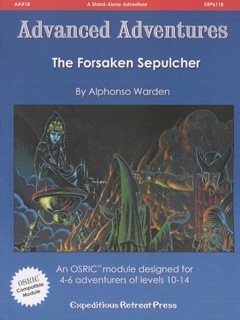
Once upon a time a high-level Cleric and a Magic-user hatched a get rich slow scheme. They found a rocky planetoid in a pocket dimension and sold/built high-end tombs to the wealthy and powerful across the multi-verse, headquartered in a mausoleum. They died and the tomb complex was forgotten. The party get access to a map and instructions to build a gate, and off they go!
The complex has two tombs detailed and five others briefly outlined in case the DM wishes to expand the adventure. The first detailed tomb is The Mithraeum of Elissa, for 4-6 characters of levels 10-12, with at least a +2 weapon in the party. The second is The Crypt of the Slime Mage, for 4-6 characters of levels 13-15, with at least a +3 weapon in the party. Both are similar enough that I believe I can discuss them at the same time; The Mithraeum has a few more undead and the Crypt has more slime-type creatures.
Both tombs are essentially linear dungeons with some puzzles thrown in to the rooms with a boss fight at the end. This is pretty much an inherent problem to all tomb-raider adventures. If the tomb is intact then there’s nothing in it but constructs and undead, and if you’re building a tomb complex then why have a choice in which way to go? There’s no wandering monsters, and there’s no teleporting, blinking, pass-walling within the complex. As I’ve stated before, I don’t like this. I know why it’s done: to keep the party from skipping over some challenge that the DM has put together. I still don’t like it; it takes away, by DM fiat, what the party has worked hard to achieve. If the wizard can scry the tomb and wants to teleport to the end, so be it! Thus the inherent problem with high-level tomb raider adventurers.
How do you feel about Save or Die? I generally don’t have an issue with it. After all, if the party sees a bunch of statues frozen in fright, cowering, or posed to strike, then any decent party will dig out their blindfolds & mirrors for the Stone Gaze monster about to come through. Not though that in that Save or Die monster attack there was some warning given: the statues. That’s how Save or Die situations are supposed to work: an insightful party will pick up on clues that the DM drops, probably quite a bit more subtle than the statue example, and will take steps. In this way the Save or Die is fair. “Standing from the doorway your torches can make out a part of the room. It seems rather barren except for the rubble on the floor.” This prompts questions from the party about the rubble, which leads to questions about the ceilings and walls, which leads the party to believe that the ceiling is going to lower down on them … IF the party picks up on the rubble. I’ll never forget the time I was taking a rare playing opportunity and died by a polymorphed medusa. No warning there was medusa about, and she wasn’t evil ENOUGH that my detect evil spell worked on her. Uh huh. That’s a bad Save or Die.
This module has A LOT of Save or Die in it. Generally the party walks in to a room, get’s 10′ in, the door behind them slams shut and then wizard locks behind them. Then they get to save or die a few times. Of the 11 rooms in the Mithraeum, 7 have doors which will slam shut behind the party and then Wizard lock. It’s a mighty lock also; you need two Knock spells or two dispel magic’s plus a combined strength of 40 to get the doors open, both the first time, when you enter the rooms, and to leave the rooms. The Save or Die in this tomb is limited to a couple of encounters with vorpal-wielding creatures, and a pit to hell in the center of a small room with a strong suction power. You need to make 8 strength checks at -2. If you miss two then you are automatically gated to the abyss when you touch the edge of the pit. i wasn’t too happy with this encounter, or with the rather lengthy (a longish paragraph) description of a mural depicting the Mithratic tauroctony ritual, especially since it was useless flavor text and had no impact at all on anything in the adventure.
The second tomb has 14 keyed encounters and it in this one that the Save vs Die issues really come to light. There are five or six rooms with the “door slams shut and wizard locks” details, and of course all of the doors require the double Knock/Dispel Magic to get through and the dungeon has the same prohibition against teleports/blinks/pass-wall, etc. There are at least 9 Save or Die traps/effects in this tomb, all with some kind of negative modifier to the save, -2 to -4 typically. There’s an additional trap which allows no save, a Power Word Kill. One or two of these have some kind of warning, IE: Yellow Mold or pushing a button, however it’s still not enough in my opinion to justify the Save or Die.
Clearly, I had some issues with the module. This is not the type of module I’m pre-disposed to liking, however my dislike goes beyond that. The large number of Save or Die situations are combined with several more high-damage traps that seem to channel Grimtooth, but in a serious way. The Slime portion of the adventure does not channel Walking Wet, even if there is a room that could come straight out of the Mushroom illustration by Sutherland in B1.
This is available on DriveThru.
I don’t mind prohibitions against teleport or divination type spells. Quite frankly these spells are overpowered as written and should have been nerfed because they can destroy a lot of adventures.
Personally, I prefer to do that as part of the campaign itself (from the first session), but I can live with temporary exceptions for special tombs and whatnot. The guys who build these things KNOW that they have to account for wizards when they build their tombs and take reasonable precautions.
On the other hand, I also HATE dungeons that use automatic closing doors on a constant basis. Once in awhile is okay (as long as the DM allows for door-spiking as a countermeasure), but when it’s over and over again, it’s just obnoxious and frustrating for the players. And if your players HATE playing in your campaign, you won’t have them for much longer.
Same thing goes for “save or die” effects. It’s fine when used sparingly AND when it’s telegraphed far enough in advance the the players can take precautions, but it’s totally unfair when it’s used constantly. ESPECIALLY if it’s also unavoidable.
“Save or suck” is actually a MUCH better choice 99% of the time, because debuffs can still be problematic (even little ones), and still provide pressure and eat into resources, but it’s doesn’t frustrate the players to the point of mutiny.
I like a little “save or die” on occasion, but in my opinion, it should only ever be a problem for player stupidity; the DM should allow smart players to out-play the effects.
I’m completely against level-drain, however.
Level drain is brutally unfair (lose your hit points AND lose a level), and it requires you to strip back the bonuses you go with each level (which is incredibly difficult because the game really isn’t built for rolling back advances).
Likewise, it can weaken characters so severely that they effectively cannot survive the adventure they’re playing through. ESPECIALLY if multiple levels are lost, or multiple characters get level drained.
Remember too that this ability is extremely common in undead (and some extraplanar creatures have it too), and that old-school modules tend to drop dozens of level-drainers into a single dungeon (sometimes even into a single ROOM), and it becomes a nightmare to deal with for EVERYBODY (including the DM).
Level drain is actually WORSE than death (because Raise Dead is MUCH easier to get than Restoration), and because your losses are significantly less debilitating (1pt of CON).
Moreover, there’s NO basis for it in the folklore. Vampires, for example, drain strength and vitality by drinking blood, but their touch has no effect otherwise (although they do have great strength, which can make an attack hit harder).
Likewise, with Wights and Spectres (based on Tolkien’s barrow wights and Nazgul respectively), they don’t have anything remotely like level drain.
The barrow wights use MAGIC to put the hobbits to sleep, and the Nazgul rely on their aura of terror their swords (or use Morghul blades for important kills). In neither case do they have anything remotely like level drain.
Level drain is a shitty mechanic that should’ve NEVER made it out of beta testing. The only reason it lasted as long as it did was because nobody knew better in the early days (D&D was the FIRST roleplaying game), and because 2nd edition D&D tried to stick very close to what was laid out originally by Gary Gygax (which makes allows for backward compatibility between editions).
Sure, you can theoretically get a Restoration spell cast to restore your levels, but that requires a 16th level cleric to cast, and only gives you back ONE level per casting. And that assumes you can FIND one in time to get back your levels before the (very short!), timer runs down preventing any restoration at all.
Given the level of time and grinding that it takes to gain even one level, level drain is a horrifically NASTY thing to do to the players (yes the PLAYERS, not just their PCs). XPs should be sacrosanct and holy.
You DO NOT need level drain to scare your players. Hell, a good DM can terrify the players with WORDS only.
I’ll give you a good example. In one of my games, a PC got bit by a poisonous vermin of some kind. The poison was survivable, and the PC would have been fine if he’s just rested for a few days. but the description of the pain was so vivid that the party burned an antidote to cure it, just because they were scared shitless.
I wanted to say “don’t do that, you idiots”, but I knew better than to break the spell.
A creative DM can easily come up with “save or suck” effects that can terrify a party without resorting to level drain (standard ghouls do exactly that with their paralytic attacks).
Agreed. I avoid level drain in my AD&D campaign games altogether. I did include level drain in a recent replay of I6 Ravenloft, but insisted the party have 2 clerics minimum. Of course, being periodically attacked by a random pack of 12 wights/wraiths or attacked by any wondering vampire/Strahd is likely a TPK with any less than 2 clerics. The level drain threat spooked the players, and there were some levels lost, but the players agreed it was an insane/unwelcome challenge for them.
Restoration being 7th level is total bullshit. It should be a 4th level spell.