Lots of shit going on / Sandboxes

Split the party. Send the thief circling around through the woods in the west to flank the ogre/trap to the North, have the ranger continues tracking to the east, while the rest of the party waits at the fork for a signal that reality has solidified. (...while leads to TPK, natch!)

Did they know it was a potion before, and it somehow now changed into an oil? The two have different observable properties.

Better question: Will they even end up using it?
They hadn't inspected the potion previously (it was over a month ago we last played) and I needed a quick description of the container, so I grabbed the one I had written: "a delicate glass vile with a silver stopper in the shape of a cloud". They haven't even popped the cork or identified it, so I am not past any sort of point-of-no-return (except in my own head). The point being is that they missed useful and interesting treasure, so I regurgitated it. "Helping" the party, rather than just letting them blunder on.

He's some of the irony... [it's OK to tune out now, I'm going to get wordy].
My player's are usually "bad" a selecting spells---leaning too heavily towards offensive, damage-dealing/combative, and ignoring the other options, even though they usually avoid combat like it's the Corona Virus. It's probably my fault at some level as DM. Strangely, this time it was a bit different.

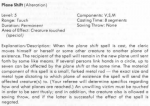
They had found two documents (some Bryce-maligned "journals", eh?) in an Invisible Box along with the potion. One was a History of the Reign of the Witch-Queen (who built the dungeon they were about to enter), and another a sage-essay on the folklore of Mirror Fiends (which I am borrowing from Trent's clever Mystical Trash Heap write-up). The historical account talks about how the Queen turned a rebel clansman into a horrible beast cursed to wander her dungeon. They "wrongly" conflated the two and came up with some good prep---the cleric petitioned her God for the spell Plane Shift.
planeshift.png
This is a seriously cool spell. NEVER used it, or saw it used, as a player. It's in 1e, but not in 0e. An it's absolutely perfect to take on the Minotaur that walks between a storm-battered island of caves in the Ethereal Plane, and a maze of mirror-portals. Without some method to track him back to his home-plane, he's probably going to tear them up with hit-and-run tactics as they traverse the maze. This spell is perfect!

Why did they "get smart" this time? I'm not sure---foreshadowing via the documents? Dunno. Something to keep in the back of my mind for future Adventure Design.

Here's another aside (and indicative of my slow gravitation from 0e/S&W towards 1e)...

I have struggled with Cleric acquisition of new spells.

Magic-users have been great---new spells ONLY through spell-books won as treasure or a (very) occasional bartering with other non-hostile NPC's (no local Wizard's Guile for setting reasons). I can't recommend this enough. It makes for great treasure, allows you introduce non-standard spells (and weird/flawed/unpredictable variants of standard spells), and the MU ends up with a ridiculous non-portable library of tomes (with lot's of duplicates) and the need to protect them.

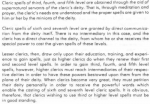
...But I didn't know what to do for clerics. Anthony Huso came to my rescue. He pointed to the section entitled "DAY-TO-DAY ACQUISITION OF CLERIC SPELLS" in the 1e DMG (pg. 38). Here's an excerpt:
clericspells.png
Of course the players moaned about having to do this, but it was the first campaign 5th-level spell (not found on a scroll), so I was able to introduce a new rule without seeming inconsistent. So the cleric decided to return to a previously visited temple and pray for hours, then I had a statue of one of the gods minion's crumble and it's disembodied head start speaking (scene stolen from original Clash of the Titans). The spell was granted---BUT!---a promise was also extracted. Yippee! More campaign fodder!

What's more, the player that groused about it originally, loved it. Went around telling everyone how she "broke the temple". (Told you they have this weird desire to brag to friendly NPCs.) It ended up being a great chance for the player to really exercise their class. Another example of First-Edition Wisdom that I had always hand-waived away before.

Live and learn.

Anyway, back to the original point. I QO'ed that Oil of Etherealness...and I shouldn't have. The player's innovation made it redundant. And, think about it, how much more rewarding it will be if they beat the Phase Minotaur as a result of their own excellent prep, than if it was due to them just pulling out a potion that was "gifted" to them by a benevolent DM (who only wanted to make sure they could keep "having fun" in what lay ahead).

Live and (hopefully) learn...(again!).

It is as EOTB says: The QO-enabled DM is not building good players, he's building dependent players. A good parent understands not to coddle one's children, because to you can ultimately hurt them with your kindness. "Reward in a Pit of Risk"...even if it's the risk of boredom. As DM, you are omnipotent, but not omniscient. Check your own power and let the game play out. Only then will your players will learn how to make it fun on their own---to the delight and surprise of all. It's gonna be better than you concoct solely on your own.

/End rant
 
Last edited:
Split the party. Send the thief circling around through the woods in the west to flank the ogre/trap to the North, have the ranger continues tracking to the east, while the rest of the party waits at the fork for a signal that reality has solidified. (...while leads to TPK, natch!)

The thief splits off from the party; the rustle ahead was a gorilla in mating season, and the thief has a chance to spot it (skill check) - if pass, can slowly back away, unsure if the marauders lie further ahead. If fail, then roll initiative for your poor lone thief who will probably be pulled apart by an angry, horny gorilla because you've violated unwritten player rule #1: don't split the party.

The ranger is good at tracking, and indeed can spot three sets of marauder footprints following the trail. Unfortunately, while he's good at noticing footprints, he's less good at noticing traps, and that's when he stumbles into a camouflaged pit trap - not deadly, but definitely gives his pursuit some pause and if he can't scramble out, then the party basically sees him wander off and never return (hopefully the can find him, the pit IS camouflaged after all).

The rest of the party twiddles their thumbs while their players migrate to their phones because they're sitting there with nothing to do.

Jeeze squeen, so far you've got one possibly dead thief, one possibly disappeared-forever ranger, and two bored players... and I haven't even gotten around to using the quantum ogre yet!

It is as EOTB says: The QO-enabled DM is not building good players, he's building dependent players. A good parent understands not to coddle one's children, because to you can ultimately hurt them with your kindness.

You've jumped to a janky conclusion by assuming that QOs are automatically going to be abused or overused by everyone that uses them. Also, dependency? I don't think you give your fellow DMs enough credit. If they fudge a die roll at a crucial moment, does that suddenly make the DM "dependent" on fudged dice rolls? Are all their rolls going to be fudged? Will the players never be able to trust an unseen dice roll every again? No. So why do you believe this to be the case with QOs?
 
The ranger is good at tracking, and indeed can spot three sets of marauder footprints following the trail.
Then he's done. Positive "yes" signal is sent. The thief stops circling. Everyone goes East.

..or is that not the fun result---does something need to "change"?

Slippery slope, me thinks. Janky is in the Eye Of The Beholder.
 
Last edited:
Then he's done. Positive "yes" signal is sent. The thief stops circling. Everyone goes East.

..or is that not the fun result---does something need to "change"?

I guess I forgot the part where your guys had magical walkie-talkies? Keep in mind, there are footprints going North too, and your group could already see there were footprints going East, so I don't know if your Ranger would have stopped to confirm that yes, there are still footprints going East.

On a side note: You've just used the player-version of a dirty metagame trick - the old ret-con the action routine. "Well, my Ranger would obviously have stopped once he saw three sets of tracks, so he wouldn't have gotten as far as the trap, so he wouldn't have fallen in." Its as old a trick as the "my fighter always sleeps in his armor" player ret-con.

For the sake of the argument though, let's say your Ranger calls back and says "hey, a bunch went this way!". You go East - now the whole party deals with the pit trap (easily spotted by the thief). Beyond, a body lies across the trail - one of the marauders, his arms pulled from their sockets - a Nature check will tell you that the local gorillas are in mating season and have been known to rip men to pieces. The Ranger notices that after the trio of footsteps he was following becomes a duo, the surviving pair have apparently split up - one set of prints heads further down the trail where rushing water can be heard, while the other has peeled off into the woods somewhere.

I still have a quantum ogre to deploy.
 
Last edited:
I see. No argument then. TPK. Probably runs smoother at the table---more back-and-forth.

Have we gotten to the QO yet, or are we just proving I am a bad player (which is akin to shooting fish in a barrel)?
 
Last edited:
Have we gotten to the QO yet, or are we just proving I am a bad player (which is akin to shooting fish in a barrel)?

Check the post edit. i swear I'm getting to my point.

Why are we supposed to exclude the overuse/abuse of the QO because you say you don't personally?

For the same reason we are supposed to assume that QOs are dangerous, corrupting influences based solely on your limited experiences with them?

I still maintain the point that QOs aren't bad when people know how to use them properly, just like how a hammer can cause a lot of damage if you swing it at someone's head, but that's not how hammers are meant to be used, and I would think it rather shortsighted to say "hammers are going to turn everyone who uses them into killers".
 
I think the "common wisdom" being expounded is that Quantum Ogres are a dangerous practice with unintended consequences on your players and your game---so avoid the habit of using them.

There's not much to be said about the (3-sigma) Master-class DMs who can pull it off unnoticed and to the enjoyment of all involved, on a rare occasion, with the self-control and foresight not to overdo it.

Come on DP! You really don't get this?
 
The Ranger notices that after the trio of footsteps he was following becomes a duo, the surviving pair have apparently split up - one set of prints heads further down the trail where rushing water can be heard, while the other has peeled off into the woods somewhere.
Oh crap! Some else had better handle this fork---I botched the last one.

(...and that poor Marauder died --- violated by a gorilla! <Ack!> His blood will forever be on my hands...)

The lesson here is to fear forks in the road (and quantum mechanics)---right? :)
 
Last edited:
The lesson here is to fear forks in the road (and quantum mechanics)---right?

The lesson here is in answering the question "where is the marauder leader"? Is he beyond the gorilla? Did he run into the forest when his companion died, or did he carry on along the trail? A better framing of this question is "where would it feel weirdly out of place, or perhaps cheat-y, to find the marauder chieftain?"

Sure, I had an idea of where he might be from the initial situation, but then the situation unfolded differently than expected. That's too bad, I had a really neat fight lined up with the marauder chieftain, and a good plot hook to communicate during the encounter. I guess I'll just crumple that up and throw it away since the party didn't go where I had expected them to go, and because if I put him in front of the party now it'll teach my players that all their choices are meaningless, and it could be considered "managing their excitement" (which apparently is a bad thing for... reasons?).
 
Sure, I had an idea of where he might be from the initial situation, but then the situation unfolded differently than expected. That's too bad, I had a really neat fight lined up with the marauder chieftain, and a good plot hook to communicate during the encounter. I guess I'll just crumple that up and throw it away since the party didn't go where I had expected them to go, and because if I put him in front of the party now it'll teach my players that their choices are meaningless, and it could be considered "managing their excitement".
In a nutshell: Yeah.

At least that's what I'd want you to do (as a player).
 
In a nutshell: Yeah.

Then you have my pity if you end up tossing out 90% of your game materials because you adamantly stick to the idea that once you've decided something goes somewhere that it can't ever move from that spot, even if the players have no idea about what you've decided and where you've put the thing, even if the perfect chance to salvage that material comes up later in the game.

Folks here are arguing from a position of cheating players who derive fun from trying to juke the game, to crack the DM's system, or as EOTB put it: "data-collecting to understand the curve around them". That kind of mechanical play is way meta, into the realm of min-maxers and those guys who show up with homebrew classes from the DnDWiki. A far worse sin, IMO, and not really something I'm comfy spreading in my group by encouraging that style of metagame.
 
Last edited:
Look. I told you about how Lareth the Beautiful plagued my players after escaping the Moathouse encounter. He followed them back to their "home base", nearly defeated them all in the Cave of Choas Temple, and they pursued him back to his home Kingdom---where was was actually the crowned Prince (different name, long story). I had all this scripted out---how his dual identity was going to be revealed in the City, etc.

But then they caught up with him in an abandoned Watch Tower en route. He jumped out of the tower balcony with his Ring of Feather Falling to escape once again (as planned)...and then...the thief shot him with a poisoned arrow. He failed his save. Arch-nemesis dead.

Should I have fudged the save roll? I had all this cool stuff planned...

No. I let him die. I adjusted. Now 5 years later, after many other travels,---they are disguised as Prince Lareth, skulking about his old haunts, and digging into mysteries only he knew. It's been GREAT. Way better than I could have planned. In retrospective, I am SO thankful I just let it happen.

This is the lesson (or part of it). Let go of control and let yourself be pleasantly surprised.

Use the Force Luke.
 
Your players knew Lareth was where he was when they found him, yes? If so, once the Quantum Ogre has made it's choice as to where it is, it breaks the quantum state. You cannot, by virtue of the definition of it, fight a quantum ogre - if you fight it, you are just fighting a regular ogre. A quantum ogre begins to adhere to the rules of the world once it materializes as a normal ogre... it can escape or die in a fight or have its plans broken or whatever. But we aren't discussing normal ogres, we are talking about quantum ogres. They are immune to such things because they technically don't exist yet.

I can't tell you if you should have fudged a roll in a moment to keep a villain in the game. I don't know all the circumstances around the choice. That die roll had a chance to be noticed, and might have pissed off your players, or it might not... I don't know, I'm not a divination specialist. In this case, your adventure came out OK, but it could just has easily not have, and so really shouldn't be taken into consideration as an example that one choice was obviously superior to the other. It might not have been - maybe your players would have had more fun if they got to check out that material you made, you'll never know now, especially if you're against the idea of quantum ogres (which would have allowed for unused material to come back into play).
 
The Quantum Ogre: A Dialogue (credit to Reddit user u/SCVannevar)

GM: You come to a fork in the path. You can go left or right. You don't see anything remarkable about either path, and they both seem to be headed toward the Fortress of the Evil Warlock, although the left hand path looks a bit more direct.
Player: I go down the left hand path.
GM: Okay, you carry on down the left hand path. After about a mile you come around a bend in the path and you see, standing in your way, an ogre.
Player: Oh, come on!
GM: What?
Player: I thought you took this game seriously.
GM: What are you talking about?
Player: You're giving me a quantum ogre!
GM: A what?
Player: A quantum ogre. It's an encounter you had planned ahead of time, and intend to carry out no matter which way I went, thus robbing my character of agency.
GM: You're saying that if you had turned right instead of left, that ogre would still have been there?
Player: Exactly!
GM: How do you know that?
Player: Well, you're running a campaign, aren't you? You're following the text, which has foreordained the presence of an ogre at this time and place!
GM: Are you saying you've read the text of the campaign?
Player: Of course not.
GM: Then in the first place, how do you know the campaign says that there's an ogre here?
Player: Well, either that, or you're deviating from the text.
GM: How do you know I'm not deviating from the text?
Player: ...well...
GM: And in the second place, what makes you think that the ogre would be there if you had gone down the right hand path?
Player: Well, would it?
GM: I'm not telling you what's down the right hand path.
Player: Why not?
GM: Because you're a good mile from that location, you can't see or hear anything. Whatever's down there may come into play later, and your lack of knowledge about it may impact events.
Player: Sigh. Fine, I go back and go down the right hand path instead.
GM: Actually, the ogre has already noticed you, and is charging toward you, its club raised. Roll initiative.
Player: Oh, come ON!
GM: Hey, you chose to go down the left hand path.
Player: But my choice is meaningless because you put a quantum ogre there!
GM: Neither you the character nor you the player has any way of knowing it's a quantum ogre.
Player: Well... Do you give me your word that it's not a quantum ogre?
GM: Technically, I can't do that. There are gods and other powerful beings in this world, including the Evil Warlock who knows you're coming for him, and they may have decided to put the ogre in your path.
Player: Did they?
GM: You don't know. It doesn't seem likely, but you can't exclude it.
Player: Sigh. Look, can we just skip the ogre and fast forward to the Fortress of Evil Warlock?
GM: Why?
Player: Because ogre encounters are boring. I want to go straight to the Fortress; that's why I went left in the first place, remember?
GM: So you insist on absolute player agency by ruling out the possibility of any quantum ogre, but you also insist on not necessarily having to face the consequences of the exercise of your agency?
Player: No! But--
GM: Then roll initiative.
Player: But you're the one who determines those consequences!
GM: Would you rather YOU determined those consequences? You want to be the GM?
Player: I want you to set consequences in line with the exercise of my agency!
GM: In other words, you want to go from point A to point B without having to encounter any ogres.
Player: Exactly!
GM: In an area you know to be rife with ogres.
Player: Only because you say it is.
GM: It's called the Ogre Basin.
Player: That doesn't mean there have to be ogres!
(Pause.)
GM: So, do you want to move the campaign to a location without ogres?
Player: Well no, I want to go to the Fortress of the Evil Warlock so that I can kill the Evil Warlock and seduce the Well-Bosomed Wench, so I have to stay in the Ogre Basin.
GM: You just want guaranteed safety from ogres.
Player: I want to have fun! Is that too much to ask?
GM: No, but your idea of fun seems to involve the exercise of omnipotent powers in a framework where, by design, you have the power of a mere mortal.
Player: Well... a magical mortal.
GM: Do you have Vaporize All Ogres memorized?
Player: Don't be smart.
GM: Look, you're the one who wanted to go left. Facing an ogre is a consequence of going left. You want to play in a world without your actions having consequences, play with another GM. Better yet, find a god simulator on Steam.
Player: Sigh. Look, the whole point of playing a role playing game is to make free choices and see the results of those choices -- and the whole point of doing THAT is to have fun. Otherwise, we'd just live in the real world, right? So I'm asking you, just this once, can we skip the ogre?
(Pause.)
GM: Well . . . just this once. We're not making a habit of it.
Player: I understand.
GM: All right. There's no ogre, there never was. You keep walking toward the Fortress of the Evil Warlock.
Player: Awesome.
GM: A little way up the road, you see three gnomes arguing over a small, shiny trinket.
Player: Oh come on, this is just another quantum ogre in disguise.
GM: We're not having that same discussion again.
Player: Ugh. Well, can we skip this too? I hate gnomes.
(Pause.)
GM: Fine. No gnomes. Farther up the path, you see a pack of goblins.
Player: Boring. Skip.
GM: A series of fallen trees blocking the path.
Player: Skip.
GM: A leper with a mysterious pouch.
Player: Skip.
GM: A beautiful woman tied to a tree.
Player: Skip. Wait -- is she as well-proportioned as the Well-Bosomed Wench?
GM: Not even close.
Player: Okay, yeah, skip.
GM: Fine, I get the message. At the end of path, after a long journey with many dangers, adventures, and memories (snort), you finally arrive at the Fortress of the Evil Warlock.
Player: All right! See, this is what I wanted all along. This is what I call fun.
GM: I aim to please. Now, there are no obvious entrances; the whole compound is surrounded by a mile-deep chasm, and terrible shadows guard the battlements.
Player: No problem. I fly in through the window of the Wench's Tower.
GM: What? How?
Player: With my Helmet of Flight.
GM: You don't have a Helmet of Flight.
Player: (exasperated sigh) I'll go back to the village and purchase a Helmet of Flight. We can assume I got enough gold from all my adventures, right?
GM: Are you serious?
Player: Are you going to give me more boring quantum ogres?
GM: You know, just because it's not your cup of tea doesn't mean it's a quantum ogre. And as we've established, unless you're either a mind reader or cheating, you have no way of knowing any given encounter is a quantum ogre.
Player: Well, I assume it's a quantum ogre because I don't think you want me to have fun. I think you just want to railroad me.
GM: That's just not true.
Player: It must be, because I've made it clear I don't want to deal with ogres, or lepers, or goblins, or any of that! So you either respect my character's agency, or I'm out of here!
(Pause.)
GM: Fine. Your journey back to the village is uneventful. You find a Helmet of Flight without difficulty, and procure it without incident. Your journey back to the Fortress is uneventful. You don the Helmet, rise up the ground, fly over the heads of the terrible shadows and into the tower window, where the Well-Bosomed Wench is waiting with open arms and open bodice.
Player: Great! Although... look, I hate to complain, but you made that too easy. I mean, do you really understand the meaning and the spirit of a tabletop role playing game? ...hey, what are you doing with that pencil?
 
Why can't you contrive some reason to pair the plot hook with something the party gets into of their own accord?

What you've suggested is literally the way I have been arguing QOs should be implemented all this time. It's not about "my way or the highway"; it's about "didn't get around to using this, maybe it'll fit in here instead".

Are you, uh, making assumptions about how things work at others' tables?

I see you trying to attack me with my own words, but no... a statement that something is akin to something else is not an indictment, nor an assumption beyond "I assume this is like this other thing"
 
So why you might be arguing that they should be implemented this way, the examples of implementing it go further than that. Which is the point - the discussion might be couched a certain way to for discussion purposes, but when providing examples it goes back to "this how or no how".

Examples exist in a vacuum - they are fictitious scenarios designed to communicate a point in a way that relates better with the reader. They cover one specific instance of a thing, not all instances across all time. I didn't think this would have to be clarified, yet here I am... had I known that providing examples would be mistaken as prescribing doctrine, I wouldn't have included them.

Here's the crux of what I say: A QO is an illusion, but that really only matters if the player realizes its an illusion. If the player feels as though they are in control of, and responsible for, every outcome and doesn't know about the material the DM has planned in advance, then there's no difference between a game with a QO and one without - the player experiences the exact same thing. Heavy-handed use, overuse, or misuse of the QO can certainly break this illusion, but amateur DM mistakes shouldn't become ammunition in a blanket argument against all DMs using the QO.

The trick to Quantum Ogres is that while some choices might be a QO, not every choice is a QO. Some choices will be illusory, but most won't. To a player with no way of telling the difference, there's no feeling of stolen agency. Plus, enough of their choices will have the impact and meaning they crave, since D&D games include dozens if not hundreds of decision points, so it's not like all the players decisions become meaningless as consequence, nor would I argue that the proper use of a QO leads to a slippery slope future corrupted by railroading and tyrant DMs flouting their god-like ability to put anything anywhere.
 
Last edited:
The lesson here is in answering the question "where is the marauder leader"?
First mention of the leader having any significance, I wasn't even assuming there was one.

Before squeen hijacked the encounter, I was going to ask some follow up questions. The first was, why do I care enough to follow these guys? Assuming that there was a satisfactory reason, then I was going to ask some questions about the forest itself (amount and density of underbrush, etc.). I assumed that the disturbed area was trapped and the rustling had a 50% chance of being the marauders.

My plan was to retrace my steps for perhaps two minutes, stop and cut a 10' pole, then cut through the woods and make a wide circle around the encounter area, missing it completely. Rogue takes point and probes with pole for pits and tripwires, Ranger next keeps an eye on the trees for signs of bend sapling "springs", ropes, nets and suspended logs. We would avoid animal trails where possible (the answers to the questions about the character of the woods would have determined the exact strategy employed). Once we circled the encounter area we would have checked both roads if possible (our path would have taken us to the north one first to see it either had more traffic, with hopes of following it to the camp.

We would then have travelled in the woods, parallel to the road but 30 yards out, using the same trap detecting strategies mentioned above, but going back to the road once in a while to make sure we still had the trail. Assuming we eventually found the camp, if we had bypassed the marauders we would lay an ambush for them. If the marauders were already there, we would stake out the camp, determine guard routines, and wait for dark to attack.

If we failed to find anything along one road, we would double back and find the other. If all else failed, we would go back to the original fork, reassessed and picked a road them - probably the east trial since they appeared to have put work into trapping it. 10' poles and checking the trees would have continued to be the tactic as we went along the path.
 
Folks here are arguing from a position of cheating players who derive fun from trying to juke the game, to crack the DM's system
How did you get that out of anything I said. I'm not trying to beat the DM, I'm trying to beat the in-game enemy, using in-game information.
 
Back
Top