Illusions

squeen

8, 8, I forget what is for
I've been thinking a bit on how to run illusions. It's a difficult subject. Anthony Huso has two posts entitled "Death By Illusion" over on his Blue Bard blog. The gist of it can be seen in this excerpt from his DM screen:
DeathByIllusion2.png
I am not completely won over about illusion causing actual player death and dissipating after the first instance of inflicted damage. I have been thinking more along the lines of Illusion causing only subdual damage until the PC reaches zero at which point they pass out for 1 round. Afterwards, they wake up with 1-hp/level and the remaining subdual-damage is recovered at the normal rate of 1-hp/round (or is it 1-hp/turn)?

Also needing clarification:
  • when should illusions dissipate if touched (low level?)
  • should illusions only be seen and have no physical effects? (low level?)
  • when should illusions be able to react/interact (only when an intelligent mind if driving them?)
That said, I use Swords & Wizardry (Complete), so there is no Illusionist class per se. I do however allow the existance of some Illusion(ist) spells to be found in the campaign-world---usable by regular magic-users (if they get so lucky).

Anyone with any play-tested house rules (or other systems) that they'd like to advocate?
 
Last edited:
The way Archon of ACKS does it is give +4 (or was it +8?) per missing sense when it comes to the Save to disbelieve an illusion (and illusory damage result in knockouts lasting 1d4 rounds). So an illusory Fireball without sound and heat is Save versus Spells+8 to disbelieve, an illusory apple without taste, smell or sound is +12 when you take a bite out of it.

I take those things into account when it comes to players examining illusory walls etc. advanced illusions do have an illusory tense of touch included, those walls are difficult to disbelieve, the super-advanced illusions will even do things like spawn illusory stones that rebound if you throw a rock through it. Most are simply holograms though and basically any scrutiny reveals their true nature without a save or anything.

I don't make illusion dissipate, I treat them the way real Life visual tricks work, once you've figured out the trick you can see it for what it is. Or when you see a scary monster in your room at night, upon closer inspection it's a pile of clothes on a chair combined with the howling wind. Both of those remain but the illusion is gone.
 
Interesting about the save bonuses! Thanks for the reply.

Do you find them problematic too? (Yet I find myself tempted to use them more and more.)

I have this whole other cunundrum going on in the campaign too. Polymorph vs. a Disguise spell. I argue that polymorph cannot make one look exactly like another person. Dopplergangers can do that. Shape Change do that, but the polymorph self/other spell cannot. You look very similar---like a wax museum duplicate...but it's not perfect. The reason I limit that is the possibility of too many sleeper agents and imposters. I know that in AD&D there is a chance of the polymorphed creature mentally becoming the "other"---but I'm not sure what that means in the context of a PC polymorphed to look like an NPC. Do they forget their true identity? But they don't have the memories of another so...hmm.

I do introduce a Poly-juice Potion (Harry Potter rip-off) with limited duration that requires a living material component from the creature being impersonated. This leads to all sort of fun scenarios where the NPC being impersonated is kept alive somewhere in chains.

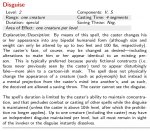
I also have a Disguise spell (below)---but that's more a mental trick. The imposter appears to look and acts like the duplicate because the victim's mind is fooled into filling in the blanks. Ergo, it is a form of Illusion.

disguise.png
 
Last edited:
If your metaphysics are Platonic I imagine polymorph spells pull their shapes from the ideal world forms.
 
I am ping-ing y'all again for tips on how you run illusions. I have a big moment coming up "soon"-ish in the home campaign in which illusion plays a major part---the tower of a deposed Witch-Queen has been left unexplored for decades (despite being connected to the functioning palace) because it is riffe with illusions and traps. So, of course the party is going there...

Looking for more guidance/options/notions (other than just Two Orcs' take from ACKS, many thanks to him for that!)---especially concerning damage from illusions.

In general, it seems illusionary magics should be easier to create/maintain and therefore more ubiquitous.
 
Last edited:
Make sure to mix real and illusory danger with real and illusory treasure. This way disbelieving everything isn't a valid solution - and illusory monster can harm you by chasing you into a real trap, or an illusory trap forces you to stay and fight a real monster. There are also nested illusions - both holograms and of the mind. You throw a pebble at a guardian, it turns invisible. Was the illusion broken? No, the guardian is real and still lurks there, following you with heavy footsteps. They don't have to be all magic either, certain geometries of hallways can make them seem long while they are short, small creatures can seem gigantic placed next to miniature furniture. The treasure is a fake, and behind the secret door is another fake treasure, one step further is the real one!

Gold paint on lead crowns, sinkholes of harmless green gas, the sound of breathing - an invisible but harmless statue looming. A certain door leads back to where you started - teleportation? No, architectural replication!
 
Those are some really good suggestions. I love the last one in particular---never would have occurred to me.
Thank you!
 
I like how this leverages the concept of players paying attention. I like that a lot.

Is there a danger of pixel bitching?
 
@EOTB: Thanks for the link. Per usual, it has my brain whirling with your insightfulness. Here's what's at the forefront of my consciousness:

What you propose is deviously wonderful---and also what (I believe) was intended by Gygax/1e (although he seems to admit they are a difficult game element to manage)
  • If the player reacts as if they believe the illusion, then damage is real (including death).
  • If a player wishes to disbelieve, they must ACTIVELY ignore the illusions and risk the consequences if they are wrong. Simply shouting "I disbelieve" is insufficient.
  • The burden is on the DM to be scrupulous in omitting elements that the illusion lacks (e.g. sound), and equally careful to include those elements in most non-illusion situations.
  • Area of effect is an important limiter and should be carefully observed.
  • Amount of feasible damage is also tied to area of effect, lack of sound, etc.
  • Expert use of illusion intermixes with reality. Exaggerated or overly ambitious illusions strain credibility and you adjust the saving throw modifier per situation.
  • You believe illusions are inherently discordant, and should not be corralled with a "safe/reasonable" game mechanic (e.g. max. damage per level)
Have I stated your position (above) correctly? I think it's a great way to handle illusions and should be documented somewhere...(cough)(cough) if only you had access to a blog of some sort...:)

I still have questions:
  1. How and when does the player's saving throw come into play? If a player ignores the illusion (e.g. the wall of illusionary fire heading at him while he stands in a pool of real oil, per your example), does he (or she) get a saving throw before taking damage (if not actively disbelieving)? If they decide to close their eyes, what then? What about if they are actively ignoring the illusion? Is a saving throw required, or are they automatically immune to the damage effects by virtue of their bold action?
  2. Do you (as Huso does above) give the PC an automatic---i.e. PC-intelligence based vs.player-intelligence based---chance of detection? It sounds like you allow for that with NPC/monsters because without random input, the DM is too all-knowing and biased.
  3. Do you (as Huso above) make illusions disappear as soon as damage is dealt? 1e BtB?
  4. Do illusions disappear when touched? For example, an illusion of an passage blocked by iron bars. A PC swings a hammer at the bars---nothing visually or audible is going to make his or her swing rebound.
  5. Why do people (e.g. this Ricks fella) get so defensive and offended when others disagree with them? (Don't bother to answer that.)
Again, I do love that you are encouraging player/DM interaction and player-intelligence. Also, I love your unabashed courage at allowing illusions to be disruptive and inherently "unsafe". Your point about potentially forcing magic-users to memorize (resource!) counter-spells such as clairaudience is another great insight---I think you "get" game balance better than most. I am all about adding elements that prevent PC from ever feeling safe in the face of the unknown---especially at high-levels.

BUT...

I still have reservations about how I'd like to handle things. First, I'm OD&D. We never played BtB way back when, and I don't feel overly constrained to follow anything I don't think "works for me", i.e. my DMing abilities/sensibilities. I do however acknowledge it's best to stick with what has been field-tested, because I haven't the time to play out enough situations to hone an optimal solution. (It's why I am asking you all.) At the end of the day, I am mainly looking to become a better DM.

Also, I don't play with an Illusionist class. Magic-users can find some Illusionist spells as treasure. NPC are not bound by PC rules. As such, I don't have to grapple with some of the issues raised in the thread (too often).

My concerns are:
  • I may not have the chops as a DM to drop all necessary clues that will allow a skilled player to make informed choices. For example, I routinely forget/fail to describe non-visual elements of encounters. Therefore, I am bit in "Ricks" camp along the lines of [paraphrasing] "a PC's character would observe more than just what I describe". Your point about my need as a DM to savor and enhance that sort of PC-DM interaction is valid, I'm just not sure if I will always remember to pull it off.
  • I watched an original Twilight Zone episode recently that was about a mental patience who knew he was particular susceptible to his over-active imagination and knew if he went to sleep he was about to die in his dreams. While I except that the mind is powerful and could cause a heart-attack like death, I also believe the body and inherent will-to-live is also strong and somewhat independent of the mind. It's not a foregone conclusion to my way of thinking that belief is sufficient for death in all cases. I think some sort of roll (saving throw, system-shock, etc.) may be warrented against Death By Illusion--- in addition to belief/disbelief. Yes, that gimps the danger a bit---but still, passing out and waking with 1-2 HP is a real threat (as is wantonly disbelieving a real attack). As is a finite chance of heart-failure.
  • I am on the fence about the permanency of illusionary damage. I originally thought subdual damage was appropriate (i.e. messes you up, but recovery is quicker---i.e. your burns disappear after you leave the area-of-effect, hp slowly come back at 1/turn if and when you realize you were duped). But, I think you may have converted me. Illusions should be terrifying.
  • I also think pre-programmed illusions (without an active controller) should be more limited.
Anyway. I think this is a fascinating topic. In the context of Adventure Design, a vast under-utilized resource. I'll probably post more after I digest for a bit. I am thrilled that the K&K thread was only 1 year ago---I've graduated to rehashing recent arguments! (I probably should read more of what's there---but my browser frequently has issues with the site.)

Thanks to all that have responded---come 'em coming!
 
Last edited:
I think this is a topic that could have easier fallen within the scope of the 1e DMG. There should have been a whole section on it.
 
I hate illusions in D&D - they're like the "concealed pit in a hallway" trap, in that they cause the party to start poking and prodding at everything, and just generally slowing down play because they believe everything could be an illusion. And like the concealed pit, they're not even a clever "gotcha" trap... just a "oh, that wasn't real? Well, that sucks".

That being said, I think they're easier to run if you keep them simple - they are only "there" insofar as you describe them as one of the things players see when they scan the area. Interaction? Yeah, your hand goes right through it, because it's fake.

So what's the point? Well, you can use them to conceal things that players wouldn't ordinarily inspect by touch, such as stuff hanging over an inaccessible place, or a big pile of dung or whatever. Especially effective if they hide a hazard, and the "trap" of the illusion (so to speak) is that it keeps players off guard long enough (or puts them in the right spot) for them to trigger the trap, rather than the illusion itself causing damage. Also good for disguising something valuable as something mundane, and for setting atmosphere (holographic people who speak to you, animated oil paintings, detailed 3D renderings of cities long lost, etc.)

Illusions that fight you are, IMO, more complication than they're worth. You could use an illusion to disguise something (turn a kobold into a baby dragon or something), but when you start actually fighting an illusion, I think it should be dispelled. None of this "if the illusion hurts you, you die in real life" Matrix-type jank to dance around.

Anywhoo, that's just how I run my table - your mileage may vary.
 

Don't mean to just say "read the link" but if your big moment is coming up soonish I'm not sure I'd have time to redistill what I wrote in the linked thread into one essay. But it gets into how I run illusions pretty thoroughly, which is unabashedly from the "if you believe it, it's real" school.

I'd missed that thread, thanks for the pointer Steve!

Allan.
 
"Illusions" I have used successfully in actual play:
  • a leprechaun Queen of Goblins created an audible illusion of a huge beast bellowing and stomping down the corridor (out of sight) that scared the party out of her domain. (They never discovered it wasn't real---still avoid it.)
  • doors that appear several feet offset from the actual door (solid wall eats knock spells)
  • party members involuntarily disguised as the (real) attacking monsters, making them a candidate for friendly-fire (old X-men comic trick)
  • disturbing sounds and phrases mentally "heard" while underwater adventuring to heighten tension
  • a difficult and chaotic King who was a doppelganger double/triple agent.
  • Drow sleeper-agents "polymorphed" to look like humans
Honestly, I think that's pretty short list. More to come soon (I hope).

EDIT: @DP I like illusions for the same reason I like secret-identities, double-agents, doppelgangers, the priest in B2, etc. --- the twist when the party's preconception get turned on its head. The Big Reveal is a great moment for all, especially when it's played out over many sessions. The one with the King (above) went on for years. They were convinced he was magically charmed despite having bumped into other doppelgangers used by the Enemy. They even organized complex heists to steal suspicious magic-items they thought had him enthralled, kept looking for discrete ways to kill him, etc.

With respect to illusions causing real damage: Can you imagine a guardian the party trys repeatedly to get past/slay---only to keep failing---and eventually realize it was an illusion they were fighting the whole time and they could have walked right past it to the treasure? What fun!

(...and that guardian-trick would only works with an EOTB-style model with normal damage.)

How does 5e handle them? Nerfed or deadly?
 
Last edited:
The solution to pixel bitching, period, whether for illusions, traps or anything else is that the DM is able to "run" two simulations simultaneously in their head - one is what's happening around the party, and the other is what's happening where the party isn't around, and then make the two collide as PC action (or inaction) dictates.

Can you elaborate on this? I'm not sure I understand what you're trying to say.
 
The following is a short excerpt from an area my players are about to explore. In writing it up, I've tried to focus on Byrce-ian Design principles, and struggled to stay brief (not normally my strong-suit) and further develop a layout that serves "at-the-table" usability.

Noteworth items: In addition to segregating the PC's immediately observable data (i.e. the "safe read aloud") just below the section heading, and separated it from discoverable details by a horizontal line, I've also added a few "DM Hints" at the start of this preamble inside gray brackets (e.g. [Unlit,odor]). These are intended as clues for the senses [sight,sound,smell,touch], and sometimes are color-matched to gray text in the body of the description. Honestly, I'm not so sure about the color-matching scheme, particular gray, but I let it go for now.

Also, the decision to spec [Unlit] instead of [Lit], addresses a personal failing of mine as a DM to forget the PCs can't see much by torchlight and just barrel into the full description. Hopefully, this little reminder will restrain me. (Also, [dark] might be better a better descriptor than [Unlit]. TDB...)

Lastly, some background on the setting. These "Dungeon & Drains" exist beneath a Royal Palace. This section are the demesne of a dead(?) Witch-Queen that, despite the well-know proximity, has been walled-off and avoided for decades because it is filled with deadly traps and guardians. Hence the difficulty in penetrating the dungeon is not necessarily a design-flaw, but more an intended feature---possibly requiring a higher-level party to penetrate. This section is intended to be a barrier. Treasure lies beyond. If it's too difficult, it's easy to avoid.

Stats Blocks only apply to Swords & Wizardry. Numbers next to attack-types are (THAC0,damage). And the LORE subsection just ties things into my home campaign and so should be ignored.

Feedback on form and function will be greatly appreciate. The content is relevant to this thread because there are many illusions, that (if treated EOTB-style), (a) won't dissolve at first touch, and (b) have the potential for dramatic demonstration of disbelief (i.e. running through the broken glass, ignoring the attacking knight, etc.). I'm curious as to how they play out at my table this weekend, and would love to hear any flaws y'all spot in the set-ups. You can even just tell me flat-out "Hey squeen! This stuff is really boring!". Seriously. I wanna know.

Lastly, below is a partial area map (done in homage to the Moneyblood Design style)---that contains errors/omissions and definately needs to be redone. Towards that end. I am programming a little CAD tool that will help me do better/faster maps in the future. Still, I hope it's enough to help orient reviewers despite a few chopped-off rooms (12 to the left & 18 to the right).
DunDrains-clip.png
Here are some thumbnails of the keyed pages, and a higher-resolution PDF attached to the post.
VP-D12-16_p76.png VP-D12-16_p77.png

I believe it was @Melan who first said here, "I'll expect your reply seconds after I press the Send button."
(not really...but I am rather excited to hear some comments---It's surprising how much more polished this section, originally written-up this past January around the time of DP's One Page Design Contest, became when I decided to showing it off to the public.)

Cheers
 

Attachments

Last edited:
Realizing 12' wide tapestries in room 14 are too big while trying to layout a maze with the little CAD program I've started writing.
(Switched to 8')

tapestryMaze.png
 
I also like the formatting, as well as the general approach to organization. I haven't had time to go through all of your notations to see if they are consistent, and perhaps I wouldn't know without seeing a larger sample. I think execution is going to be the key.

I get where EOTB is coming from when it comes to bolding certain phrases, but I note you would lose the impact of the way you are currently using it, which is to link common elements together (like the basin in the tapestry maze). You may need two different types of formatting to achieve both, but it may be hard to do that without losing some of the cleanness of the current formatting.

The bolding pops more in the PNGs than in the PDF. Hmm, it appears that the bolding is lost at certain zoom levels. It's weird. I'm not sure why that would be, but if you ever publish you might want to take a stab at fixing it.

Continuing with the tapestry maze, I see why you wanted to keep the "encounter" material together, but I feel like as a DM I prefer to see elements defining the physical space together, and separated from elements regarding the more fiddly monster actions and specialized mechanics. I think I would prefer if, after the readaloud, it was briefly identified that there were monsters present, and where they are and whether they can be seen, but I would prefer it if the monster detail was at the end of the room along with the stats. This gives me a better sense for the whole of the room before I get to combat. There can be interaction with room elements during combat, and for instance I might not have been aware that a character pulling down a tapestry or trying to push by it or climb it would be subject to a confusion effect.

The readaloud does not mention the skeletons, which would be immediately obvious if you enter the west door.

Given that it is hard to make up a maze in my head on the spur of the moment, an inset detail map with the tapestries noted and the starting monster positioning would be helpful. EDIT: I see you have started to develop it, I assume this is your intent.
 
@EOTB & @Boeric: Thank you both very much for the feedback!

The readaloud does not mention the skeletons, which would be immediately obvious if you enter the west door.
An absolute fool's sin of omission! Proves you need and editor as you quickly become blind to the obvious. I will fix that.

With regard to the bolding: I have been back and forth about this quite a bit myself. It was in fact Bryce and DP's comments after my last posted attempt that sent me in this direction. The mental difference is this: I am no longer bolding to call the DM's attention to interesting elements in the text so much as bolding solely as cross-referencing indicator. I have tried limiting myself strictly (stat blocks aside---and they may lose some bolding next iteration, I think) to a scheme where if-and-only-if you see a bolded word in a paragraph, then you are guaranteed that matching word can be found as a key (first word) to a block of descriptive text. i.e. Cross-referencing mechanism only.

...Or at least, I'm going to try that for a bit and see what mileage I get.

I also take EOTB's point about color (red) as an alternate indicator. I'll have to play with that too.

I also agree with Beoric: the [ENCOUNTER] block chokes the initial text. I'm struggling with how to resolve that. In general, my encounter rooms tend to get a bit comlpex. Feels like I might need some flash of inspiration (from somewhere) to help smooth things out. A new Encoiunter Theory (to irk DP).

Later, I'll tell you all how the evening's play went, but I am too tired tonight.

Thanks again. Good points all around. I know it eats up some of your day to wade through so much text, so it's really appreciated.
 
Last edited:
I am no longer bolding to call the DM's attention to interesting elements in the text so much as bolding solely as cross-referencing indicator. I have tried limiting myself strictly (stat blocks aside---and they may lose some bolding next iteration, I think) to a scheme where if-and-only-if you see a bolded word in a paragraph, then you are guaranteed that matching word can be found as a key (first word) to a block of descriptive text. i.e. Cross-referencing mechanism only.

This is good practice, please keep this. You've heard my arguments for it before, but to re-iterate:

It makes it easier to know what the key components of a room are when scanning the description text.
It makes it easier to find specific features of interest when scanning the page.
It makes it easier to know what is or isn't referenced further in the room description (by proxy, this also communicates what is or isn't a mundane feature in the room... no bold = not going to do anything exciting = not worth the DM expending much energy on).
It can be combined seamlessly with other text tools (like colors, font style, bullets, or text boxes).

The old way boiled down to "bold is for emphasis" and left it at that, but there were no rules in place for what exactly needs to be emphasized. One thing I think many module editors don't consider is that the DM is reading the whole room key from top-to-bottom, and so the key should be formatted to better suit the way the situation unfolds sequentially at the game table (putting first things first, so to speak).
 
Last edited:
Back
Top