By Ian Hickey
Gravity Realms
2e
Levels 1-2
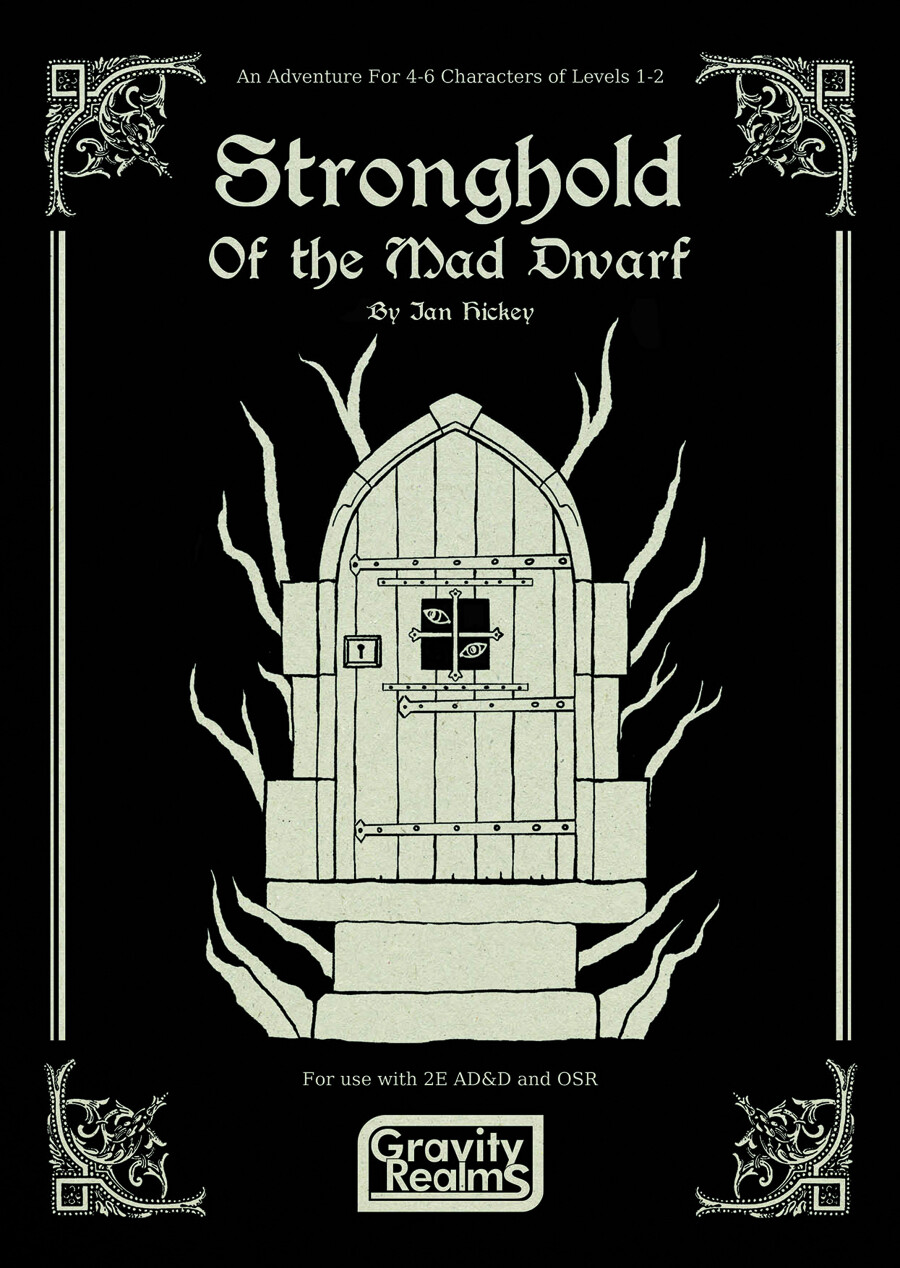
Do you dare venture into the Stronghold of the Mad Dwarf? Its dark corridors and forgotten halls hold horrors beyond your mind’s comprehension. For centuries the Tome of Many Verses has been locked away, along with the horrors it has created.
This 44 page adventure uses 22 pages to describe four small dungeon levels and one larger one, the larger one having about 23 rooms. It is padded out and tries to theme areas, to no great advantage, but has several classic elements to it that help it rise above the typical dreck. Its heart is in the right place, even though it doesn’t succeed very well.
This one falls in to the “classic dungeon” category. There’s a small outside area, a small antechamber level, a larger “main” dungeon of 23 rooms, a couple of very small levels under that, and then a map in the classic megadungeon side-view noting other are levels yet to be detailed/left for the DM. The main theme here is an old dwarf complex, dug too far, and the main treasure being a book of demon summoning guarded by a kind of gibbering mouther made of dwarf parts. The vibe here is classic dungeon, with spiders, mad dwarves, and a few oddball creatures in a mix of “empty” dungeon rooms and some larger spaces with more interesting things going on. It’s also “kill based” XP, as it’s 2e Not gold=xp here, with coinage limited as a result. We’re going to ignore the hooks as well since they are just the usual “you’re hired” couple of lines and this is, in the end, a site based adventure in the classic dungeon style.
There’s a small outside area right in front of the doors, which you can think of a much smaller version of the Stonehell outside. A few ruins and a couple of monsters. You’ll get to a small antechamber level of a couple of rooms, and then down in to the core dungeon of 23 rooms. Under that is a small cavern level of a few rooms and the dwarf spider pens level.
The entry in to the core dungeon is the lift shaft. The platform having failed a long time ago, you’re faced with a pit, 180 feet deep, to navigate your way down. No solution is give, nor should there one be! The adventurers are left to tie those ropes together and go in through thepit, classic style. The dungeon does this sort of classic element stuff in a few places, with another standing out being a locked door with an open window grate in it. The key is in the keyhole on the other side. That’s it, nothing else suggested. Again, the adventurers are left to their own solution, as they should be. I love these sort of classic obstacles, without spoon feeding the DM on solutions. When the adventure is doing this is channeling those classic dungeons of old; twelve in one blow!
There are, at times, some decent room descriptions as well. “The roof to the common room has collapsed and is blocking the entrance. Inside chunks of broken furniture, tables and chairs are half buried in rubble.” Another environmental obstacle! Rubble, half buried furniture, all turning an otherwise empty room in to something a little more interesting. When the adventure is hitting on all cylinders it does a pretty decent job. That main room you descend in to from the pit has sixteen pillars and a 15 foot vaulted ceiling, with rubble under the pit from the platform and mechanism which has collapsed from above. And a floor covered in guano. Ought oh! 1-100 bats! Hope you’re not making a lot of noise! In another large cavern we’ve got the classic flowstone and mite/tite situation, along with a giant cave clam blending in surrounded by treasure it has coughed up. Does it make sense? No. But it sure recalls those classic D&D exploration of caverns illustrations.
Let us not get attached though. The padding is hard with this one. Not to an excessive degree, but it is present in nearly every passage. This room once served as. The main entryway is open for business. This used to be. These phrases do nothing for the adventure and clog up the DMs ability to scan the text to find the entries they actually need. “The locked door at which the adventurers stand is the old entrance to the stronghold before the new additions were added above.” That is a perfect example. It is irrelevant. It is trivia. It adds nothing.
It also gets weird about the creatures in places. In one room there is a small amount of read aloud that describes one of the mad dwarves attacking. Another room has a full on room description and no description of occupants, except it then stat blocks two of the ad dwarves. Elsewhere the adventure “might” encounter a giant rat nest in this room. The spider pens level simply notes, at the beginning, that there are 3-30 spiders on the level, with no further mention of them. This is maddening. There CAN be a place for creatures sometimes being present, or for a level having a total number of creatures on it, but this is not how you do that. Boxed text is not present everywhere, which is fine either way, but it can get long in places, causing the players to lose interest and pull out phones.
And then there are the mad dwarves. Not undead, just maddened. And when you’re close to them you need to make a save vs spalls or be paralyzed for 1d6 rounds. Ouch. Area attack. Multiple dwarves in an encounter. OSR. Run away. But, also, i feel like Fear and Paralysis are some HEFTY shit to be throwing at a party at level one. I remember several near TPKs from level four to six parties who fear’d away or got paralyzed. Those are some BAD. ASS. EFFECTS. I’m not sure about this in a level one, but we’ll give it the benefit of the doubt.
The adventure is a little slow. Some of the rooms are memorable, and there’s a decent number of things to poke and prod at, but it feels a little drab. The descriptions could be better, more consistent, and the environment feels quite static. But, other than the padding, it’s not really doing much wrong. I just don’t think that the classic elements, when they appear, are enough to carry it.
This is $13 at DriveThru. There is no preview. How are you gonna have your pudding if you don’t have a preview?! Put in a preview, show some rooms, let us get an idea of the content we are purchasing before we push the buy button.
https://www.drivethrurpg.com/en/product/572215/stronghold-of-the-mad-dwarf-ad-d-2e-version?1892600
By Roberto MarcariniOld School FoxOSELevels 3-4 Beyond those tangled boughs, deep within the forest, the…
By Tyler McIntoshTable Rock Independent PressOSRLevels 4-6 AN ANCIENT EVIL FALLS FROM THE HEAVENS ONTO…
By ShanklimbSelf PublishedDomenwoodLevels 2-3 A desperate mother, Brala, approaches the PCs – in a tavern,…
By Ron MeischkerOrange Cat GamesCastles & CrusadesLevels 4-6 An ancient tomb. A fading bard. A…
By Scott_MFirst Era AdventuresOSRICLevels 1-2 Clinging to a rugged mountainside, this once-magnificent palace of a…
By Howard ShirleyParzoval GamesOSRLevel 1 A beautiful bride, a handsome groom, a starlit wedding… and…
View Comments
> The padding is hard with this one. Not to an excessive degree, but it is present in nearly every passage. This room once served as. The main entryway is open for business. This used to be. These phrases do nothing for the adventure and clog up the DMs ability to scan the text to find the entries they actually need. “The locked door at which the adventurers stand is the old entrance to the stronghold before the new additions were added above.” That is a perfect example. It is irrelevant. It is trivia. It adds nothing.
The more I consider the "this room used to be" issue, the less egregious I find it. If you go all the way back to the AD&D DMG example dungeon, you kind of understand why authors use it. The room with the hidden door that's high up and used to be accessible by a wooden platform that's no longer there (instead leaving only holes in the wall with wood splinters in them) did the same thing, and it served to orient the DM to the situation of the room quite well, even if all that gets communicated to the players is "there's holes in the wall with splinters in them".
I get that most of the time authors are overdoing it, or doing it wrong, but the existence of "this room used to be" *can* actually be beneficial sometimes and isn't *always* a detriment.
Yeha. But put the history/trivia in a final paragraph titled “lore” so it doesnt clog up the main description.
Overall history, sure, but specific room history? The hunting/page-flipping would be more detrimental than just some extra words in a key, IMHO. I think the main problem is a lack of deft hands.
If I say "this room used to be an armory, but it's empty now except for some broken furniture" - ok, usual complaints about lazy writing, give us what's supposed to be there now, etc. But at the same time, knowing what it was *can* help fill some improvised gaps when players ask "what are the walls like?" (there are many old hooks and empty mounting brackets), "what kind of scrap furniture is here?" (rotten weapon racks and some old archery targets), "what does the door look like?" (it's got a big unlocked lock and is reinforced with iron), and so on. I wouldn't want to have to find that in another section when "this room used to be an armory" is one sentence and does the job.
I just realized you said add it after the key, not inside the key (thought you meant at the end of the booklet as an annex). That is indeed sensible.
Just put "old hooks and empty mounting brackets"/"rotten weapon racks and some old archery targets"/"big unlocked lock reinforced with iron" in the room key, instead of the room's history.
Yep. The "This room used to be..." is almost always just the writer thinking through what this room will be and what might be in there...
E.g it's part of the process that a good writer or editor will recognise as a mental doodle not to be included in the final cut. Show don't tell. How do I convey "used to be an armoury" effectively in the present...
Call me crazy, but I think the rule should be, add history when it is relevant, and don't when it isn't. You can quibble about what is relevant and what isn't, but that ought to be your starting point.
You also have to consider who it is useful to. It is only useful to the players if (a) the information helps them in some way, or at least adds verisimilitude, AND (b) it is reasonably discoverable. It is useful for DMs if (a) it helps the DM understand the room/module/setting, OR (b) it helps the DM improvise.
The Abbey Dungeon example is not remotely discoverable by players. However, IMO it does help the DM understand the room and answer player questions about the physical space. Which is necessary partly because the actual physical description entirely sucks.
Gygax's description: "EMPTY CEREMONIAL CHAMBER: This large place appears to be a dead end. It has roof supports similar to chamber 1, but the vaulted ceiling dome here is fully 25’ high. When the monastery was functioning, the faithful were brought here after death, consecrated, and then carried to their final resting place by silent monks after the mourners left.A wooden platform, supposedly merely a dais for ceremony and religious rites, was placed against the south wall. This platform being 9’ off the ground enabled the use of the secret door in the south wall — this portal being 8½’ wide, 10’ high, and 10’ above the floor of the chamber. Amongst the 7 small protruding knobs of stone about 9½’ above the floor, the 7th pushes in to trigger the door mechanism, and the portal will swing inward (swings east) with a grinding noise. The only clue which still remains are socket holes in the south wall. There are 2 at the 20’ and 2 at the 30’ line (that is, on either side of the center-most 10’ south wall space). Each pair has 1 socket at about 4’ height, 1 at about 8’. Each socket is ½’ × ½’ square and a little deeper. The first socket hole examined by the party will have several splinters of wood (from the platform, of course) which might prove to be another clue to thinking players."
Which is an example of why emulating Gygax's style is not necessarily a best practice, and probably part of the reason Bryce won't review TSR modules. Also, I still have no idea why there would be a row of stone protuberances, maybe 1' above the platform.
My description: There are two 6" x 6" holes in the south wall, spaced 10' apart, and 4' above the floor. The holes contain splinters of old wood. There is an identical pair of holes directly above them, 8' above the floor. Above the top holes, 9.5' above the floor, is a row of 7 stone protuberances. If the westernmost protuberance is pressed in, a secret door opens in the middle of the south wall, 10' above the floor.
Here's a stab at a DM-facing description, to precede the practical one:
The corridor opens into a cavernous vault, imposing and uplifting, a chamber of concealed glory, with no apparent exits. The cracked and missing floor tiles must once have been laid out in colorful patterns, while the walls show traces of painted plaster, mostly eroded by time and the damp, but still directing the eye upward to the domed ceiling. The ceiling itself is covered with countless years of grime, masking all but hints of the frescoes beneath it. Footsteps and conversation echo loudly throughout the room and down the corridor, suggesting hushed tones as the best option for privacy.
In Bryce metrics, that's a terrible description.
It's too purple ("a chamber of concealed glory" - what part of that is useable to anyone?), acts for the players ("directing the eye upwards" - my eyes go where they want, dammit), and gives them meta direction ("suggesting hushed tones as the best option" - excuse me, I'll do my own thinking, thanks). Plus it's longer than three sentences.
Bryce would never approve.
God dammit, I did it again, because you specified "DM-facing". Gah it's too early, and this comment section really needs an EDIT button.
Still seems a little less than helpful though.
The overall intent was to get the DM, and through them the players, thinking in three dimensions because that's where the puzzle is; and to hint at the earlier use, not because the lore is important (although a DM could insert any lore they wanted there), but to make the space interesting enough to investigate.
Yeah, it's DM facing, but I wouldn't be surprised if some read it verbatim, so I tried to do a couple of things to mitigate that. One was to try to create natural break points between ideas, so that a listener would have a chance to process one idea before the DM moved on to another.
Another other was to avoid the second person where I am tiptoeing around instances that imply the PC is doing or feeling something, which may or may not be successful as a mitigation effort. I don't say "your eyes are directed", and I don't say "you find yourself speaking in hushed tones".
With respect to "directing the eyes" in particular, that is in part a transitive device that moves from a description of the walls to a description of the ceiling. Moreover, it is possible to reliably direct someone's eyes without their making a choice about it. I remember a novel where an artist character was talking about the idea, and said something like, if I have a spot on a painting, and I make everywhere dark and that one place light, and I paint a bunch of people looking at that space, and I draw a bunch of lines moving toward that space, and a draw a pair of naked tits in it, I'm pretty sure I can get you to look at that spot. And lots of old churches and cathedrals have a way of directing your eyes upwards, in ways that are a lot more subtle than that. Can you think of another way of describing that feeling? Because I can't.
"Suggesting hushed tones" I'm not going to defend too vigorously. I chose to mention whispering specifically, rather than leaving it at a bare description of the echoes, because I wanted a subtle reminder about how people behave in a place of worship. And I'm not sure I'm too offside by "suggesting" something, because it isn't really removing player agency to just give them more description.
The overall intent was to give hints of the space formerly being a place of worship, making it worthy of investigation; and to get the DM thinking in three dimensional imagery, because the players need a shot at finding a secret door that is 10' above the ground.
So "glory" because it was something important before, and "concealed" because hiding it gets the players in the mood to investigate. If you give them what they think is an answer, they will stop looking.
Beoric, what you have to remember is Bryce has to point to the words on the page and say them out aloud.
My all time favorite room key from N5, a dungeon that is 10% latrines and 80% entirely empty:
> Room 49-51. Two of these rooms were used as concealed treasure rooms. The third was used for general storage. This changed after Korin and company arrived. Now all three are used as latrines.