By J Watkins
JSG Press
Shadowdark/"OSR"
Level: "Low levels"
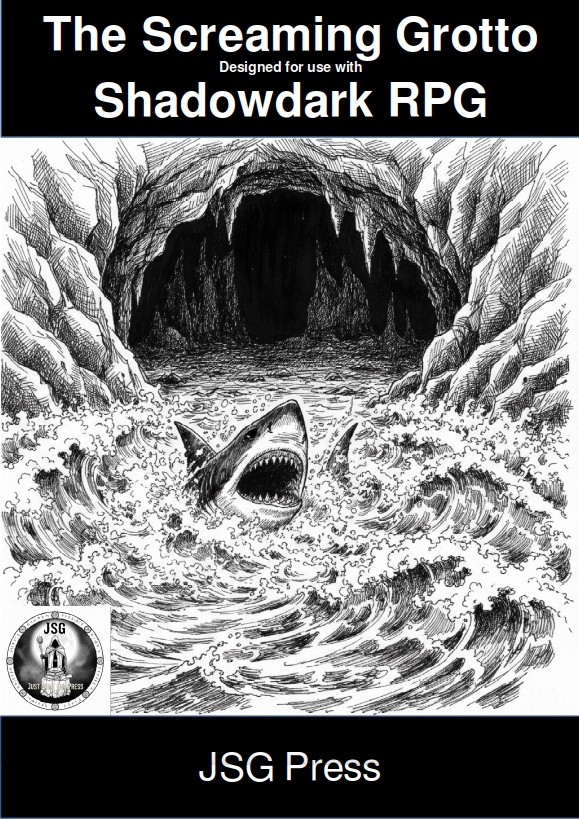
Sailors and villagers are vanishing from Seaton, and the only clue is the chilling sound of screaming coming from a nearby flooded cove. The village council hired you to investigate the “cursed” grotto. But beware: The tide is coming in, and the secrets the villagers are hiding may be as deadly as the monster at the bottom of the water. Trust no one.
This nineteen page adventure uses nine pages to describe nine rooms in a basic sea save with a hag. It makes an attempt at coming off able to reference and run, but also loaded with (avoidable by the DM) long and purple read-aloud and, in the end, is just just a basic nine room adventure with stuff to stab … with a sea theme.
There is a VERY loose hook here about a village with missing people in it, and them hiring you to go check out the caves where they think the problem is. They go to you because they are actually shipwreckers, and thusly are afraid to appeal to the local worthies. That’s all addressed in about the same number of words I’ve used here. The whole Shipwreckers thing is a nice idea, and solves the issue of by the local rulers are not involved, but it doesn’t really get any attention at all except to suggest that maybe they attack the party when they return. A few more notes here would have been nice, like some specificity about a missing group that went to the caves themselves to solve it or some such. A delta or two, them anxious, a lean to tower with a lamp that can be erected, something to hint at the possibilities and expand, just a touch, on the village would have been much appreciated. As is it’s dumped in passing on the DM. And that’s not how you support a DM during play.
“Unknown to them, an evil twisted Sea Hag has taken up residence in a sea cave in the cove. It is an evil and base creature.” I wonder if the hag is evil?
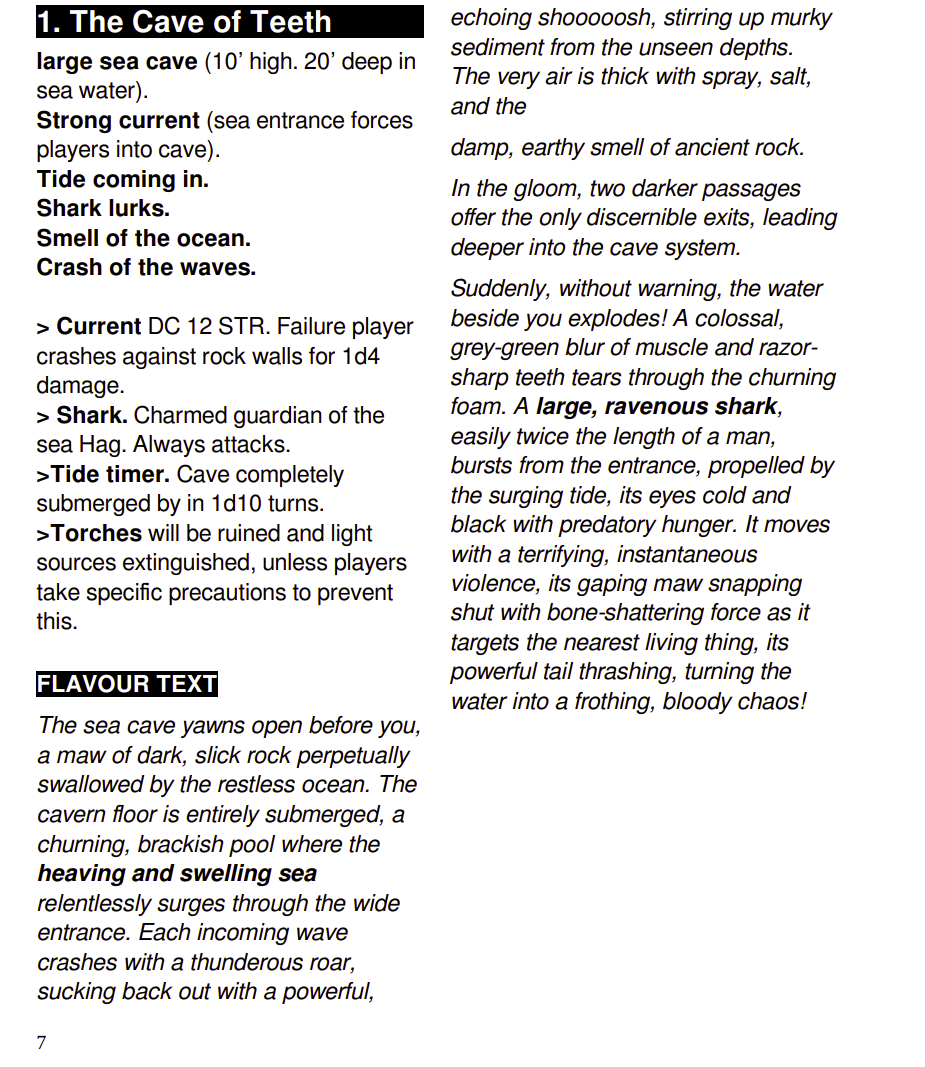
That’s the first actual room and can serve admirably to raise numbers issues about the adventure. Every room is like this, one per page, with a short summary up front and then a very long section of read-aloud. This is supported by a color map done in one of those arty/tile things, it looks like, for vtt use, and a more traditional map for the DM to consult with, which is better done.
On the positive side of things, the read-aloud it at the end and relatively easily avoided. It’s not at the beginning, getting in the way. I think this is meaningful, cognitively. It’s not vying for your attention before you get to the room, proper. And then, of course, the summary information is using a keyword style. Tide coming in. Sharks lurking. Smell of the ocean. Crash of the waves. That’s not bad. More evocative than not and lodges firmly the environment in the DM. We know the vibe. And then, of course, a few little mechanics things to help guide the DM. The torches, the tide timer (timers having been covered in the preamble to the keys), the creature. Frankly, works that basic vibe/elements format in to a longer adventure would be an interesting project., if only as an exercise to boiling a room down to its essence.
But, of course, the read-aloud is far too long. More than three or four sentences and the players attention goes elsewhere. The font is not the best for the DM to focus on. It turns purple in several place “eyes cold and black with predatory hunger” and “a blur of muscle and razor-sharp teeth.” In other places the read-aloud over-reveals (even here, with regard to the shark) and thus destroys that interactivity loop between the party and the DM that is at the heart of every RPG. You want the cue the party and then have them follow up. And I always wonder, when seeing this misplaced effort, and then supported pages in the preamble and appendices, what might have been if the effort spent on that were instead spent on the keys, or by enhancing the village/hook/shipwrecking just a tad.
The overall effect here is the highly proscribed nature that one thinks of in 4e adventure. The read-aloud is a preamble to what’s import: the mechanistic action of the party members. The focus on mechanics and the environment to “spice up” the combats. “Ahh, yes, but in THIS fight with the kobolds there are areas of quicksand on the floor and gusts of wind to extinguish torches! And a big red button the wall behind the kobolds that turns everything off.” It this tendency toward the encounter as set-piece, constructed, rather a more naturalistic bend in which play naturally evolves. It’s not quite in this territory, but it is leaning in that direction with the perfunctory read aloud. And, I think, without it, a more naturalistic manner of play.
This is $2 at DriveThru. The preview is the first fourteen pages, enough to show you the setup and a few rooms. Good preview; you can make a purchasing decision from it.
https://www.drivethrurpg.com/en/product/542164/the-screaming-grotto?1892600
By Jon PGwion's MistakeOSRLevels 3-5 Cross a mysterious bridge that appeared on the coast and…
Joseph MohrOld School Role PlayingOSRICLevels 2-3 [...] Fostrid has suggested that the adventurers meet him…
By Roberto MarcariniOld School FoxOSELevels 3-4 Beyond those tangled boughs, deep within the forest, the…
By Tyler McIntoshTable Rock Independent PressOSRLevels 4-6 AN ANCIENT EVIL FALLS FROM THE HEAVENS ONTO…
By ShanklimbSelf PublishedDomenwoodLevels 2-3 A desperate mother, Brala, approaches the PCs – in a tavern,…
By Ron MeischkerOrange Cat GamesCastles & CrusadesLevels 4-6 An ancient tomb. A fading bard. A…
View Comments
I wonder if it's a Wavestone Keep contest reject?
Hey Bryce, how about doing yourself and us a favor by reviewing something good? You've been wading in stinkers lately. There's some EMDT stuff you haven't reviewed. That will be a surefire pallet cleanser. Also some Dungeon Age stuff. You deserve it.
There's an OSE house organ: Carcass Crawler, the adventures in there are at least written by folks who know how to write adventures.